The Critical Role of Learning Toys in Newborn Development: A Comprehensive Guide
The arrival of a newborn is a time of immense joy, wonder, and responsibility. Among the countless decisions new parents face, choosing the right toys for their baby might seem secondary to feeding, sleeping, and health care. Yet the first months of life are a period of explosive brain growth, during which every sensory experience shapes neural connections. Learning toys designed specifically for newborns are not frivolous luxuries; they are essential tools that support cognitive, motor, and emotional development. This article explores the science behind newborn learning, categorizes the most effective types of developmental toys, and offers practical guidance for selecting safe and stimulating options.
The Neuroscience of Early Learning: Why Toys Matter
In the first three years of life, a baby’s brain forms more than one million new neural connections every second. This period, often called the “critical window” of development, is when the foundation for lifelong learning, behavior, and health is laid. Newborns arrive with a natural curiosity and an innate drive to explore their environment. They learn through their senses—sight, sound, touch, taste, and smell—and through movement and social interaction. High-contrast patterns, gentle sounds, varied textures, and responsive toys all provide the sensory input that wires the developing brain.
Learning toys for newborns are purposefully designed to stimulate specific areas of development. Unlike generic plush animals or passive decorations, these toys engage a baby’s attention, encourage reaching and grasping, and introduce cause-and-effect relationships. For example, a black-and-white pattern card held 8–12 inches from a newborn’s eyes supports visual tracking, a skill that later underpins reading. A soft rattle that makes a gentle sound when shaken teaches the baby that their actions have consequences. This early feedback loop is crucial for developing a sense of agency and control.
Categories of Learning Toys for Newborns
Not all toys are created equal, especially for the youngest infants. The most effective learning toys fall into several distinct categories, each targeting different developmental domains.
Sensory Stimulation Toys
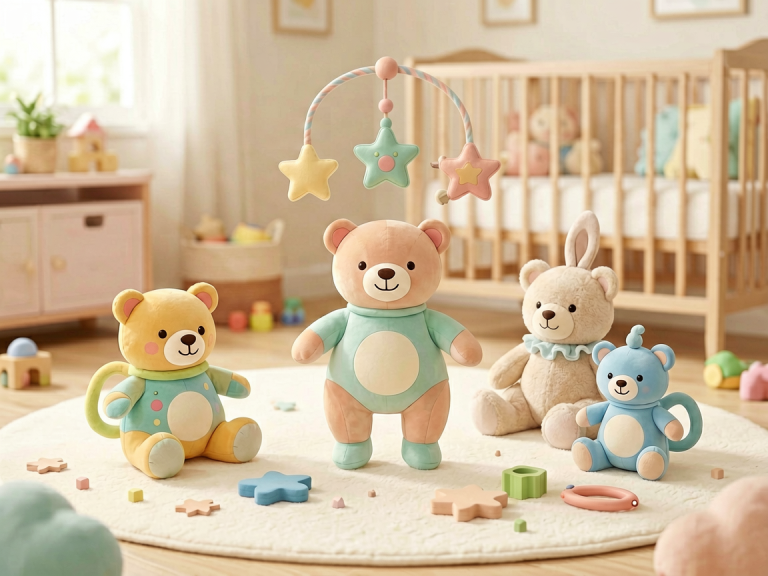
These toys are designed to engage a newborn’s primary learning channel: the senses. High-contrast black-and-white or red-and-white pattern cards, mobiles, and books are ideal for visual development. Newborns can only see objects about 8–15 inches away and are most attracted to bold, high-contrast patterns. Beyond vision, tactile toys introduce different textures—soft fleece, crinkly fabric, smooth wood, or bumpy silicone. A simple cloth book with varied fabrics and ribbons offers a rich tactile experience. Auditory toys, such as soft rattles, gentle bells, or musical mobiles, help train the brain to process sounds and locate their source.
Motor Skill Development Toys
Motor development in newborns progresses from reflexive movements to intentional actions. Toys that encourage reaching, grasping, and batting are key. An infant gym or play mat with hanging toys provides a safe space for a baby to practice swatting at objects, which strengthens shoulder and arm muscles and encourages hand-eye coordination. Soft grasping rings, teethers with varied diameters, and lightweight rattles help develop the palmar grasp, which later evolves into the pincer grip needed for writing. Spinning toys or activity centers that require pushing or pulling also build gross motor skills.
Visual Tracking and Cognitive Toys
Newborns gradually learn to track moving objects with their eyes, a skill essential for reading and sports. Mobiles with slowly rotating shapes or black-and-white patterns that move across a baby’s field of vision are excellent for this. Mirror toys (made of unbreakable acrylic) allow babies to explore facial expressions and develop self-awareness. Simple cause-and-effect toys, such as a ball that lights up when rolled or a toy that plays music when a button is pressed, introduce basic problem-solving. At this stage, “cognitive” simply means noticing patterns, anticipating events, and remembering simple routines.
Social and Emotional Learning Toys
Even newborns benefit from toys that promote social interaction. Soft dolls with simple faces, puppets with contrasting colors, or toys that “respond” to the baby’s coos with sounds encourage turn-taking and early conversational skills. Books with high-contrast images and gentle rhymes, read aloud by a parent, build emotional bonds and introduce rhythm and language patterns. These interactions are the bedrock of later language acquisition and empathy.
Key Developmental Benefits of Newborn Learning Toys
The right toys do far more than occupy a baby’s time. They actively shape developmental milestones.
Enhanced Brain Plasticity. Repeated sensory experiences strengthen neural pathways. When a newborn stares at a black-and-white spiral pattern, the neurons in the visual cortex fire and form connections. Over time, this practice improves visual acuity and the ability to distinguish details.
Improved Motor Coordination. Reaching for a dangling toy requires the brain to calculate distance, coordinate arm and hand movements, and adjust grip. Each attempt refines these motor pathways. Toys that offer different resistance levels—soft to grasp, hard to squeeze—challenge fine motor skills progressively.
Language Development. While newborns cannot understand words, they absorb the rhythms and sounds of language. Toys that produce varied sounds (shaking, rattling, crinkling) expose the baby to different auditory frequencies. When paired with a caregiver’s narration—“Look at the red ball! It goes shake-shake-shake!”—the baby begins to associate sounds with objects and emotions.
Emotional Regulation and Security. Familiar toys become comfort objects that provide a sense of security. A soft, textured blanket or a gentle musical toy that plays a lullaby can help a newborn self-soothe. This early ability to regulate emotion is linked to better stress management later in life.
Cause-and-Effect Learning. One of the most profound discoveries for a newborn is that their actions produce reactions. A toy that lights up when squeezed or makes a sound when shaken teaches the baby that they are an agent in their world. This understanding is the foundation of problem-solving and logical thinking.
How to Choose Safe and Appropriate Learning Toys
Safety is paramount when selecting toys for newborns, as they explore primarily with their mouths and hands. The following guidelines help parents make informed choices.
Check for Choking Hazards. All toys should be free of small parts that could become detached. Buttons, batteries, or loose stitching can be dangerous. The general rule: if a toy or any of its parts can fit through a toilet paper roll, it is too small for a newborn.
Choose Non-Toxic Materials. Newborns mouth everything. Look for toys labeled BPA-free, phthalate-free, and made from food-grade silicone, organic cotton, or sustainably sourced wood with non-toxic paint. Avoid toys with strong chemical smells.
Prioritize Washability. Spit-up, drool, and diaper changes mean toys get dirty quickly. Machine-washable fabric toys, wipe-clean plastic, and dishwasher-safe teethers are practical choices.
Avoid Overstimulation. While stimulation is beneficial, too much can overwhelm a newborn’s undeveloped nervous system. Bright flashing lights, loud noises, or overly busy patterns may cause distress. The best toys offer one or two sensory features at a time—for instance, a soft rattle with a gentle sound and a simple texture.
Age Appropriateness. Always follow the manufacturer’s age recommendations. Toys designed for older babies may have small parts or require motor skills that a newborn does not yet possess. For the first three months, consider toys that focus on visual tracking, grasping, and auditory input.
Practical Tips for Parents and Caregivers
To maximize the benefits of learning toys, integration into daily routines matters more than the number of toys owned.
Create a Sensory-Rich Environment. Rotate toys to maintain novelty. A newborn can become bored by the same mobile day after day. Switch the mobile’s pattern, move the play gym to a different location, or introduce a new texture blanket for tummy time.
Engage in Active Play. A toy is only as effective as the interaction it inspires. Rather than propping a baby in front of a mobile, lie beside them and point to the shapes. Shake a rattle gently and wait for the baby’s eyes to follow. Narrate your actions: “I’m shaking the blue rattle. Can you hear it? It goes shhh shhh.”
Follow the Baby’s Cues. If the baby turns away, cries, or loses interest, stop the activity. Overstimulation can lead to fussiness and difficulty sleeping. Short, focused play sessions of two to five minutes are often more beneficial than extended exposure.
Incorporate Toys into Tummy Time. Tummy time is crucial for building neck, shoulder, and arm strength. Place a high-contrast toy or a small mirror just out of the baby’s reach to encourage them to lift their head and push up. A soft, textured mat can make tummy time more comfortable and engaging.
Use Toys as Tools for Bonding. A toy can be a bridge for interaction. Sing a song while shaking a musical shaker, or make funny faces in a baby mirror together. These shared moments build trust and attachment.
Conclusion
Learning toys for newborns are far more than commercial products; they are carefully designed instruments that support one of the most remarkable periods of human development. From visual stimulation that sharpens sight to grasping toys that build motor control, each plaything offers a unique opportunity for growth. However, the true value of these toys emerges only when they are used with intention, safety awareness, and loving interaction. A toy alone cannot teach a newborn; it is the caregiver’s presence, voice, and engagement that transform a simple object into a powerful learning tool. By choosing age-appropriate, safe, and stimulating toys, and by using them as part of responsive, joyful play, parents give their newborns the best possible start on a lifelong journey of discovery. The gentle rattle, the black-and-white book, the soft textured blanket—these are not just toys. They are the first building blocks of a curious, capable, and confident mind.