The Endless Possibilities: Why Open-Ended Building Toys Are Essential for Childhood Development
In today’s fast-paced, screen-dominated world, the quiet clatter of wooden blocks or the click of interlocking plastic bricks might seem almost nostalgic. Yet these simple objects hold a profound power: they are the foundation of open-ended building toys, a category of playthings that spark imagination, encourage experimentation, and nurture skills that last a lifetime. Unlike toys with a single predetermined function or a fixed outcome, open-ended building toys—such as classic unit blocks, magnetic tiles, LEGO bricks, Tinker Toys, and modular construction sets—invite children to create, deconstruct, and recreate without limits. They are not just toys; they are tools for cognitive, social, and emotional growth. In this article, we will explore the multifaceted benefits of open-ended building toys, compare them with closed-ended alternatives, and offer practical guidance for parents seeking the best play experiences for their children.
What Are Open-Ended Building Toys? A Definition and Their Unique Appeal
Open-ended building toys are play materials that do not prescribe a specific outcome or a single way to use them. A set of wooden blocks can become a castle, a rocket ship, a zoo enclosure, or a simple line of dominoes—the only boundary is the child’s imagination. This flexibility stands in stark contrast to closed-ended toys, like a puzzle that must be solved in one way or a battery-operated robot that performs a fixed set of actions. The appeal of open-ended building toys lies in their infinite variability. They grow with the child: a toddler might stack two blocks and knock them down with glee, while a ten-year-old might engineer a complex suspension bridge using the same set. This adaptability ensures that the toy remains engaging and challenging across different developmental stages, offering a far better return on investment than single-use novelties.
Moreover, open-ended building toys are inherently democratic. They do not require reading skills, language proficiency, or prior knowledge. A child from any background can pick up a handful of colorful magnetic shapes and begin to explore. This universality makes them powerful tools for inclusive play, both at home and in classroom settings. They also encourage what psychologist Lev Vygotsky called the “zone of proximal development,” where children stretch their abilities just beyond their current comfort zone, often with the help of a peer or adult. Because the toy itself does not impose limits, children are free to set their own challenges—building the tallest tower, the longest bridge, or the most symmetrical structure—and learn from both success and failure.
Cognitive Benefits: Fostering Creativity, Problem-Solving, and Persistence
One of the most celebrated advantages of open-ended building toys is their ability to cultivate creativity. When a child sits down with a pile of assorted pieces, there is no instruction manual dictating what to build. The child must generate ideas from within, visualize possibilities, and then translate those mental images into physical reality. This process exercises divergent thinking—the ability to come up with multiple solutions to a single problem. Research in developmental psychology has shown that children who engage regularly with open-ended construction play score higher on measures of creative thinking and originality. For instance, a 2019 study published in *Thinking Skills and Creativity* found that preschoolers who played with unstructured building blocks demonstrated greater flexibility in generating novel uses for everyday objects compared to peers who played with structured kits.
Beyond creativity, building toys are fertile ground for problem-solving and logical reasoning. Consider a child attempting to build a stable arch. She may find that the blocks keep falling because the keystone is not properly placed. She tries a different configuration, adjusts the support on one side, and finally succeeds. This iterative process—hypothesis, test, failure, modification—is the essence of scientific thinking. Children learn that mistakes are not dead ends but stepping stones to better solutions. They develop persistence and resilience because the toy does not punish them for “wrong” answers; it simply offers another chance to try again. Over time, this builds a growth mindset, the belief that effort and strategy can improve outcomes, which is linked to higher academic achievement and emotional well-being.
Furthermore, open-ended building toys enhance spatial reasoning, a cognitive skill crucial for success in STEM fields. When children rotate a block to see if it fits, estimate how many units are needed to complete a wall, or imagine the three-dimensional structure from a two-dimensional plan, they are exercising mental rotation and spatial visualization. A longitudinal study by the University of Colorado found that children who played with construction toys from ages 3 to 5 showed significantly stronger spatial skills at age 7, even after controlling for socioeconomic factors. These skills are predictive of later proficiency in geometry, engineering, and even computer programming.
Physical Development and Spatial Awareness: Hands-On Learning
While cognitive benefits are paramount, we must not overlook the physical and sensorimotor gains. Open-ended building toys require fine motor control: grasping small blocks, aligning connectors, applying just the right amount of pressure to snap a piece into place. For toddlers and preschoolers, these activities strengthen the small muscles in the hands and fingers, improving dexterity and hand-eye coordination. As children progress, they learn to coordinate both hands—one to stabilize the structure, the other to add a piece—which fosters bilateral coordination essential for writing, tying shoes, and playing musical instruments.
Equally important is the development of spatial awareness and body awareness. When a child builds a tall tower, she must judge distances, assess angles, and understand the relationship between parts and the whole. She begins to internalize concepts like balance, symmetry, weight distribution, and gravity. For example, building a cantilever requires an intuitive grasp of counterweights long before formal physics lessons. These embodied experiences lay a concrete foundation for abstract mathematical concepts. Researchers at the University of Chicago have shown that children who engage in block play have better understanding of fractions and proportionality, as they physically see how two small blocks can equal one larger block in length.
Social and Emotional Growth Through Collaborative Play
Open-ended building toys are not solitary by nature. When children play together with blocks or magnetic tiles, they enter a rich social world. They must negotiate: “Should we build a castle or a spaceship?” They must share resources: “I need the blue triangle for the roof—can you pass it?” They must coordinate actions: “You hold the base while I put the roof on.” These interactions teach cooperation, compromise, and empathy. A child who wants to add a spire to the tower must consider his partner’s vision, leading to vital conflict-resolution skills.
Moreover, building together fosters communication. Children describe their ideas, justify their choices, and give directions. This verbal exchange strengthens language development, particularly for second-language learners who can participate non-verbally first and gradually pick up vocabulary. The shared sense of accomplishment when a group project succeeds—or the collective amusement when it collapses dramatically—builds social bonds and a sense of belonging. In educational settings, teachers often use open-ended building toys for cooperative learning activities because they naturally encourage collaboration without competition. Unlike many board games, there are no winners or losers; everyone can contribute to a shared creation.
On an emotional level, open-ended building toys provide a safe space for self-expression and mastery. A child who feels anxious or frustrated can channel those emotions into the act of building—knocking down a tower might release tension, while carefully constructing a symmetrical pattern might soothe and focus the mind. The sense of pride and ownership that comes from creating something entirely one’s own builds self-esteem. Even a simple structure can be a source of genuine accomplishment, and when the tower inevitably falls, the child learns to manage disappointment and try again—a crucial emotional regulation skill.
Comparing Open-Ended vs. Closed-Ended Toys: Why Choice Matters
To fully appreciate open-ended building toys, it helps to contrast them with closed-ended alternatives. Closed-ended toys, such as jigsaw puzzles, model kits with step-by-step instructions, or electronic games with predetermined levels, have their merits. They teach following directions, patience, and specific skills like sorting or pattern recognition. However, they often limit creative agency. Once a puzzle is solved, it may be set aside; once a model is built per the instructions, there is little reason to deconstruct and rebuild. The child’s role is more that of a follower than a creator.
Open-ended toys, by contrast, empower the child to be the architect of her own play. They support what developmental experts call “executive function”—the set of cognitive processes that include planning, self-control, and flexible thinking. A child building a free-form structure must plan ahead (“I need a big base first”), inhibit impulses (“I want to put this here, but it will tip over, so I’ll wait”), and shift strategies when the plan fails (“That didn’t work, so I’ll try a different shape”). These are the very skills that predict academic readiness and success in adulthood.
Of course, not all open-ended toys are created equal. Some, like classic wooden unit blocks, are extremely simple and provide the most open-ended experience. Others, like LEGO sets with themed kits (e.g., a Star Wars spaceship), can be somewhat less open-ended if children feel pressured to follow the instructions. However, even these can become open-ended once the child diverges from the manual. The key is to provide a mix: some sets for guided building that teaches technical skills, and plenty of loose parts for free creation. Ultimately, the best approach is to offer toys that prioritize process over product, exploration over instruction.
Practical Tips for Parents: Selecting and Using Open-Ended Building Toys
Given the myriad options on the market, how can parents choose wisely? First, consider the child’s age and developmental stage. For infants and toddlers (1–3 years), large, lightweight blocks that are easy to grasp and cannot be swallowed are ideal. Soft foam blocks or large cardboard bricks allow safe exploration. For preschoolers (3–5 years), wooden unit blocks in standard sizes (like the classic unit block system) are excellent because they introduce mathematical ratios (e.g., two half-units equal one unit). Magnetic tiles are also a hit at this age, as they allow easy construction of 3D shapes without the frustration of pieces falling apart. For school-age children (6+ years), more complex systems like LEGO (with a focus on classic bricks rather than themed sets), K’NEX, or engineering-focused sets like Meccano can challenge fine motor skills and introduce mechanical concepts.
Second, prioritize quality. Well-made wooden blocks with smooth edges will last for decades and can be passed down. Magnetic tiles should have strong magnets encased securely to prevent breakage. Avoid cheap plastic sets that snap easily or have sharp edges. Durability not only saves money but also ensures that the toy can withstand the inevitable stress of creative play.
Third, encourage a “loose parts” mindset. Supplement building sets with found objects like cardboard tubes, bottle caps, fabric scraps, and small boxes. These everyday items extend the possibilities of construction play and teach children that creativity does not require expensive toys. A piece of string can become a drawbridge; a toilet paper roll can be a telescope. The more varied the materials, the richer the play.
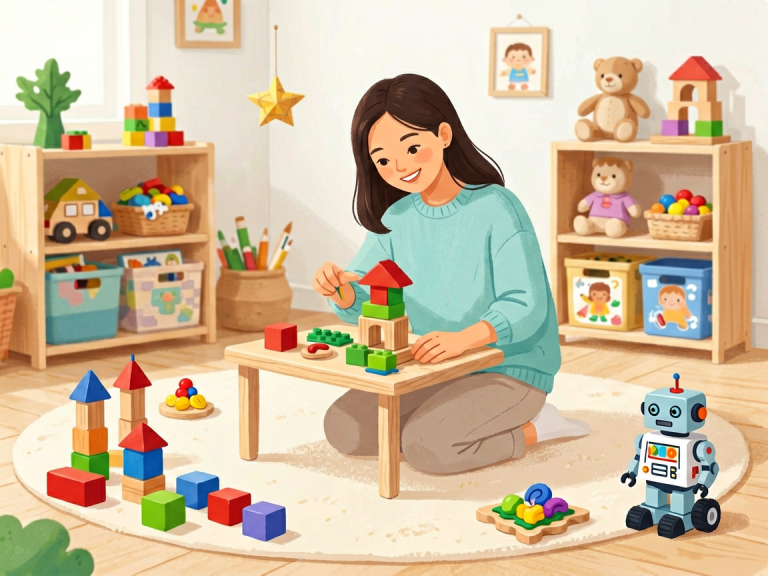
Fourth, be an active, not directive, participant. Join your child in building, but follow their lead. Ask open-ended questions: “What do you think will happen if we add another block here?” or “I wonder how we can make our bridge stronger?” Avoid correcting or imposing your own ideas. The goal is to support their problem-solving, not to solve it for them. Also, provide ample unstructured time. Building deeply requires focused attention, so resist the urge to rush through play. A child’s “messy” building zone—with blocks scattered on the floor—is actually a workshop of learning.
Finally, embrace failure. When a structure collapses, resist the urge to say, “Oh no, it fell!” Instead, say, “Wow, look what happened! Why do you think it fell? What could we do differently?” This reframes failure as a learning opportunity. Over time, children become less afraid of making mistakes and more willing to take creative risks—one of the most valuable gifts we can give them.
Conclusion: Building More Than Structures
Open-ended building toys are far more than simple playthings. They are laboratories for the mind, gymnasiums for the hands, and stages for social interaction. In an era when many children’s pastimes are passive, structured, or screen-based, these humble blocks, tiles, and connectors offer a vital counterbalance: active, child-directed, and deeply satisfying. They teach children that they are not just consumers of entertainment but creators of their own worlds. They build not only towers and bridges but also confidence, curiosity, and resilience.
As parents, educators, and caregivers, we have the privilege of choosing what we place in children’s hands. By investing in open-ended building toys—and by giving children the time, space, and encouragement to use them freely—we are laying a foundation for a lifetime of learning and joy. Every block placed, every piece connected, every tower that rises and falls is a small step toward a bigger goal: raising children who are not afraid to imagine, to experiment, and to build something that has never been built before. And that, perhaps, is the most important structure of all.