The Ultimate Guide to the Best Learning Toys for Newborns: Nurturing Development from Day One
Welcoming a newborn into the world is a miraculous event, and as parents, caregivers, or educators, we naturally want to give the baby the best possible start in life. While it may seem that a newborn spends most of the time sleeping, eating, and crying, every moment is actually a learning opportunity. The brain of a newborn develops at an astonishing rate—synapses are forming at a speed of over one million per second during the first year. This is why choosing the right learning toys for newborns is not a frivolous task but a deeply meaningful one. The best learning toys for newborns are not flashy, expensive, or complex; rather, they are simple, safe, and purposefully designed to stimulate the senses, encourage bonding, and support the natural developmental milestones that occur in the first few months of life. In this comprehensive guide, we will explore the science behind newborn learning, the criteria for selecting optimal toys, and a curated list of the best categories of toys that truly make a difference.
Understanding Newborn Development and the Role of Play
Before diving into specific toys, it is essential to understand what a newborn is capable of and how they learn. Newborns are born with a limited but highly refined set of senses. Their vision is blurry—they can focus best on objects 8 to 12 inches away, roughly the distance to a caregiver’s face. They are most responsive to high-contrast patterns (black and white, bold shapes), bright colors (especially red), and the human face. Hearing is well developed in utero, and newborns recognize their mother’s voice and familiar sounds almost immediately. Their sense of touch is acute; they respond to gentle strokes, warm skin, and different textures. Reflexes such as grasping, rooting, and stepping are present, but voluntary control is minimal.
Play for a newborn is not the same as play for a toddler. For a baby under three months old, “play” is any interaction that engages their senses and builds neural connections. A toy that encourages staring, tracking, reaching, listening, or feeling is a learning toy. The best learning toys for newborns are those that align with these developmental windows. They do not require complex manipulation; instead, they invite the baby to observe, respond, and begin to make sense of the world. Moreover, the social-emotional component is crucial—a toy that facilitates parent-child interaction (like a rattle that a parent shakes while making eye contact) is far more valuable than a toy that replaces human interaction.
Key Features to Look for in Newborn Learning Toys
When evaluating any toy for a newborn, safety is non-negotiable. All toys should be free of small parts that could be a choking hazard, made from non-toxic materials (BPA-free, phthalate-free), have no sharp edges, and be easy to clean. The size should be large enough that the baby cannot fit the entire toy into their mouth. But beyond safety, there are several developmental features that distinguish the best learning toys:
- High Contrast and Bold Patterns – Because newborn vision is still developing, toys with stark black-and-white patterns, bold geometric shapes, or primary colors stimulate the visual cortex more effectively than pastel or muted tones.
- Variety of Textures – Different fabrics, ridges, smooth surfaces, and soft bumps provide tactile stimulation that helps develop the sense of touch and fine motor awareness.
- Auditory Feedback – Rattles, bells, crinkle sounds, and gentle chimes encourage auditory discrimination and cause-and-effect learning. However, the sound should be soft and not jarring.
- Mirror Features – Unbreakable baby-safe mirrors allow newborns to explore face recognition, which is a key social milestone.
- Ease of Grasping – Simple rings, soft cloth handles, or toys with small loops allow reflexive grasping to transition into voluntary reaching and clutching.
- Interactive and Soothing – Many top-rated newborn toys double as comfort objects, with soft, cuddly elements that provide emotional security.
Top Categories of Learning Toys for Newborns
Now, let’s explore the specific types of toys that have proven most beneficial for newborns. These categories are based on developmental research and recommendations from pediatricians and early childhood educators.
Visual Stimulation Toys: The Foundation of Sight
The first thing a newborn does with a toy is look at it. This is why high-contrast visual stimuli are so powerful. In the first few weeks, babies are especially drawn to black-and-white images and patterns with sharp lines. A classic example is a set of black-and-white contrast cards or a visual stimulation mobile. Look for mobiles that have simple, bold shapes (circles, stripes, checkerboards) in black and white, or with one bright accent color like red. These mobiles help the baby practice tracking—following an object with their eyes—which is a precursor to reading and hand-eye coordination.
Another excellent tool is a high-contrast cloth book. Soft fabric books with black-and-white illustrations and a few simple words allow caregivers to hold the book at the optimal distance while the baby lies on their back. As the baby grows, the books can be introduced with crinkle pages or tags for additional sensory input. Some of the best learning toys in this category include the “Manhattan Toy Black & White Baby Soft Book” or “Sassy Tummy Time Discovery Mirror.” These toys not only engage vision but also encourage tummy time, which strengthens neck and shoulder muscles.
Auditory Stimulation Toys: Hearing the World
Hearing is one of the most mature senses at birth, but newborns still need refinement. Auditory toys help them differentiate sounds, locate sound sources, and eventually associate sounds with actions. A classic newborn auditory toy is the rattle. But not all rattles are equal—the best ones produce a gentle, pleasant sound rather than a loud clatter. A wooden or fabric rattle with a soft bell inside allows the baby to shake it (or better, the caregiver shakes it) and listen. Over time, the baby will begin to turn their head toward the sound, which strengthens neck muscles and auditory localization.
Another wonderful auditory toy is a musical mobile or a wind-up music box. The melodies should be simple and slow—think lullabies. Avoid toys with harsh electronic sounds or flashing lights, as these can overstimulate a newborn’s developing nervous system. A soft crinkle toy, such as a fabric block or elephant that makes a papery sound when squeezed, also provides auditory feedback that is intriguing without being overwhelming. The “Fisher-Price Deluxe Kick ‘n Play Piano” (for slightly older newborns) is a larger option that combines auditory and gross motor skills, but for the earliest weeks, a simple rattle or soft music box is perfect.
Tactile and Grasping Toys: Learning Through Touch
Touch is the first sense to develop in the womb, and after birth, skin-to-skin contact is vital. Toys that offer a variety of textures invite the newborn to explore through their hands and mouth. The best learning toys for tactile stimulation are soft, multi-textured balls or sensory plush blocks. Look for toys that combine smooth ribbons, fuzzy fleece, bumpy rubber, and crinkly fabric all in one. These toys can be placed in the baby’s hand during awake time to activate the palmar grasp reflex and encourage voluntary reaching.
Cloth teethers are another great option for newborns, even before teeth appear. The act of mouthing is how babies learn about objects—their shape, temperature, and texture. Softer teethers that can be easily gripped, like a silicone ring with varied bumps, double as both a tactile and oral toy. The “Manhattan Toy Winkel Rattle” is a classic that combines a soft, colorful tube structure with easy-to-grasp loops and gentle rattling. It is lightweight, washable, and perfect for tiny hands. Additionally, sensory tags on blankets or stuffed animals—those little loops of ribbon sewn along the edge—are extremely popular because newborns naturally love to grab and mouth them.
Movement and Tummy Time Toys: Building Strength
Physical development is a critical part of newborn learning, and toys that encourage movement are essential. Tummy time is the single most important activity for strengthening the neck, back, and shoulder muscles, preventing flat head syndrome, and developing motor skills. The best learning toys for tummy time are those that motivate the baby to lift their head. A tummy time mat with a soft, padded surface and a large, unbreakable mirror can be incredibly stimulating. The baby sees their own reflection, which is fascinating, and tries to lift their head to see it better.
Another outstanding option is a tummy time water mat or a light-up activity mat. Water mats have colorful, moving shapes inside a sealed plastic pillow; as the baby pushes, the shapes float and dance. This encourages reaching, pushing, and weight shifting. Some mats come with a detachable arch that holds dangling toys—these toys (like soft rings, mirrors, or small plush characters) encourage the baby to reach upward while on their back or belly. The “Skip Hop Silver Lining Cloud Baby Play Mat” is a popular choice because it has a cloud-like mirror and multiple hanging toys. For movement on the back, a play gym or activity gym with low-hanging toys that can be batted at helps develop hand-eye coordination and core strength.
Social and Emotional Toys: Bonding and Comfort
Newborns are not just learning about objects; they are learning about people. Social-emotional learning begins with the connection between baby and caregiver. The best toys in this category are those that facilitate interaction. For example, a soft, high-contrast hand puppet allows a parent to make the puppet “talk” or “sing,” drawing the baby’s attention to the caregiver’s voice and face. The puppet’s movements help the baby practice visual tracking and social smiling.
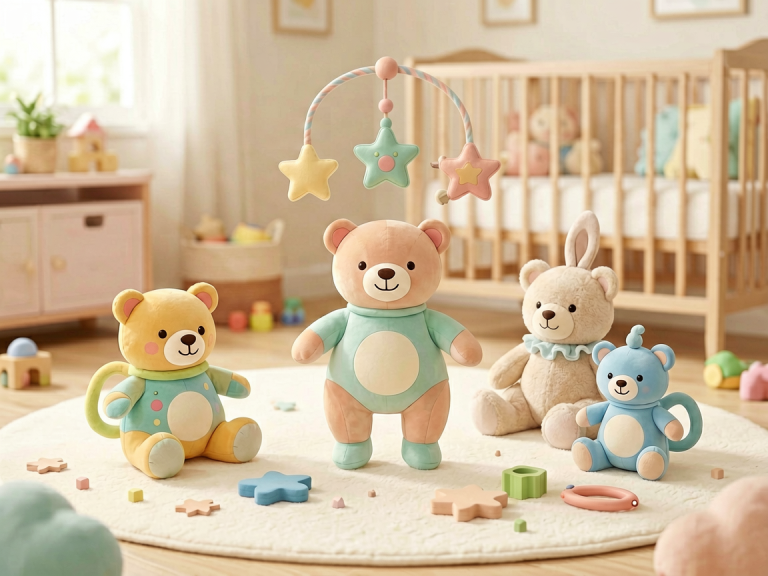
Comfort objects like a soft security blanket or a small, non-choking-hazard stuffed animal (with embroidered features, no loose buttons) can provide emotional regulation. Newborns often become calmer when they have a familiar, soft object to clutch. Many of the top-rated plush toys are designed with multiple textures, crinkle feet, and satin edges—these provide both comfort and sensory exploration. Another excellent social toy is a simple wooden or fabric teething ring in the shape of a face. The baby can grasp it, mouth it, and see a simple smiling face, which can be reassuring.
Safety Tips for Choosing Newborn Toys
Even among the best learning toys, safety vigilance is essential. Always follow the age recommendations on the packaging. For newborns, avoid any toy with small parts that could break off, including beads, buttons, plastic eyes, or loose magnets. Be wary of long strings or ribbons that could pose a strangulation hazard—toys for newborns should have cords shorter than 12 inches, or ideally no cords at all. Check for certification labels like ASTM (American Society for Testing and Materials) or CE (Conformité Européenne) to ensure the toy meets international safety standards.
Cleanliness is also crucial, as newborns put everything in their mouths. Choose toys that are machine washable or can be wiped clean with mild soap and water. Rotate toys every few days to maintain novelty, but never leave a newborn unattended with any toy, especially during tummy time or while in a crib or bassinet.
Conclusion: Less Is More When It Comes to Newborn Learning Toys
In the end, the best learning toys for newborns are not the ones that promise to make your baby a genius or that come with a long list of electronic features. Instead, they are the simple, thoughtfully designed tools that engage one or two senses at a time, respect the baby’s limited attention span, and create moments of connection between baby and caregiver. A set of black-and-white cards, a soft rattle, a textured ball, and a tummy time mirror will do more for a newborn’s development than a hundred flashy gadgets. Remember that the most powerful “toy” of all is you—your face, your voice, your gentle touch. Combine these with a few carefully chosen objects, and you have given your newborn the richest possible learning environment. As your baby grows, you can gradually introduce more complex toys, but for those precious first three months, simplicity truly is the key to unlocking the wonders of early development.