Ensuring Safe Play: A Comprehensive Guide to Safe Toys for Newborns
Welcoming a newborn into the family is a time of immense joy, discovery, and careful preparation. Among the many decisions new parents face, selecting toys for their baby is both exciting and daunting. While toys stimulate sensory development and foster early learning, safety must always take precedence. A newborn’s world is one of exploration through touch, taste, and sound, and every object they encounter must be free of hazards. This article provides a detailed examination of what constitutes safe toys for newborns, covering materials, design standards, certifications, and practical tips for choosing the best playthings for the tiniest members of the family.
Why Safety Matters for Newborn Toys
Newborns are not just small versions of older children; they have unique physiological and behavioral characteristics that make them particularly vulnerable. Their immune systems are still developing, their airways are narrow, and they explore objects primarily by putting them in their mouths. According to the American Academy of Pediatrics (AAP), choking is one of the leading causes of injury in infants under one year of age. A toy that seems harmless to an adult—such as a rattle with a loose bead or a stuffed animal with button eyes—can become a life-threatening hazard for a newborn.
Furthermore, newborns have delicate skin that is highly absorbent, making them susceptible to toxic chemicals found in some plastics, dyes, and finishes. Prolonged exposure to substances like bisphenol A (BPA), phthalates, or lead can disrupt hormonal development and cause long-term health issues. The first three months of life are a critical window for neural and physical growth, so the toys a baby interacts with must not only be physically safe but also chemically benign. In short, safety is not an afterthought—it is the single most important criterion when choosing toys for a newborn.
Key Safety Considerations
When evaluating any toy for a newborn, parents should examine multiple dimensions of safety. The following subsections break down the most critical factors.
Choking Hazards
The most immediate and dangerous risk for newborns is choking. Any part of a toy that can fit completely into a baby’s mouth—typically objects smaller than 1.25 inches in diameter—poses a choking risk. Infants lack the coordination and strength to dislodge stuck objects, so prevention is essential. Reputable manufacturers design infant toys with no small detachable components. For example, rattles should be one solid piece, and teethers should not contain loose filling or internal beads. A good rule of thumb is to check any toy with a "choke tube" (a cylinder about the size of a baby’s throat) available at many pediatrician’s offices or online. If a toy or any of its parts fits inside the tube, it is unsafe for a newborn.
Toxic Materials
Beyond choking, chemical toxicity is a major concern. Many conventional plastics contain additives that can leach out of the toy when a baby chews or drools on it. BPA is commonly found in polycarbonate plastics and epoxy resins; it is an endocrine disruptor linked to reproductive and developmental problems. Phthalates, used to soften PVC, have been associated with hormone disruption and are banned in children’s products in many countries. Similarly, heavy metals like lead, cadmium, and antimony may be present in cheap paints or metallic components.
To avoid these risks, parents should look for toys labeled "BPA-free," "phthalate-free," and "lead-free." Natural materials such as solid untreated wood, organic cotton, and food-grade silicone are excellent alternatives. For example, a simple wooden ring made of beech wood with a non-toxic, water-based finish is far safer than a plastic teething toy from an unknown manufacturer. Always check that the toy meets the safety standards of the region where you live.
Sharp Edges and Strangulation
Newborn skin is fragile, and even a slightly rough seam or sharp corner can cause a cut or irritation. All toys should have smooth, rounded edges and no protruding screws, staples, or wires. Additionally, strangulation is a real risk with toys that have strings, cords, or ribbons. The Consumer Product Safety Commission (CPSC) recommends that any string attached to a crib toy or play mat should be no longer than 12 inches to prevent entanglement. Avoid toys with long ribbons or cords that could wrap around a baby’s neck. Also, be cautious with mobiles—they should be securely mounted out of reach, as an infant can become entangled if the mobile is within grabbing distance.
Entrapment and Suffocation
Soft, plush toys and pillows are attractive for cuddling, but they present suffocation hazards. The AAP advises that cribs should be free of all soft objects, including stuffed animals, blankets, and bumpers, until at least 12 months of age. For newborns, a safe sleeping environment is a firm mattress with a fitted sheet—nothing else. Therefore, any toy that is meant to be placed in the crib during sleep should be avoided altogether. For supervised playtime, choose plush toys that are well-constructed, with no loose stuffing that could come out and be inhaled. Additionally, avoid toys with small batteries or magnets, which can cause severe internal injuries if ingested.
Types of Safe Toys for Newborns
Understanding the general safety principles is important, but knowing which specific types of toys are suitable for newborns makes shopping easier. Below are some of the best categories.
Rattles and Teethers
Rattles are classic newborn toys that provide auditory and visual stimulation. The safest rattles are those made from a single piece of material—no internal beads, no glued-on parts. Look for rattles constructed from soft, BPA-free plastic, food-grade silicone, or natural wood. The sound should be soft, not jarring, to avoid startling the baby. Similarly, teethers are essential during the teething phase (which can begin as early as three months, though newborns may start mouthing earlier). A good teether is free of small parts, easy to grip, and made of non-toxic materials. Silicone teethers with a variety of textures are popular because they are easy to clean and do not harbor bacteria.
Soft Toys and Plush
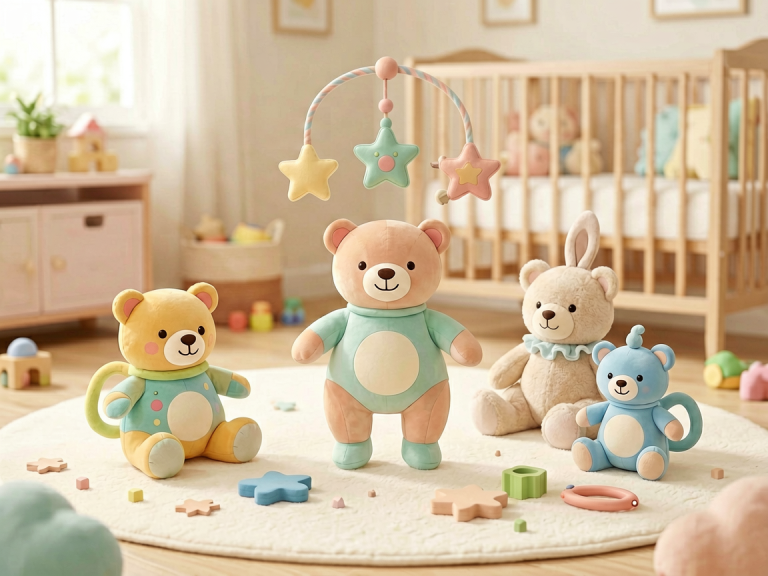
While plush toys are not safe for unsupervised sleep, they can be part of supervised tummy time or cuddle sessions. Choose soft toys that are machine washable (to maintain hygiene) and hypoallergenic. The eyes, nose, and any embellishments should be embroidered or securely stitched, never glued or attached with plastic. Fiberfill should be encapsulated in a durable fabric envelope, with no seams that could burst open. Organic cotton and bamboo fibers are excellent natural choices. Avoid toys with long fur, loose threads, or small tufts that can be pulled off and ingested.
Activity Gyms and Play Mats
Activity gyms introduce newborns to a world of color, movement, and sound. Look for play mats with a thick, non-toxic foam core that is free of phthalates and lead. The mat’s cover should be removable for washing. Hanging toys—such as soft rattles, mirrors, and crinkle shapes—must be attached with short, sturdy loops or clips that cannot be detached. Ensure that the gym’s frame is stable and does not pose a tipping hazard. Many modern play mats also feature high-contrast black-and-white patterns, which are ideal for a newborn’s developing vision.
Sensory Toys
Sensory stimulation is crucial in the first weeks of life. Simple, safe toys can include high-contrast picture cards (made of thick, non-toxic cardboard), textured balls (soft fabric or silicone with nubs), and crinkle books made of fabric. These toys should be large enough that they cannot be swallowed and free of any sharp edges. A soft, textured rattle that makes a gentle jingle when shaken can help a newborn learn cause and effect. Lightweight, easy-to-hold rings or blocks (made of fabric or soft plastic) also allow an infant to practice grasping.
Materials and Construction
The construction quality of a toy is just as important as the materials. Even the safest raw material can become hazardous if the toy is poorly assembled. Here is a closer look at materials commonly used in safe newborn toys.
Natural materials are generally the gold standard. Solid wood—such as beech, maple, or basswood—that is untreated or finished with a non-toxic, water-based sealant is durable and free of harmful chemicals. Unlike plywood or particleboard, solid wood does not contain formaldehyde-based glues. Organic cotton and bamboo fabrics are free of pesticides and synthetic dyes, making them gentle on a baby’s skin. Wool is another excellent natural option but should be avoided if the baby has wool allergies.
Food-grade silicone is a modern favorite because it is flexible, durable, and can be sterilized in boiling water. It contains no BPA, phthalates, or latex, and it does not degrade with repeated chewing. Silicone teethers and pacifiers are widely recommended by pediatricians. However, beware of cheap silicones that may contain fillers; always choose high-quality, 100% food-grade silicone.
On the other hand, avoid toys made from PVC (polyvinyl chloride), as it often contains phthalates. Also steer clear of toys with painted surfaces unless the paint is explicitly certified as non-toxic and lead-free. Manufacturers that follow stringent safety protocols will clearly label their products with certifications and ingredient lists.
Seamless or "one-piece" construction is especially important for toys that will be mouthed. Glued-on components, like plastic eyes on a plush toy, can be easily pulled off. Stitched-on features are safer, but should be checked for loose threads. For wooden toys, ensure there are no splinters or rough patches. For silicone toys, look for mold lines that are smooth and even.
Safety Certifications and Standards
Navigating toy safety can be overwhelming, but recognized certifications provide a shortcut. In the United States, the ASTM F963 standard (Standard Consumer Safety Specification for Toy Safety) is the benchmark. Toys that comply with ASTM F963 have been tested for mechanical hazards, flammability, and chemical limits. Similarly, the Consumer Product Safety Improvement Act (CPSIA) requires that children’s products be tested for lead content, phthalates, and other toxins. Look for a "CPSIA compliant" label.
In Europe, the EN71 standard covers similar requirements, and toys bearing the CE mark indicate conformity with EU safety directives. Many reputable global brands also obtain third-party certifications such as the Global Organic Textile Standard (GOTS) for organic fabrics, or the Forest Stewardship Council (FSC) for wood sourcing. While these certifications are not mandatory for safety, they offer extra assurance about the toy’s environmental and health profiles.
Parents should also be aware of recalls. The CPSC maintains an online database of recalled toys. Before purchasing a new toy, especially from an unknown brand, a quick check on the CPSC website can prevent a potential disaster. Additionally, avoid purchasing toys from second-hand shops or garage sales unless the item is in pristine condition and you can verify its manufacturing date (older toys may not meet current safety standards).
Tips for Choosing Safe Toys
To simplify the decision-making process, keep these actionable tips in mind:
- Always check the age recommendation. Toys labeled "0+ months" are designed with newborn safety in mind. Avoid toys meant for older children—they often contain small parts or harder materials.
- Inspect before each use. Over time, toys can become damaged. Check for loose threads, cracked plastic, splinters, or fading paint. Discard any toy that shows signs of wear.
- Buy from reputable brands. Well-known companies that specialize in infant development—such as Fisher‑Price, Lamaze, HABA, or Lovevery—invest heavily in safety testing. Generic, unbranded toys from discount stores may cut corners.
- Consider the baby’s developmental stage. In the first month, a newborn may only be interested in looking at high-contrast patterns. By two months, they start reaching for objects. By three months, they begin mouthing. Choose toys that match these milestones: a simple black-and-white card for visual tracking, a soft rattle for grasping, and a silicone teether for the mouthing stage.
- Prioritize washability. Newborns drool constantly, and toys quickly become covered in saliva and potential germs. Machine-washable soft toys and dishwasher-safe silicone items are ideal.
- Avoid toys with batteries or magnets until well after the first year. Coin cell batteries are a particularly dangerous choking hazard and can cause severe internal burns if swallowed.
Toys to Avoid
While the above guidelines cover what is safe, it is equally important to know what to avoid. The following items should never be given to a newborn:
- Old or second-hand toys that lack safety certifications. A vintage rattle may have lead paint. A hand-me-down stuffed animal may have loose buttons.
- Toys with long strings, ribbons, or cords. Any length exceeding 12 inches is a strangulation risk.
- Toys with small detachable parts, such as plastic eyes, bells, or beads. Even if they seem secure, an infant can eventually pry them loose.
- Any toy that fits entirely into a toilet paper roll. This is a simple choke test used by safety experts.
- Water-filled teethers or toys. They can leak and grow mold inside, and the liquid may contain harmful bacteria.
- Toys labeled "decorative" or "collectible." These are not intended for play and may contain fragile components or toxins.
Conclusion
Choosing safe toys for a newborn is both a responsibility and an act of love. The right toys can enhance sensory development, encourage motor skills, and provide comfort—but only when they are free of choking hazards, toxic chemicals, and other dangers. By understanding the key safety principles, selecting appropriate types of toys, and paying attention to materials and certifications, parents can create a safe and enriching play environment for their baby. Remember that simplicity often wins: a newborn does not need flashy electronic gadgets or complex contraptions. A soft, well-made rattle or a textured teether can offer just the right amount of stimulation. Always trust your instincts—if a toy looks questionable, it probably is. When in doubt, consult your pediatrician. Ultimately, safe toys contribute to a joyful, healthy start in life, giving both baby and parents peace of mind.