The Essential Guide to Indoor Toys for Newborns: Stimulating Development in a Safe Home Environment
Introduction: Why Indoor Toys Matter for Newborns
The first months of a newborn's life are a period of extraordinary growth and discovery. While many new parents focus on feeding schedules, sleep routines, and diaper changes, the role of indoor toys in early development is often underestimated. Newborns are not merely passive recipients of care; they are active learners whose brains form millions of neural connections every day. Indoor toys designed specifically for newborns serve as powerful tools to stimulate sensory exploration, motor skill development, and cognitive growth—all within the controlled, safe environment of the home. Unlike outdoor playthings, indoor toys for newborns are crafted with the unique constraints of indoor spaces in mind: they must be compact, safe for unsupervised use, and adaptable to limited floor space. This article explores the multifaceted world of indoor toys for newborns, offering evidence-based insights into selection criteria, developmental benefits, and safety considerations that every parent should know.
The Developmental Significance of Play in the First Six Months
From birth to around six months of age, a newborn undergoes a remarkable transformation. During this period, the brain doubles in size, and sensory pathways become increasingly refined. Indoor toys play a crucial role in this process by providing the necessary stimuli for neural development. According to pediatric research, early play experiences enhance synaptic pruning, the brain’s natural process of eliminating weaker connections while strengthening useful ones. For instance, a simple black-and-white mobile hanging above a crib can stimulate visual tracking, an essential precursor to hand-eye coordination. Similarly, a soft rattle encourages grasping and auditory feedback, laying the foundation for cause-and-effect understanding. Indoor toys also support emotional regulation. When a newborn successfully reaches for and touches a textured toy, the sense of agency fosters confidence and reduces stress. Therefore, the selection of indoor toys is not a trivial matter; it is an investment in the child’s long-term cognitive and emotional health.
Key Criteria for Selecting Indoor Toys for Newborns
Safety as the Non-Negotiable Priority
Safety is the foremost consideration when choosing any toy for a newborn. The U.S. Consumer Product Safety Commission (CPSC) and international standards such as EN71 provide clear guidelines: all toys should be free of small parts that could pose choking hazards, made from non-toxic materials (BPA-free, phthalate-free, and lead-free), and have no sharp edges or loose components that could break off. For indoor use, parents should also avoid toys with long strings or cords that could entangle a baby’s neck. Always check that the toy is labeled for newborns (usually 0+ months) and that it can withstand the inevitable drooling, mouthing, and chewing. Additionally, consider the toy’s weight: it should be lightweight enough that if dropped, it will not cause injury. Wipeable surfaces are also ideal because newborns explore the world with their mouths, and hygiene is paramount.
Age-Appropriate Complexity
Newborns have limited motor skills—they cannot sit, crawl, or intentionally grasp objects for the first several weeks. Therefore, toys intended for this age group should match their developmental stage. For a one-month-old, high-contrast black-and-white patterns (such as a soft book or a wall poster) are more stimulating than colorful toys, as their vision is still developing. By three months, babies begin to swipe at dangling objects and enjoy toys that produce gentle sounds, like crinkle cloths or soft rattles. By six months, they can often hold objects and transfer them between hands, making textured teething rings and simple activity gyms appropriate. Ignoring age guidelines can lead to frustration—or worse, a toy that is too complex may cause overstimulation, while one that is too simple may bore the baby.
Categories of Indoor Toys That Maximize Development
Sensory Toys: Engaging Sight, Sound, and Touch
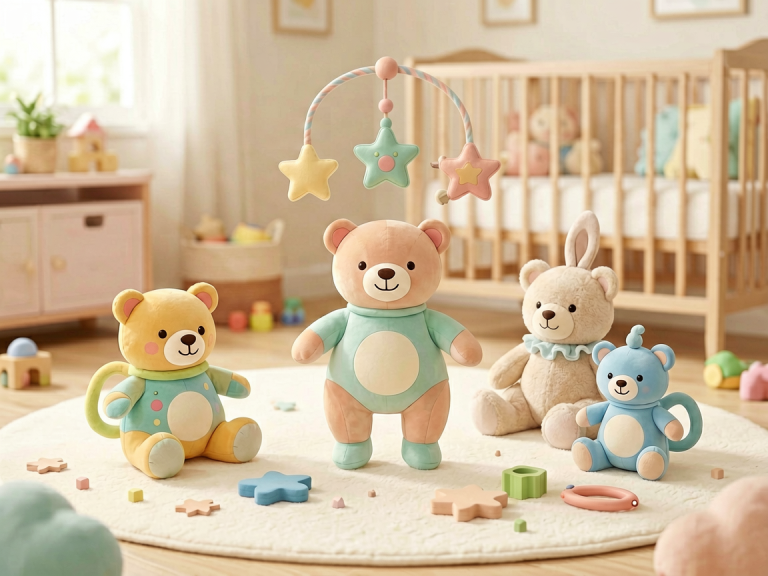
Sensory toys are the cornerstone of newborn play. These include high-contrast card sets, black-and-white mobiles, and soft books with crinkly pages that stimulate multiple senses simultaneously. For auditory stimulation, gentle musical rattles, sound-making plush toys (with volume control), and wind-up musical mobiles offer rhythmic patterns that soothe and captivate. Tactile toys, such as textured balls made of velvet, corduroy, or silicone, encourage exploration through touch. A particularly effective sensory toy is the “gym mat” or “play mat,” which features hanging toys of different shapes, colors, and textures. When placed under supervision, these mats allow the baby to kick, bat at, and explore while lying on their back, strengthening neck and shoulder muscles as they learn to lift their heads.
Motor Skill Development Toys: From Reflex to Intentional Movement
In the first three months, newborns exhibit reflexive movements: the grasp reflex, rooting reflex, and stepping reflex. Toys that capitalize on these reflexes include soft teething rings designed for easy gripping and soft cloth blocks that invite batting. As the baby progresses to purposeful reaching (around four months), activity arches attached to bouncy seats or car seats become valuable. These arches feature dangling rings, teethers, and mirrors that encourage the baby to extend their arms and legs. The “obstacle course” concept can be adapted indoors: a large, clean play mat surrounded by a few pillows and safe, soft toys encourages the baby to roll, pivot, and eventually creep. Always ensure that the play area is clear of hazards like sharp furniture corners or loose rugs.
Cognitive Development Toys: Building Cause and Effect
Even at two months, newborns begin to understand that their actions produce reactions. Simple cause-and-effect toys include a lightweight rattle that sounds when shaken, a small mirror (unbreakable acrylic) that reflects the baby’s face, and a “tummy time” water mat that shows floating fish when pressed. For older newborns (4–6 months), nesting cups that stack and unstack, simple shape sorters with large pieces, and soft activity cubes with buttons that squeak or light up gently introduce problem-solving concepts. These toys should not be electronic toys with loud sounds or flashing lights, which can overstimulate the developing nervous system; rather, they should be quiet, slow-paced, and responsive to the baby’s touch.
The Importance of Tummy Time and Associated Indoor Toys
Tummy time is universally recommended by pediatricians to prevent flat spots on the back of the head and to strengthen the neck, shoulders, and arms—all necessary for rolling, crawling, and eventually walking. However, many newborns initially dislike being placed on their stomachs. Indoor toys can make tummy time more enjoyable. A soft, padded mat with a built-in tummy time pillow or incline can elevate the baby’s chest, allowing them a better view. Placing a high-contrast mirror directly in front encourages the baby to lift their head to see their own reflection. Additionally, a “tummy time roll” (a foam roll covered in soft fabric) provides gentle support and can be gradually removed as the baby gains strength. Toys that squeak or crinkle during tummy time motivate the baby to reach forward, thus extending their arms. Parents should supervise tummy time for short intervals—starting with one to two minutes, several times a day—and gradually increase as the baby’s tolerance grows.
Creative Indoor Play Without Commercial Toys
While manufactured indoor toys are beneficial, parents should not overlook the value of everyday household objects as playthings—provided they are safe. A clean, empty plastic bottle with a secure lid filled with dried rice or beans (taped shut) becomes a homemade rattle that teaches sound variation. A cardboard box large enough for the baby to lie in can be decorated with black-and-white patterns or mirrors (secured with non-toxic glue). Soft fabric scraps of different textures—satin, fleece, denim—can be sewn together to create a DIY texture book. Even a simple, clean sock placed over a hand can become a puppet that talks and makes faces, stimulating social interaction. These low-cost, indoor toys are especially valuable because they encourage creativity in both parents and babies, and they avoid the plastic waste associated with many commercial products. However, always inspect household items for sharp edges, loose parts, and non-toxic materials before giving them to a newborn.
Safety and Hygiene Practices for Indoor Toys
Because newborns put everything into their mouths, indoor toys must be kept scrupulously clean. Soft fabric toys should be machine-washable or spot-cleanable; many can be placed in a mesh laundry bag and run through a gentle cycle with hypoallergenic detergent. Plastic toys should be wiped down with a mild soap solution or a baby-safe disinfectant spray. Avoid harsh chemicals like bleach, which can leave residues. Additionally, toys should be stored in a clean, dry container to prevent mold growth. Regularly inspect all toys for signs of wear—cracks, peeling paint, or loose threads—and discard or repair them immediately. A recommended practice is to rotate toys every week or two. This not only keeps the baby’s interest fresh but also reduces clutter and makes cleaning easier. Remember that even the safest indoor toy can become a hazard if it is damaged or dirty.
Age-Appropriate Toy Recommendations for Newborns (0–6 Months)
To help parents navigate the vast market, here is a structured list of indoor toys categorized by developmental stage:
- 0–2 Months: High-contrast black-and-white cards or mobiles (placed 8–12 inches from baby’s eyes), a soft rattle with a handle, a lullaby-playing musical mobile with slow, gentle rotation, and a small, unbreakable mirror for face recognition.
- 2–4 Months: A baby gym with hanging toys that can be batted and grasped, a soft teething ring (made of food-grade silicone), a crinkle cloth book, and a textured ball that is easy to hold (like a silicone massage ball).
- 4–6 Months: An activity cube with buttons, levers, and squeakers; nesting cups or stacking rings; a simple cause-and-effect toy like a pop-up box; a tummy-time water mat; and a soft doll or plush animal with a face that can be held and examined.
Potential Pitfalls to Avoid When Choosing Indoor Toys
Not all toys marketed for newborns are truly appropriate. One common mistake is selecting toys with bright, flashing lights or loud sounds that overstimulate the baby’s developing sensory system. Another pitfall is purchasing toys that are too heavy or that have small detachable parts—such as eyes on stuffed animals—that can become choking hazards. Parents should also be wary of toys that claim to “teach” complex skills like reading or math; newborns learn best through simple, repetitive interactions, not through didactic instruction. Additionally, avoid plastic toys with strong chemical odors, which may indicate off-gassing of volatile organic compounds (VOCs). Finally, remember that the best indoor toy is often a responsive caregiver. Toys are tools, not replacements for human interaction. A parent’s face, voice, and touch are the most powerful stimuli for a newborn’s development.
Conclusion: Balancing Stimulation with Comfort
Indoor toys for newborns serve as bridges between the confined world of the home and the vast universe of learning. They provide the sensory, motor, and cognitive challenges that babies crave, all within a safe and predictable environment. However, the key to effective toy use is moderation and parent involvement. Too many toys at once can overwhelm a baby; too few can lead to understimulation. The ideal approach is to curate a small collection of high-quality, safe, and developmentally appropriate toys, and to engage with the baby during play. A soft rattle is just a piece of plastic unless a parent shakes it and responds to the baby’s coos. A black-and-white card becomes a learning tool when a parent holds it up and talks about the shapes. Ultimately, the most valuable indoor “toy” is the loving presence of a caregiver who turns everyday moments into opportunities for wonder, growth, and connection. With thoughtful selection and mindful interaction, indoor toys can transform a newborn’s first home into a rich laboratory of discovery—one that lays the foundation for a lifetime of joyful learning.