Magnetic Tiles vs Building Blocks: Which Sparks Greater Creativity in Children?
Introduction: The Debate Over Creative Play
In the ever-evolving landscape of childhood development, few tools have captured the imagination of parents, educators, and psychologists quite like building blocks and magnetic tiles. Both are celebrated as gateways to creativity, spatial reasoning, and problem-solving. Yet, a growing debate asks: which of these two popular construction toys truly nurtures creativity more effectively? Are magnetic tiles, with their sleek magnets and geometric precision, superior to the classic wooden block, with its tactile warmth and limitless stacking potential? Or does the humble block, unembellished and timeless, hold an irreplaceable advantage?
This article aims to dissect the distinct characteristics of each toy, exploring how they engage a child's mind, foster divergent thinking, and support different types of creative expression. By examining material properties, structural possibilities, cognitive demands, and the role of failure and iteration, we can better understand the unique strengths of magnetic tiles and building blocks—and how they might complement each other in a child's creative journey.
The Anatomy of Creativity: What We Mean by "Creative Play"
Before comparing the two, it is essential to define creativity in the context of play. Creativity is not merely the ability to produce something novel; it involves divergent thinking—generating multiple solutions to a problem—as well as convergent thinking, where one refines ideas into a coherent outcome. Creative play often requires flexibility, persistence, and the willingness to experiment without fear of mistakes.
Both magnetic tiles and building blocks facilitate these processes, but they do so through different mechanisms. Building blocks demand physical precision and balance; magnetic tiles reward geometric intuition and spatial planning. Understanding these differences helps parents choose the right tool for specific developmental stages or creative goals.
Building Blocks: The Foundation of Unstructured Exploration
Physical and Sensory Engagement
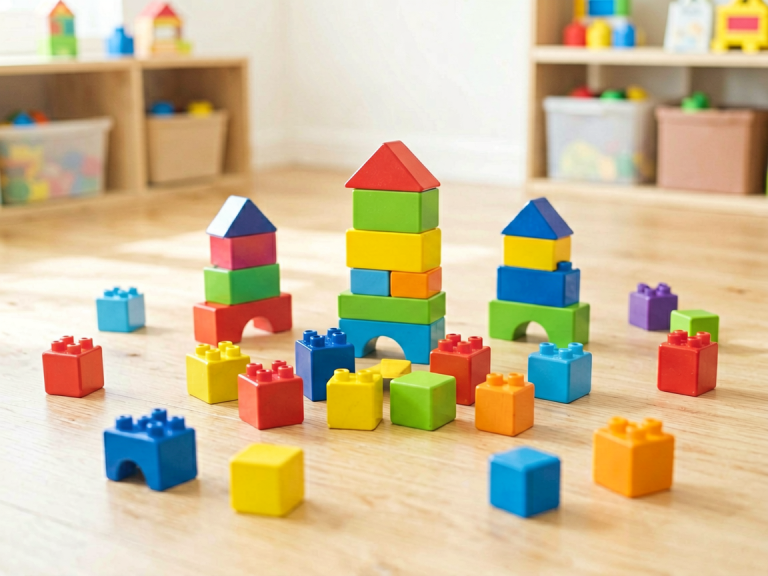
Classic wooden building blocks offer a sensory experience that magnetic tiles cannot replicate. The weight, texture, and slight friction of natural wood provide immediate tactile feedback. When a child stacks a block, they feel its mass, hear the soft click as it settles, and see slight wobbles that signal instability. This multi-sensory input grounds the child in the physical world, encouraging careful observation and fine motor control.
Unlike magnets, which snap together with a satisfying but uniform click, blocks require precise alignment. A tower built from irregularly shaped blocks demands constant adjustment; gravity is the only force holding it together. This inherent instability becomes a teacher. Children learn that every angle, every offset matters. They discover that a slightly tilted block can bring down an entire structure, fostering a deeper understanding of cause and effect and a respect for physical laws.
Creativity Through Constraint
Paradoxically, the limitations of building blocks can boost creativity. Because blocks do not stick together, children must think about balance, center of gravity, and friction. They cannot simply connect pieces at any angle; they must find stable configurations. This constraint forces divergent thinking: How can I make a bridge when the blocks keep slipping? What if I use a larger base? What if I place a cylinder horizontally instead of vertically?
Moreover, blocks are fundamentally abstract. A rectangular block can represent a wall, a train, a bed, or a computer. This symbolic flexibility is central to imaginative play. A child can transform a set of blocks into a castle, a spaceship, or a grocery store, with no inherent geometric limitation dictating the form. The open-endedness of blocks encourages narrative development alongside physical construction.
Iteration and Resilience
One of the greatest strengths of building blocks is the inevitability of collapse. Every child who builds with blocks experiences the disappointment of a falling tower. Yet this failure is a critical lesson in resilience and iteration. After a collapse, a child must analyze what went wrong—Was the base too narrow? Were the blocks uneven?—and try again. This trial-and-error process is the essence of creative problem-solving.
Research in developmental psychology suggests that moderate frustration during play can enhance executive function skills, including self-regulation and persistence. Blocks, by their nature, provide many such opportunities. Magnetic tiles, in contrast, rarely collapse because the magnets hold pieces firmly; while this reduces frustration, it also removes a powerful learning moment.
Magnetic Tiles: The Geometry of Instant Gratification
Ease of Use and Rapid Prototyping
Magnetic tiles, such as Magna-Tiles or PicassoTiles, offer a completely different entry point. The magnets inside each square, triangle, or rectangle allow pieces to snap together effortlessly, even for very young children. A three-year-old can attach tiles at 90-degree angles, forming a cube or a prism in seconds. This low barrier to entry enables even toddlers to experience the thrill of construction without the fine motor demands of balancing blocks.
The ease of connection encourages rapid prototyping. A child can build a tower, knock it down, and rebuild it in a new shape in minutes. The speed of iteration allows for more experimentation in a shorter time frame. For children who might become frustrated by blocks' finickiness, magnetic tiles provide a satisfying, frustration-free alternative that keeps them engaged longer.
Geometric and Spatial Reasoning
Magnetic tiles excel at teaching geometric relationships. Their uniform shapes—squares, equilateral triangles, right triangles, rectangles—all for precise and predictable connections. Children can explore concepts like symmetry, tessellation, and three-dimensional geometry intuitively. Building a cube from six squares or an octahedron from eight triangles requires spatial visualization that directly maps onto mathematical thinking.
Furthermore, magnetic tiles enable structures impossible with blocks alone. Cantilevers, arches, suspended frameworks, and even rotating mechanisms (if hinges are included) become achievable. This expands the creative horizon; children can build models of real-world architecture, like bridges with overhangs or geodesic domes, that would be unstable in wood.
Creativity in the Third Dimension
While blocks are inherently three-dimensional, magnetic tiles make the transition from 2D to 3D exceptionally fluid. A child can lay tiles flat to create a pattern—a flower, a star, a mosaic—and then fold the pattern upward to form a three-dimensional object. This interplay between planar and volumetric thinking fosters a unique form of creative flexibility. Children learn that the same set of pieces can represent different dimensions depending on assembly.
Magnetic tiles also shine in collaborative play. The strong magnets allow multiple children to attach their sections together easily, creating large communal structures. This social aspect of creativity—negotiating designs, sharing pieces, building on each other's ideas—is enhanced by the tiles' forgiving connectivity.
A Potential Drawback: Over-Structured Play?
Critics argue that magnetic tiles, by their very precision, may limit creativity. Because pieces only attach at specific angles (usually 90° or 60° with triangle sides), the range of possible shapes is mathematically constrained. A child cannot, for instance, tilt a tile slightly to create an irregular angle. The rigidity of the magnetic connection means that every structure follows predefined geometric rules. This can lead to a certain uniformity: many children's creations with magnetic tiles look similar—cubes, castles with square towers, flat houses with triangular roofs.
In contrast, blocks allow for organic, asymmetrical, and even intentionally chaotic constructions. A block tower can lean, wobble, and still stand; a magnetic tile structure that does not align perfectly will simply fall apart or refuse to connect. This constraint may channel creativity into geometric patterns rather than freeform sculpture.
Comparative Analysis: Which Fosters Deeper Creativity?
The question is not which toy is "better," but rather which conditions each toy cultivates. Research from the field of cognitive development suggests that the most creative play occurs when the toy presents a "Goldilocks" level of challenge—not too easy, not too hard. Building blocks offer a steeper learning curve but richer rewards for perseverance. Magnetic tiles offer immediate success but may plateau in creative complexity if children do not push beyond the obvious shapes.
Age and Developmental Stage
For toddlers and preschoolers (ages 2–4), magnetic tiles are often ideal. They build confidence, introduce basic geometry, and prevent frustration. At this stage, creativity is less about complex structures and more about the sheer joy of assembling and disassembling. Blocks, especially smaller ones, can be frustrating for tiny hands.
For older children (ages 5–8), a mix of both is beneficial. Blocks challenge fine motor skills and introduce concepts of balance and weight distribution. Magnetic tiles encourage abstract thinking and geometric exploration. Children in this age group can use blocks for storytelling (e.g., building a village) and use tiles for engineering challenges (e.g., building a stable bridge).
Types of Creativity
Consider two axes of creativity: divergent (generating many ideas) and convergent (refining one idea into a coherent product). Magnetic tiles seem to support divergent creativity more in the initial brainstorming phase because building and rebuilding are so fast. Children can try ten different roof designs in five minutes. However, blocks may support convergent creativity more because the process of carefully balancing and adjusting requires deep focus and refinement.
Also, blocks lend themselves to representational creativity (creating things that look like real objects), while magnetic tiles excel at abstract or geometric creativity. A block castle can have irregular towers and crooked walls that mimic real medieval architecture; a magnetic tile castle tends to be symmetrical and geometrically perfect.
Synthesis: The Best of Both Worlds
Rather than pitting magnetic tiles against building blocks, the most creative outcome arises from using both together. A child might build a sturdy base from blocks—learning about stability—and then add magnetic tile walls for color and geometric precision. Or they could use magnetic tiles to create a framework (a skeleton of a building) and then fill in the "walls" with blocks. This hybrid approach forces the child to reconcile two different structural logics, fostering cognitive flexibility.
Parents and educators should also consider the environment. A play space with a diverse set of construction materials—including soft blocks, LEGO, clay, and recyclables—provides the richest creative soil. The goal is not to crown one toy as the champion of creativity, but to understand the unique language each toy speaks and to help children become multilingual in creative expression.
Conclusion: Embrace the Duality
In the end, the debate between magnetic tiles and building blocks is a false dichotomy. Both are powerful tools for nurturing creativity, but they do so in different ways—blocks through physical challenge, balance, and symbolic freedom; tiles through geometric ease, rapid iteration, and spatial reasoning. A child who plays exclusively with magnetic tiles may miss the tactile wisdom and resilience gained from blocks. A child who plays only with blocks may miss the confidence and geometric fluency that magnets provide.
The most creative children are those who have access to both, who learn to switch between the two modes of thinking, and who understand that creativity is not about having the perfect tool but about using whatever tools are available to imagine, build, and rebuild their world. So, buy a set of wooden blocks and a set of magnetic tiles. Watch your child learn that a tower can stand by weight or by magnetic force—and that both ways are beautiful.