Sparking Young Curiosities: The Best Science Gifts for 5-Year-Olds
Introduction: Why Science Gifts Matter at Age Five
At five years old, a child’s brain is a sponge for wonder. Questions like “Why is the sky blue?” and “How do plants eat?” tumble out faster than parents can answer. This is the golden age of curiosity—a time when hands-on exploration lays the foundation for lifelong learning. Choosing the right science gift for a 5-year-old is not just about entertainment; it’s about nurturing observation skills, critical thinking, and the joy of discovery. The best gifts strike a delicate balance: they must be safe enough for a preschooler to use with minimal supervision, engaging enough to hold a short attention span, and open-ended enough to invite repeated play. In this guide, I have curated a list of science-inspired presents that go beyond plastic microscopes and cheap magnifying glasses. Each recommendation has been tested against the developmental needs of a 5-year-old: fine motor control, cause-and-effect reasoning, and a boundless appetite for pretend play. Whether you are a parent, grandparent, or family friend, these gifts will transform ordinary afternoons into mini science lessons.
Hands-On Experiment Kits: Messy, Magical, and Meaningful
Few things capture a 5-year-old’s imagination like mixing, pouring, and watching unexpected reactions. Age-appropriate chemistry and physics kits are among the best science gifts because they turn abstract concepts into tangible results. Look for kits that include non-toxic, edible or washable materials such as baking soda, vinegar, food coloring, and cornstarch. For example, a “fizzing volcano” kit is a classic favorite: the child builds a small clay or paper-mâché volcano, then pours in baking soda and colored vinegar to create a foamy eruption. This simple experiment teaches about acids and bases while also allowing for artistic expression (painting the volcano). Another excellent option is a “color-changing” chemistry set that uses pH-sensitive liquids. Five-year-olds love to drop lemon juice onto a paper that turns from blue to red, and they can repeat the action dozens of times without getting bored. The key is choosing kits that come with clear, picture-based instruction cards so that a non-reading child can follow along with a parent. Safety is paramount: avoid any kits containing borax, strong acids, or small magnets that could be swallowed. Reputable brands like *Learning Resources* and *Thames & Kosmos* offer specific lines for preschoolers that are labeled “No-Read” or “My First” to guarantee zero frustration. When a child watches a purple liquid turn green, then yellow, they are not just playing—they are absorbing the concept of chemical change through their senses.
Building and Engineering Toys: The Physics of Fun
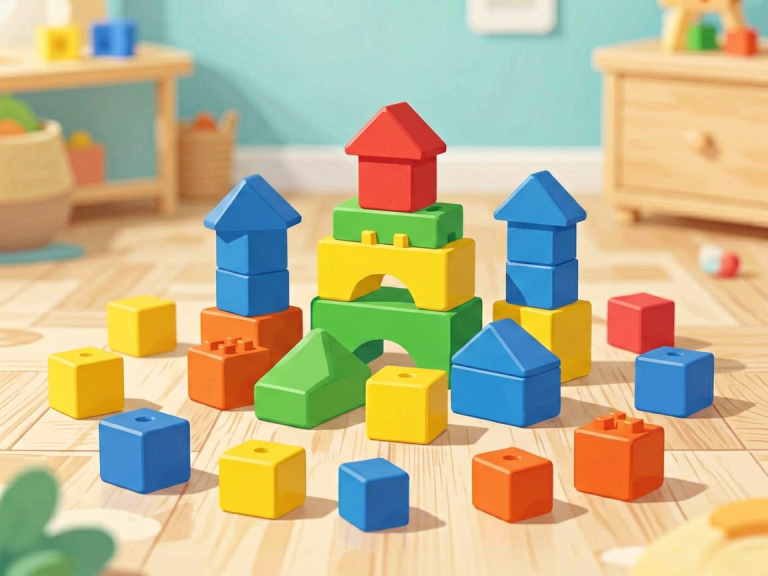
At five, many children have developed enough hand strength and spatial awareness to tackle more complex construction sets. Building toys that involve gears, pulleys, ramps, or magnetic connections are ideal because they introduce fundamental physics principles without any textbook jargon. One standout gift is a set of magnetic tiles, such as *Magnatiles* or *PicassoTiles*. These translucent geometric shapes snap together with hidden magnets, allowing a child to build towers, bridges, and even simple houses. While playing, the child unconsciously experiments with balance, weight distribution, and structural integrity—if the tower leans too far, it crashes, and the child tries a different configuration. Another superb choice is a marble run kit. For a 5-year-old, look for sets with large, chunky pieces that are easy to grip, like *Hape Quadrilla* or *National Geographic’s marble run*. The child assembles ramps, tubes, and funnels, then releases a marble to see what path it takes. Each run becomes a mini-investigation: “What happens if I raise this ramp? The marble goes faster!” or “If I block this hole, the marble gets stuck.” These toys teach cause-and-effect, prediction, and even a little bit of patience (since marbles can fly off if pieces are not aligned). Do not overlook simple wooden balance scales either. A child can weigh small toys, stones, or dried beans, and learn concepts like heavier/lighter, equilibrium, and estimation. The beauty of engineering gifts is that they grow with the child: at five, they build simple structures; at seven, they will design complex ones. Choose open-ended sets that allow for endless creativity, not just a single model.
Nature Exploration Tools: The World as a Laboratory
Nothing beats the outdoors for science education, but the right tools can turn a backyard walk into a serious research expedition. The best science gifts for 5-year-olds often involve observation and collection. A sturdy, child-sized magnifying glass with a built-in light (for examining bugs, leaves, and rocks) is a must-have. Pair it with a plastic tweezers and a small collection container. Children at this age love to capture a roly-poly bug, study its legs, and then release it—a whole lesson in entomology and empathy in one activity. Another wonderful gift is a bug viewer with a ventilated lid and a magnifying top, so the child can see the insect from above and below. Add a simple field guide for local insects and plants, but choose one with mostly pictures; the child can “identify” by matching shapes. For a gift that encourages patience, consider a butterfly garden kit that includes a mesh habitat and a certificate to mail for live caterpillars. Over a couple of weeks, the child watches the caterpillars eat, form chrysalises, and emerge as painted lady butterflies. This is not just entertaining—it teaches life cycles, metamorphosis, and responsibility. Do not forget a good pair of kid-sized binoculars with rubber armor (to survive drops). Use them to watch birds at a feeder, clouds, or even the moon. Finally, a simple plastic rain gauge and a weather chart can turn every morning into a meteorology lesson. The child marks whether it is sunny, rainy, or cloudy, and learns to predict patterns. Encourage parents to keep a small “nature journal” where the child can draw observations (stick figures of bugs or squiggly leaf shapes count). These tools are low-tech but high-impact; they teach children that science is not just in a lab but all around them.
Puzzles and Logic Games: Brain-Building Fun
Science is also about patterns, categorization, and problem-solving. At age five, children are developmentally ready for more sophisticated puzzles that require reasoning, not just trial and error. One category of excellent science gifts is “cause-and-effect” marble track puzzles, but simpler versions exist that are purely cognitive. For instance, a set of sequencing cards that show the life cycle of a frog or the water cycle can be laid out in order by the child. This exercises memory, sequencing, and understanding of natural processes. Another idea: a magnetic “human body” puzzle that lets the child place bones and organs on a clear plastic body outline. It is a gentle introduction to anatomy and the idea that our bodies are systems. For logic specifically, look for games like *Robot Turtles* (a board game that teaches the basics of programming) or *ThinkFun’s Roll & Play* (a large die and activity cards that involve movements and questions). At this age, the classic “Snap Circuits” might be too advanced, but there are “My First Snap Circuits” sets with large, brightly colored components that snap together to light a bulb or spin a fan. The child does not need to understand Ohm’s law; they just see that connecting a wire to a battery makes the light go on. This is the foundation of electrical engineering. Even a simple set of pattern blocks (triangles, squares, hexagons) combined with challenge cards is a brilliant science gift; it teaches geometry, symmetry, and spatial reasoning. The key is to avoid frustration: choose puzzles that have a clear endpoint or a satisfying “click” when solved. A child who succeeds at a challenging puzzle gains confidence and persistence—two traits essential for future scientists.
Books That Spark Curiosity: Stories as Gateways
Finally, no science gift list is complete without books. A 5-year-old may not read independently yet, but a well-illustrated non-fiction picture book can spark conversations and questions that last for days. The best science books for this age are those that combine engaging narrative with accurate, simple explanations. *Ada Twist, Scientist* by Andrea Beaty is a modern classic: it follows a young girl who asks “why” about everything, conducting messy experiments at home. The rhyming text and lively illustrations make it a bedtime favorite while modeling the scientific method. For a more factual approach, consider *The Magic School Bus* series—the original books are still excellent, with Ms. Frizzle taking the class on wild field trips inside the human body or to the solar system. Another gem is *What Do You Do With a Tail Like This?* by Steve Jenkins, which uses cut-paper collages to show how animals use their noses, ears, and tails. It encourages observation and comparison. Do not overlook interactive books, such as *Press Here* by Hervé Tullet, which playfully introduces cause-and-effect through simple colored dots. And for a gift that keeps on giving, a subscription to a science magazine for preschoolers, like *National Geographic Little Kids*, arrives every month with animal facts, puzzles, and activities. Books are the most portable science gifts: they travel in a backpack, they fit under a pillow, and they can be read over and over. They also teach children that science is a story—one that they can help write with their own questions.
Conclusion: The Real Gift Is Wonder
When choosing the best science gifts for a 5-year-old, remember that the most expensive electronic kit is not necessarily the best. The ideal gift is one that invites the child to ask “What if?” and then provides a safe, engaging way to find out. Whether it is a fizzy volcano, a set of magnetic tiles, a bug viewer, a logic puzzle, or a beautiful picture book, the true value lies in the moments of shared discovery. A parent and child building a marble run together, exclaiming when the ball finally reaches the bottom, are doing something more profound than playing: they are building a relationship with the natural world and with each other. So go ahead—pick a gift that makes a 5-year-old’s eyes widen. That spark of curiosity is the beginning of all science.
*(Word count: approximately 1,280 words)*