The Best Science Gifts for 3-Year-Olds: Sparking Curiosity and Early Learning
Every parent knows that three-year-olds are natural-born scientists. At this age, children are bursting with questions: "Why is the sky blue?" "What happens if I drop this egg?" "How does that light turn on?" Their brains are wired for exploration, cause-and-effect reasoning, and sensory discovery. Choosing the right science gift for a three-year-old isn't about flashcards or complicated experiments—it's about channeling that innate curiosity into hands-on, safe, and joyful play. The best science gifts for this age group are those that encourage open-ended exploration, fine motor skills, vocabulary building, and—most importantly—wonder. Below, I’ve curated a list of outstanding science-themed gifts that will delight both the child and the grown-up who gets to watch the magic unfold.
Sensory Exploration Toys: The Foundation of Scientific Thinking
Before a child can understand molecules or gravity, they need to experience texture, sound, smell, and sight. Sensory play is the bedrock of early science learning because it builds neural connections and teaches children to observe and describe their environment.
One standout gift is a Sensory Bin with Themed Materials. Fill a shallow plastic bin with dried rice, beans, or sand, then add scoops, funnels, small plastic animals, and tongs. For a science twist, choose a theme like "ocean exploration" with blue-tinted water beads (soaked and safe) and toy sea creatures, or "dinosaur dig" with kinetic sand and small fossil replicas. Three-year-olds will spend hours pouring, sifting, and sorting, which intuitively teaches concepts like volume, texture, and classification. Look for kits like the *National Geographic Sensory Science Kit* or create your own using non-toxic, washable materials. The key is to supervise mouthing tendencies—choose items larger than a toilet paper roll to prevent choking.
Another excellent choice is Water Play Tables with Scientific Accessories. A table that holds water (or even a large plastic basin) can become a mini hydrology lab. Add floating and sinking objects: a cork, a plastic boat, a metal spoon, a sponge. Ask the child, "What do you think will happen if we put the sponge in?" This simple activity introduces buoyancy, absorption, and prediction. Brands like *Step2* and *Little Tikes* offer sturdy water tables, but you can also buy a set of *Boon Building Pipes* that attach to a bathtub or table. Watching water flow through a clear pipe is mesmerizing for a three-year-old and lays the groundwork for understanding fluid dynamics.
Simple Physics and Cause-and-Effect Toys
Three-year-olds are obsessed with "what happens when I do this?" Science gifts that capitalize on cause and effect are guaranteed hits because they give children a sense of control and discovery.
Magnetic Building Blocks are a perfect example. Unlike traditional wooden blocks, magnetic tiles (like *Magnatiles* or *PicassoTiles*) allow children to attach pieces by simply bringing them close. The satisfying click and the way structures can be built vertically—defying gravity—teaches basic magnetism and stability. Toddlers can build simple towers, then knock them down while observing how the magnets hold or separate. Safety note: ensure the magnets are securely encased and cannot be swallowed. Most reputable brands have strong safety ratings. This toy grows with the child, from flat patterns at age three to complex 3D structures at age six.
Another fantastic gift is a Simple Gear Set. Gears that snap onto a base plate, with a handle that turns them all, demonstrate mechanical connection and motion. The *Learning Resources Gears! Gears! Gears!* sets are ideal because they are chunky, colorful, and require minimal frustration. A three-year-old can turn one gear and watch three others spin. This teaches rotational motion, cause sequences, and problem-solving when they need to figure out which gear to add to get the whole chain moving. It’s also great for hand-eye coordination.
Don’t overlook the power of Ramps and Ball Tracks. Products like the *Hape Quadrilla Wooden Marble Run* (with large, easy-to-handle pieces) or the plastic *Battat Wooden Ramp Racer* allow children to roll cars or balls down inclines. The child can change the angle, add a bump, or switch the ball for a heavier one. They are experimenting with gravity, slope, and momentum. The sheer delight when a ball zooms down a track is the happy sound of a budding physicist. For safety, choose sets with enclosed tracks so marbles don't roll under furniture or into mouths.
Biology and Nature Exploration Kits
Three-year-olds are naturally drawn to living things. A gift that brings them close to plants, insects, or animals can spark a lifelong love of biology. The key is to choose tools that are safe, durable, and focused on observation rather than dissection.
A Child-Friendly Magnifying Glass is a must-have. Look for one with a large, shatterproof lens and a handle designed for small hands. The *Educational Insights GeoSafari Jr. My First Microscope* is also excellent—it is a low-power, non-digital microscope that uses a large viewing stage for leaves, rocks, or fabric. No slides required. A three-year-old can place a flower petal under it and see an alien-looking world of veins and cells. Pair it with a collecting kit: a small bug viewer (like the *Nature Bound Bug Catcher with magnifying lid*), a butterfly net, and a plastic container for "treasures." Going on a backyard hunt for "things that move" or "things that are green" turns a walk into a scientific expedition.
Another brilliant option is Grow-Your-Own Kits. Simple plant-growing sets where children can see seeds sprout in a few days are magical. The *KidzLabs Grow Your Own Crystal* or *Plant a Bean in a Clear Cup*—there are kits like the *Grace Garden Fairy Garden* or *4M Green Science Grow-A-Maze* where a bean plant winds through a visible maze. Watching roots and stems change daily reinforces concepts of growth, light, and water. For three-year-olds, choose kits with large seeds (like beans or sunflowers) and instructions that involve no sharp tools. The responsibility of watering a plant also builds nurturing habits.
Building and Engineering: Early STEM in Action
Construction toys are arguably the most classic science gift, but for three-year-olds, the focus should be on large, easy-to-connect pieces that encourage trial and error without frustration.
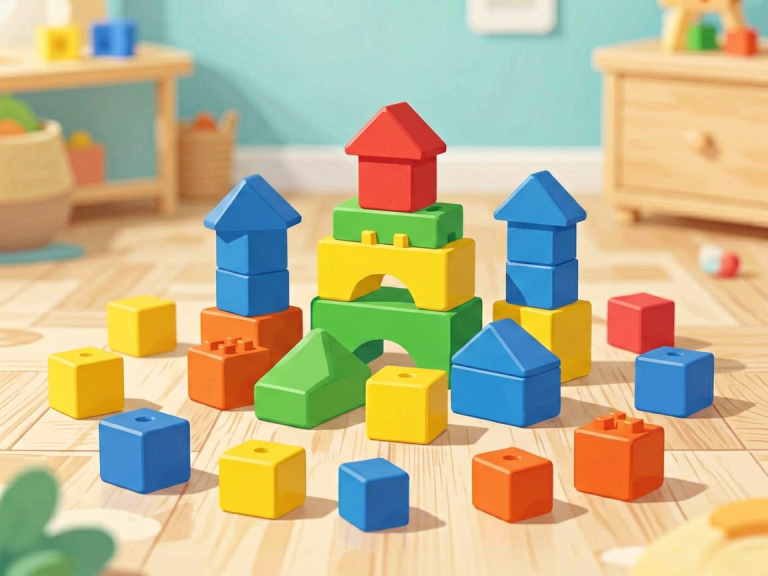
Large interlocking blocks—such as *Duplo* (the larger version of Lego) or *Mega Bloks First Builders*—are perfect. These sets often come with animal figures, wheels, and simple instructions for building a house or a vehicle. The act of aligning and pressing blocks together strengthens fine motor skills and spatial awareness. When a tower falls, the child learns about balance and structural integrity. You can add a challenge: "Can we build a tower that is taller than your teddy bear?" This introduces measurement and comparison.
Wooden Stacking and Balancing Toys are deceptively scientific. The *Tegu Magnetic Wooden Blocks* or a simple *Wobbel Board* (a curved wooden board that rocks) teaches equilibrium and gravity. The *Grimm's Rainbow Stacker*—a set of twelve wooden arches—lets children create tunnels, walls, and towers. They experience how weight distribution affects stability. There is no right way to play; the child discovers physics through trial and error. These toys are also aesthetically beautiful and can be part of a nursery decoration.
For future engineers, consider a Simple Tool Set. A set of plastic hammers, screwdrivers, and bolts (like *Melissa & Doug Wooden Take-Along Tool Kit*) allows children to "fix" things. They learn that screws turn, nails go into holes, and that tools have specific functions. This is mechanical understanding in its purest form. Supervise to ensure they don't hit anything fragile—but let them try to "repair" a cardboard box. It’s hands-on engineering.
Chemistry and Messy Play: Safe Reactions
Three-year-olds love making things fizz, bubble, and change color. While you won't give them a chemistry set, there are safe, non-toxic ways to introduce chemical reactions.
Baking Soda and Vinegar Kits are a classic. You can buy a pre-made kit like the *Playz Explosive Kitchen Lab* (with child-safe tools) or simply provide a tray, baking soda, a squeeze bottle of vinegar, and food coloring. Drop the colored vinegar onto a mound of baking soda and watch the foam erupt. The child learns that mixing two substances creates something new—a gas (carbon dioxide). They also learn prediction if you ask, "What color will it be if we put blue vinegar on yellow baking soda?" This is chemistry disguised as art.
Non-Newtonian Fluid (Oobleck) Supplies make an unforgettable gift. Mix cornstarch and water (a 2:1 ratio) to create a substance that acts like a solid when squeezed and a liquid when left alone. Kits like *The AmScope Oobleck Kit* include pre-measured cornstarch and instructions. Three-year-olds will be fascinated by the way it drips or crumbles. This introduces states of matter and the concept of "shear thickening." Yes, it’s messy—set it up on a vinyl tablecloth or in the bathtub. The clean-up is worth the wonder.
Color-Mixing Sets are another great choice. Watercolor tablets or *Colorations Liquid Watercolor* with pipettes and clear cups let children drop one color into another. They witness blue + yellow = green. This is not just art; it's experimental chemistry. The *Learning Resources Primary Science Lab Set* includes test tubes, a magnifying glass, and simple experiment cards. One card says, "Mix red and blue water to make purple." This structured yet open-ended play cultivates observation and record-keeping (even if their "record" is excited shouting).
Science Books and Visual Aids
Even the most hands-on scientist needs a reference book! For three-year-olds, board books with simple explanations and interactive features are perfect.
"Baby Science" Board Book Series—such as *"Baby Loves Gravity!"* or *"Baby Loves Aerospace Engineering!"* by Ruth Spiro—present complex ideas in one-line sentences with bright illustrations. For example, "Gravity pulls things down. But a rocket goes up!" These books are durable, chew-proof, and introduce vocabulary like "force" and "energy" without overwhelming.
Another must-have is "My First Science Box" by Mudpuppy, which includes a board book and small props like a magnifier and a bug viewer. Or choose a pop-up book like *"How Does a Seed Grow?"* by Susan B. Katz, where children can pull tabs to see a seedling emerge from soil. Visual aids like *A Globe for Babies* (a soft, inflatable globe) teach that the Earth is round and that there are oceans and land. At three, this is a conceptual leap—but they can hold it, spin it, and point to "where the fish live."
Final Thoughts: What to Look for in a Science Gift for a 3-Year-Old
When shopping for the best science gifts for a three-year-old, prioritize safety, durability, and open-endedness. Avoid toys with small parts (choking hazard), sharp edges, or toxic materials. Look for certification like ASTM or CE. Choose gifts that allow the child to be the experimenter, not just a spectator. The best toy is one that the child can use in multiple ways—a set of blocks can become a tower, a bridge, or a spaceship. Science for a three-year-old is not about memorizing facts; it’s about developing habits of observation, questioning, and joyful trial and error.
Finally, remember that the most valuable "science gift" you can give your child is your presence. Sit with them, ask open-ended questions ("What do you notice?" "What do you think will happen next?"), and marvel together. The toys listed above are excellent tools, but the real laboratory is your child’s mind, and you are their favorite lab partner. Whether it’s a sensory bin full of beans or a wooden stacking rainbow, the goal is to foster a sense of wonder that will last a lifetime. Happy experimenting!