The Building Blocks of Early Development: Why Building Toys Matter for Toddlers
In the whirlwind of early childhood, every toy, every game, and every interaction shapes the architecture of a growing mind. Among the countless options available to parents and caregivers, building toys for toddlers stand out as timeless, versatile, and profoundly developmental. These simple sets of blocks, magnetic pieces, or interlocking bricks are far more than mere playthings. They are the silent tutors of logic, the architects of creativity, and the catalysts for fine motor mastery. This article explores the multifaceted benefits of building toys for toddlers, offers guidance on selecting the right ones, and underscores why they deserve a central place in every toddler's toy box.
Cognitive Development: The Foundation of Problem-Solving
Building toys are, at their core, a gymnasium for the brain. When a toddler picks up a wooden block and attempts to stack it atop another, they are engaging in a series of complex cognitive processes. First, they must plan—deciding where to place the block, how much pressure to apply, and what might happen if they fail. This involves spatial reasoning, a skill that correlates strongly with later mathematical and scientific thinking.
Studies in early childhood education consistently show that children who frequently play with construction toys develop stronger spatial visualization abilities. A 2017 study published in the journal *Child Development* found that three-year-olds who played with blocks exhibited improved understanding of geometric shapes and spatial relationships compared to peers who did not. Furthermore, building toys encourage cause-and-effect reasoning. A toddler quickly learns that a tower of unevenly stacked blocks will topple, while a stable base leads to a higher, more satisfying structure. This trial-and-error process builds resilience and persistence—qualities essential for academic and life success.
Beyond spatial skills, building toys foster symbolic thinking. A toddler may declare that a tall stack of blocks is a "castle" or a "skyscraper," transforming abstract forms into meaningful representations. This is an early form of metaphor and abstraction, laying groundwork for language development and creative storytelling.
Physical Development: From Grasping to Coordination
The physical demands of building toys are equally significant. For toddlers, whose fine motor skills are still emerging, manipulating small blocks or snapping together magnetic tiles provides a perfect challenge. The pincer grasp—using the thumb and index finger to pick up a block—is a crucial milestone that building toys naturally reinforce. Each time a toddler picks up a square block or connects two Lego Duplo pieces, they strengthen the small muscles in their hands and fingers, improving dexterity and hand-eye coordination.
Moreover, building activities often require bilateral coordination—using both hands together in a coordinated manner. For instance, a toddler might hold a base plate steady with one hand while stacking a block with the other. This skill is foundational for later tasks such as writing, buttoning clothes, and using scissors. As children grow, more complex building sets (like those with gears or wheels) introduce the concept of rotational motion and mechanical cause-and-effect, further refining their physical abilities.
Gross motor development also benefits. While constructing a large tower on the floor, a toddler may squat, reach, stretch, and shift their body weight. These movements build core strength and balance. In outdoor settings, oversized building blocks or foam bricks encourage running, carrying, and lifting, integrating physical play with construction.
Social and Emotional Growth: Collaboration and Confidence
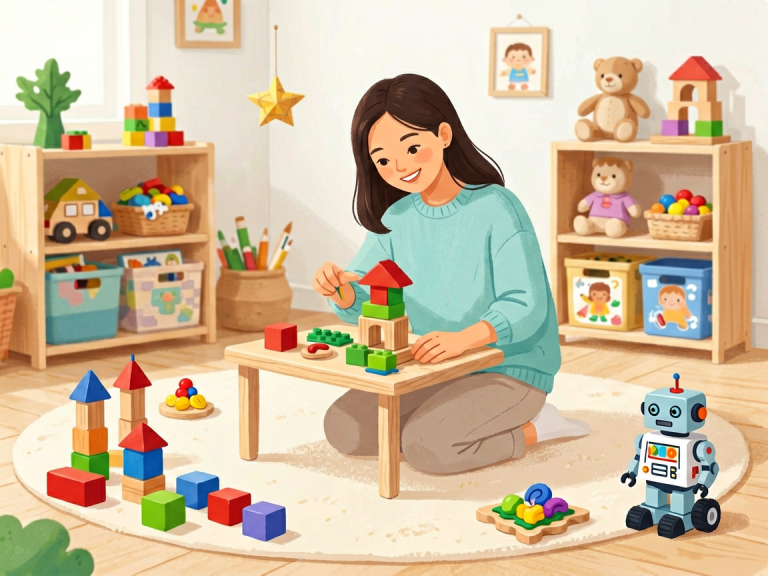
Building toys are not solitary by nature. When toddlers engage in constructive play with peers or adults, they learn invaluable social skills. Sharing blocks, negotiating which piece goes where, and taking turns to add to a communal structure foster cooperation and communication. A child who builds a tower with a friend must articulate their ideas: "Put the red one here!" or "No, that's too big!"—practicing language in a meaningful context.
Emotionally, building toys offer a safe space for self-expression and mastery. A toddler who successfully completes a structure experiences a surge of pride and self-efficacy. This sense of accomplishment boosts confidence and encourages them to tackle progressively harder challenges. Conversely, when a tower falls (as it inevitably will), children learn to manage frustration and disappointment. With gentle guidance from a caregiver, they can reframe failure as an opportunity to try again—a lesson in emotional regulation that will serve them for a lifetime.
Building toys also support imaginative play. A set of blocks can become a zoo, a spaceship, or a city. This pretend play allows toddlers to explore different roles and scenarios, building empathy and narrative skills. As they narrate their creations—"The dog lives here, and the car goes vroom!"—they integrate language, memory, and creativity.
Choosing the Right Building Toys for Toddlers
Not all building toys are created equal, and age-appropriateness is key. For toddlers aged 12 to 18 months, simple, large wooden blocks (such as those from the classic unit block sets) are ideal. They are easy to grasp, too large to swallow, and free of small parts. Magnetic building tiles with rounded edges are also excellent for this age group, as they connect with satisfying ease and allow for both flat and three-dimensional creations.
From 18 months to 3 years, children can handle interlocking bricks like Lego Duplo, which are larger than standard Lego and designed for small hands. These sets often include themed pieces (animals, wheels, windows) that spark imaginative play. Soft foam blocks or cardboard brick-like blocks are another wonderful option, especially for building larger structures or for children who still tend to throw toys. At this stage, avoid sets with tiny pieces that pose choking hazards—always check the manufacturer's age recommendation.
For toddlers approaching age three, consider introducing simple gear sets or interlocking disks. These add mechanical elements that challenge their reasoning. However, the most important factor is not the complexity of the set but the openness of the play. The best building toys are those that do not prescribe a single outcome. A set that forces a specific model (e.g., a pre-designed car) limits creativity. Instead, choose sets with many identical or varied pieces that can be combined freely—blocks, tubes, connectors, and panels.
Safety Considerations for Building Toy Play
Safety is paramount when selecting and using building toys for toddlers. First and foremost, ensure that all pieces are larger than a toddler's mouth—a standard test is that they should not fit through a toilet paper roll. Wooden blocks should be sanded smooth and finished with non-toxic paint or varnish. Magnetic toys, while generally safe, should have magnets securely encased; loose magnets can cause severe internal injury if swallowed.
Supervision is crucial, especially during the early stages when toddlers may mouth objects. Also, watch for splinters or cracks in wooden blocks, and discard any damaged pieces. For children who are still unsteady on their feet, create a soft play area with mats or carpet to cushion falls when a tower collapses. Finally, rotate toys to maintain interest and reduce clutter. Too many options can overwhelm a toddler; a small, curated selection of building toys invites deeper engagement.
Conclusion: Building a Brighter Future
Building toys for toddlers are not merely a source of entertainment; they are a profound educational tool that nurtures the whole child. From the cognitive leaps of spatial reasoning and problem-solving to the physical gains in fine and gross motor skills, and from the social bonds formed through cooperative play to the emotional resilience built through trial and error, these toys offer a comprehensive developmental workout.
As parents, educators, and caregivers, we can support this journey by choosing high-quality, open-ended building materials that match each toddler's developmental stage. We can sit beside them, not to direct, but to wonder aloud: "What happens if we put this block here?" or "How can we make it taller?" In doing so, we honor their innate drive to build, question, and discover. In a world increasingly dominated by screens and passive entertainment, building toys remain a steadfast ally—one small block at a time, constructing the minds and characters of tomorrow.