The Building Blocks of Tomorrow: Why STEM Toys for Toddlers Shape Brighter Futures
Introduction: More Than Just Play
In a world increasingly driven by technology, engineering, and scientific discovery, the concept of early childhood education has evolved far beyond alphabet blocks and crayons. Parents, educators, and child development experts now recognize that the first few years of life are a critical window for cognitive growth, problem-solving, and creative thinking. It is within this context that STEM toys for toddlers have emerged not merely as a trend but as a foundational tool for preparing young minds for the challenges and opportunities of the 21st century.
STEM, an acronym for Science, Technology, Engineering, and Mathematics, represents a holistic approach to learning that emphasizes inquiry, experimentation, and logical reasoning. When applied to toys designed for children aged one to three, these principles become accessible through colorful, safe, and engaging materials that spark curiosity. However, the concept of a "STEM toy" for a toddler may seem paradoxical—how can a child who barely walks grasp the laws of physics or the basics of coding? The answer lies not in formal instruction but in the subtle, playful introduction of concepts that lay the groundwork for later academic success.
This article explores the profound importance of STEM toys for toddlers, examining their developmental benefits, the criteria for selecting high-quality options, specific categories of toys that excel in this domain, and practical tips for integrating them into daily play. By the end, it will be clear that these toys are not just entertainment but powerful catalysts for lifelong learning.
The Developmental Science Behind STEM Play for Toddlers
Cognitive Growth Through Hands-On Exploration
Toddlers are natural scientists. Their relentless curiosity about the world—why does a ball roll? What happens when I drop this block?—mirrors the very essence of scientific inquiry. STEM toys capitalize on this innate drive by providing structured yet open-ended opportunities for exploration. For instance, a simple stacking toy that requires a child to match sizes or shapes involves early mathematical reasoning. Research in developmental psychology shows that between the ages of one and three, children's brains form neural connections at an astonishing rate—up to one million new synapses per second. Engaging in activities that involve cause and effect, pattern recognition, and spatial awareness strengthens these connections, building a neural architecture conducive to complex thinking.
One landmark study from Purdue University found that toddlers who played with construction-based toys, such as interlocking blocks or magnetic tiles, demonstrated significantly improved performance on tasks measuring spatial reasoning and problem-solving by age four. These skills are directly correlated with later aptitude in STEM fields. Moreover, the hands-on nature of such toys encourages fine motor development, hand-eye coordination, and the ability to focus attention—all essential for future academic endeavors.
Language and Social Skills: The Hidden Benefits
While STEM toys are often associated with solitary, analytical play, they also foster critical social and linguistic development. When a toddler and a caregiver build a tower together, or when two children collaborate on a simple puzzle, they engage in negotiation, turn-taking, and vocabulary expansion. Words like "more," "tall," "under," "heavy," and "fall" become part of their active lexicon through contextual use. This is not merely language acquisition; it is the integration of technical vocabulary within a meaningful experience. A child who says "the red block goes on top" has internalized both a color concept and a relational geometry concept.
Additionally, many modern STEM toys incorporate elements of storytelling or role-play. For example, a toy tool set might encourage a toddler to "fix" a broken toy, prompting conversations about how things work and the role of an engineer. Such play nurtures empathy, resilience, and the ability to articulate ideas—skills that are far from trivial in the competitive world of tomorrow.
Criteria for Choosing the Best STEM Toys for Toddlers
Safety, Durability, and Age Appropriateness
Before delving into specific toy categories, it is crucial to establish guidelines for selection. For toddlers, safety is paramount. Toys must be made from non-toxic materials, free from small parts that pose choking hazards, and designed to withstand the enthusiastic handling (and occasional chewing) of a young child. Look for certifications such as ASTM (American Society for Testing and Materials) or CPSC (Consumer Product Safety Commission) compliance. Additionally, age labels are not arbitrary; they are based on developmental milestones. A toy recommended for ages three and up may contain small magnets or intricate pieces that are dangerous for a two-year-old.
Durability is equally important. Toddlers are not gentle. A STEM toy that breaks after a few uses undermines the learning process and frustrates the child. Quality brands like Melissa & Doug, LEGO Duplo, or Hape invest in robust materials and thoughtful design. Wooden toys, for instance, offer longevity and a tactile experience that plastic often lacks. Furthermore, the best STEM toys are those that grow with the child—offering multiple levels of complexity as the toddler's abilities expand. An excellent example is a shape sorter that first introduces basic shapes, then later challenges the child to sort by color or size.
Open-Ended vs. Structured Play
Another critical consideration is the balance between open-ended and structured play. Open-ended toys, such as wooden blocks, Play-Doh, or magnetic tiles, allow children to create their own rules and outcomes. They foster creativity, divergent thinking, and problem-solving because there is no single "correct" way to use them. In contrast, structured toys—like a circuit-building kit or a math puzzle—introduce specific concepts and often have a defined goal. The ideal STEM toy collection for a toddler includes both types. A child might spend thirty minutes stacking blocks in a tower (open-ended) and then ten minutes fitting a cylinder into a matching hole (structured). Each type exercises different cognitive muscles.
Parents should also consider the toy's ability to engage multiple senses. STEM learning is most effective when it is multi-modal—involving sight, touch, hearing, and even smell or taste (safely). A toy that lights up when a connection is made, for example, reinforces cause-and-effect through visual and auditory feedback. Similarly, textured materials like sand, water, or play dough provide tactile stimulation that supports sensory integration, a key component of early brain development.
Top Categories of STEM Toys for Toddlers
Building and Construction Toys
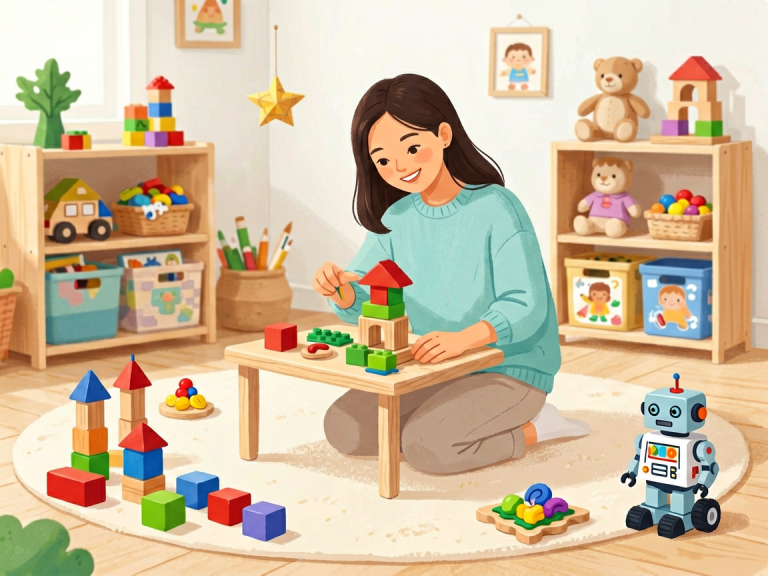
Perhaps the quintessential STEM toy for toddlers is the building set. From classic wooden blocks to interlocking plastic bricks like Mega Bloks or LEGO Duplo, these toys offer infinite possibilities. They introduce fundamental engineering concepts such as balance, symmetry, and structural integrity. A toddler who learns that a tower needs a wide base to stand tall is unknowingly grasping a principle of physics. Modern variations include magnetic tiles (e.g., Magna-Tiles) that snap together with satisfying clicks, allowing children to build 3D shapes, bridges, and even simple machines. These toys also promote spatial awareness, as the child must visualize how pieces fit together in three dimensions.
Cause-and-Effect and Simple Mechanics
Toys that demonstrate mechanical cause and effect are particularly engaging for toddlers. Ball track sets, such as those made by Hape or Battat, where a child places a ball at the top of a ramp and watches it roll down, weave through tunnels, and ring bells, teach sequences and the idea of energy transfer. Similarly, simple gears and pulleys that can be cranked or turned help children understand rotational motion and force. Some electronic toys—like a toddler-friendly coding robot (e.g., Botley or Code-a-Pillar)—allow even very young children to press buttons to make a toy move forward, backward, or turn. This is an introduction to computational thinking: breaking down an action into a series of commands.
Sensory Science Kits and Nature Exploration
While formal chemistry sets are inappropriate for toddlers, sensory science kits that involve water, sand, or non-toxic slime are excellent STEM tools. A water table with cups, funnels, and floating objects teaches volume, displacement, and fluid dynamics. A simple magnet set (with large, safe magnets) lets toddlers discover the invisible force of attraction and repulsion. Nature exploration kits—such as a bug-catching jar with a magnifying lid or a simple birdhouse to assemble—connect toddlers to biology and ecology. These toys encourage observation, classification, and questioning—the very heart of scientific method.
Puzzles and Matching Games
Puzzles are deceptively powerful STEM tools. They require pattern recognition, logical deduction, and fine motor precision. For toddlers, chunky wooden puzzles with large pieces that fit into corresponding cutouts are ideal. As they progress, puzzles that require matching shapes to shadows or that depict simple sequences (e.g., a life cycle of a butterfly) introduce more advanced concepts. Magnetic puzzles, where pieces stick to a board, add an extra element of sensory feedback. Additionally, sorting games that ask a child to group objects by color, size, or texture develop early mathematical classification skills—the precursor to algebra.
Practical Tips for Integrating STEM Toys into Daily Life
Follow the Child's Lead
The most effective STEM play is child-directed. While a parent might have a specific learning objective in mind—like teaching color names—forcing a toddler to engage in a structured activity often backfires. Instead, observe what fascinates your child. If they are repeatedly dropping a toy from their high chair, that is a natural opportunity to introduce a ramp or a ball drop toy that harnesses their interest in gravity. Be a facilitator, not a director. Ask open-ended questions like "What do you think will happen if we put the big block on top?" or "How can we make the tower taller without falling?" Such language encourages critical thinking without prescribing an answer.
Rotate Toys to Maintain Novelty
Toddlers can become overwhelmed by too many choices. A common mistake is to buy a dozen STEM toys and leave them all available simultaneously. This can lead to shallow engagement. Instead, rotate toys every week or two. Put away the building blocks and bring out the water table, then swap again after a few days. When a toy reappears, it feels new again, and the child often approaches it with fresh curiosity. This practice also helps children learn patience and focus—they know that not every toy is available at once, so they invest more deeply in the ones that are.
Embrace Mess and Failure
STEM learning is inherently messy. Water spills, blocks tumble, and slime gets on clothes. Parents who obsess over cleanliness may inadvertently stifle exploration. Designate a play area where mess is acceptable—a plastic tablecloth or an outdoor space works well—and dress the child in washable clothes. More importantly, embrace failure as a learning opportunity. When a block tower falls, instead of rushing to rebuild it for the child, say, "Oh, it fell! Why do you think that happened? Should we try a different way?" This reframes failure not as a mistake but as data, a core STEM principle.
Conclusion: A Foundation for a Lifetime of Discovery
STEM toys for toddlers are far more than a marketing buzzword or a parenting trend. They are thoughtfully designed tools that harness the natural curiosity of early childhood to build skills that will serve children for the rest of their lives. From the cognitive benefits of spatial reasoning and logical thinking to the social-emotional gains of collaboration and perseverance, these toys address the whole child. They do not promise to create prodigies; rather, they aim to cultivate a mindset—one that sees problems as puzzles, mistakes as lessons, and the world as a place to explore, question, and understand.
As parents and educators, our role is to provide the raw materials for that exploration: safe, engaging, and developmentally appropriate toys that invite wonder. In doing so, we are not just preparing toddlers for kindergarten or for a future career in technology; we are nurturing a lifelong love of learning. And in a rapidly changing world, that might be the most valuable gift of all. So the next time you see your toddler carefully stacking blocks, or repeatedly dropping a ball down a slide, remember: you are witnessing the earliest steps of a scientist, an engineer, a mathematician, or an inventor. All they need is the right tool—and a little room to play.