STEM Toys vs Montessori Toys: A Comparative Analysis of Educational Play Philosophies
Introduction
In the modern landscape of childhood development, the term "educational toys" has become almost synonymous with "good parenting." Yet beneath this umbrella lies a fascinating and often misunderstood dichotomy: STEM toys and Montessori toys. Both are lauded for their ability to cultivate intelligence, creativity, and problem-solving skills, but they spring from fundamentally different educational philosophies. STEM (Science, Technology, Engineering, and Mathematics) toys emphasize systematic inquiry, technological literacy, and the application of scientific principles. Montessori toys, rooted in the groundbreaking work of Dr. Maria Montessori, prioritize self-directed, sensory-rich exploration and the development of the whole child—cognitive, social, emotional, and physical. This article aims to dissect the differences, strengths, and limitations of each approach, providing parents, educators, and curious readers with a nuanced understanding of how these two distinct worlds of play shape young minds.
The Core Philosophy: Exploration vs. Self-Directed Learning
At first glance, both STEM and Montessori toys encourage "learning by doing," but their underlying motivations diverge sharply.
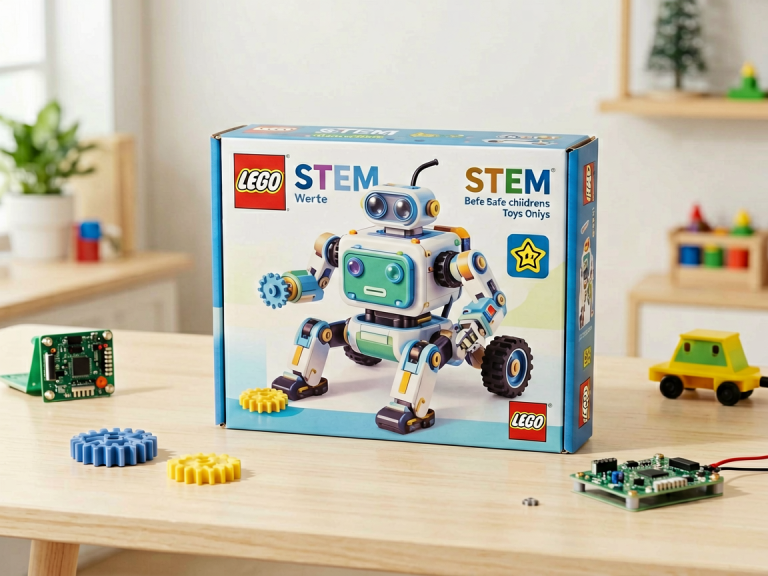
STEM toys are built on a scaffolded, often adult-guided model of discovery. A build‑your‑own‑robot kit, for example, typically comes with explicit instructions, step‑by‑step schematics, and a predetermined outcome. The child is expected to follow a logical sequence—identifying gears, connecting circuits, testing variables—to achieve a functional result. This mirrors the scientific method: hypothesize, experiment, observe, and conclude. The philosophy here is that structured exposure to STEM concepts at an early age builds foundational knowledge in coding, engineering, and mathematics, preparing children for a technology‑driven future. The adult’s role is not merely a facilitator but often a coach who explains why a lever works or how a battery creates a current.
Montessori toys, conversely, are deliberately devoid of instructions, predetermined outcomes, or adult imposition. A classic Montessori material like the Pink Tower consists of ten wooden cubes ranging from 1 cm to 10 cm in size. There is no manual telling the child how to stack them. The child is free to arrange, sort, compare, and discover through trial and error. The philosophy is one of "auto‑education": the child’s own repeated interactions with the material gradually internalize concepts like dimension, weight, and spatial relationships. The adult’s role is that of an observer and a prepared environment creator, not a direct instructor. This approach honors the child’s intrinsic curiosity and pace, aiming to foster concentration, independence, and a love for learning that is not externally motivated.
Design and Materials: High-Tech vs. Nature-Inspired
The physical characteristics of STEM and Montessori toys reflect their philosophical origins.
STEM toys are often visually stimulating, brightly coloured, and packed with electronic components. They may include microprocessors, sensors, lights, sounds, and digital interfaces. A typical STEM toy might be a programmable drone, a chemistry set with real chemicals, or a magnetic building set with LED‑embedded bricks. The materials are frequently plastic, metal, and silicon, chosen for durability and electrical conductivity. While many modern STEM kits emphasize eco‑friendliness, the predominant aesthetic is one of modernity and gadgetry. This design is intentional: it captures the child’s attention with immediate sensory feedback (flashing lights, motor movements) and mimics the tools of professional engineers and scientists.
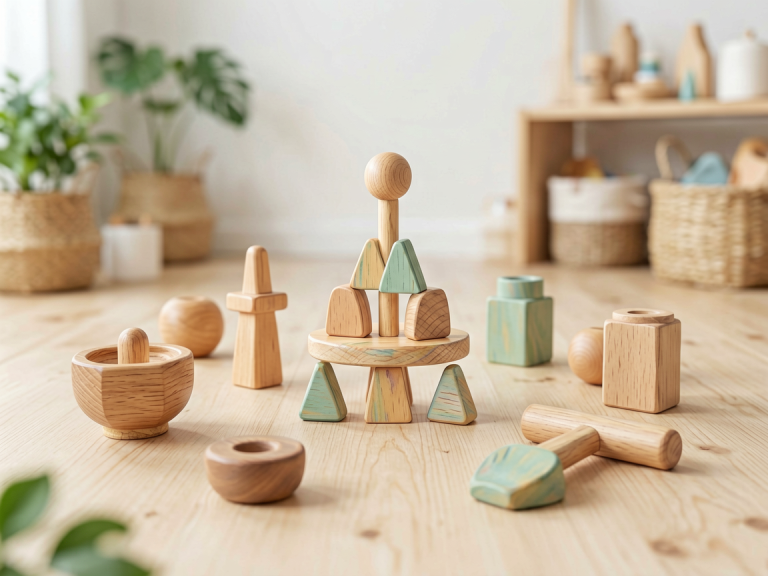
Montessori toys, in stark contrast, are almost exclusively made of natural materials—wood, cotton, sand, water, and occasionally glass or metal. They are minimalist in design, often monochromatic or subdued in colour (e.g., the red of the Long Rods or the blue and pink of the Sandpaper Letters). There are no batteries, no screens, no pre‑recorded sounds. The tactile quality is paramount: the smoothness of a wooden knob, the roughness of sandpaper textures, the weight of a brass weight. The purpose is to isolate a single concept at a time (e.g., size, texture, sound, number) without extraneous distraction. This design philosophy is predicated on the theory that a child’s attention is most deeply engaged when the environment is orderly, beautiful, and free from overwhelming stimuli.
Developmental Goals: Skills vs. Holistic Growth
Perhaps the most critical distinction lies in what each approach aims to develop in the child.
STEM toys are unabashedly skill‑oriented. They target specific competencies: logical reasoning, computational thinking, spatial visualization, measurement, and experimentation. Children who regularly engage with high‑quality STEM kits often show accelerated abilities in pattern recognition, cause‑and‑effect reasoning, and perseverance in the face of programming bugs or construction failures. However, critics argue that the narrow focus on academic and technical domains can inadvertently neglect emotional intelligence, imaginative play, and social collaboration. A child building a robotic arm may become an expert in gears but might not learn how to negotiate sharing that arm with a friend or how to express the joy of creation through art.
Montessori toys aim for holistic growth that integrates mind, body, and spirit. The Montessori materials are intentionally designed to refine fine motor skills (grasping knobs, pouring water), develop concentration (repeating an activity until mastery), and build self‑discipline (putting materials back on the shelf in order). Equally important is the cultivation of social grace, empathy, and practical life skills (e.g., using a child‑sized broom or polishing a brass tray). For instance, the “Silence Game” teaches children to control their bodies and notice ambient sounds—a far cry from the buzz of a STEM toy. Montessori proponents argue that a child who has learned to focus deeply on a simple wooden puzzle will be better prepared to tackle complex algebraic problems later, precisely because the foundation of concentration has been laid.
Practical Applications: Classroom vs. Home
The settings in which these toys are typically used also reveal their differences.
STEM toys thrive in structured environments, such as after‑school clubs, maker spaces, and tech‑focused classrooms. They are often used by groups of children working together on a common project, which can foster teamwork. However, many STEM kits are also marketed directly to parents hoping to give their children a competitive edge. At home, they can be effective if a parent has the time and patience to guide the child through failure. A common pitfall is that children may become frustrated when a circuit doesn’t light up or a code has an error, and without adult scaffolding, the toy may be abandoned.
Montessori toys, by contrast, are the cornerstone of Montessori classrooms, where children aged 3 to 6 work independently for uninterrupted 3‑hour work cycles. At home, they require a prepared environment: low shelves, accessible materials, and a parent who resists the urge to intervene. Montessori toys are less about instant gratification and more about cumulative, self‑correcting learning. A child who places the largest block at the top of the Pink Tower will see it fall—there is no external reward or punishment, only the natural consequence. This builds resilience and intrinsic motivation, but it can be slow. Parents used to the flashy results of a working robot may feel anxious when their child simply stacks and re‑stacks blocks for weeks.
Choosing the Right Approach for Your Child
There is no universally superior choice; the right answer depends on the child’s temperament, developmental stage, and learning context.
For a child who is highly kinesthetic, curious about how things work, and able to handle frustration, STEM toys can be incredibly empowering. They are particularly beneficial for children aged 5 and up who show an early aptitude for math or engineering. Conversely, for a child who is easily overwhelmed by sensory input, or who needs to develop fine motor skills and attention span, Montessori toys offer a calmer, more foundational path. Many experts recommend a hybrid approach: use Montessori materials for the early years (ages 2–5) to build sensory‑motor integration and independence, and gradually introduce STEM kits around age 6 or 7 when the child has the cognitive readiness to engage with abstract systems.
It is also wise to consider the quality of the toy. Both STEM and Montessori markets are flooded with cheap imitations. A true Montessori material is made of wood, is self‑correcting, and isolates a single concept. A good STEM toy is open‑ended, allows for multiple outcomes, and comes with adult support resources. The worst educational toys of either category are those that claim to be “interactive” but actually just entertain passively, like a plastic computer that asks multiple‑choice questions.
Conclusion
The STEM versus Montessori debate is not a battle to be won, but a spectrum to be navigated. STEM toys excel at demystifying technology and fostering analytical thinking in a world where digital literacy is non‑negotiable. Montessori toys excel at nurturing the child’s soul—their ability to focus, to love learning, to respect the environment, and to develop inner discipline. The most enlightened approach may be to see these two paradigms not as rivals but as complementary. A child who learns to code a robot on Monday and then carefully scrubs a wooden table on Tuesday is not confused; they are becoming a whole human being—one who can both program the future and care for the present. As parents and educators, our job is not to choose sides, but to provide a rich, balanced landscape of play where the wonders of science and the quiet beauty of self‑discovery can coexist.