The Ultimate Guide to the Best STEM Gifts for 2-Year-Olds: Building Brains Through Play
When it comes to choosing gifts for a two-year-old, the options can be overwhelming. Plush toys, musical instruments, picture books, and colorful stacking rings fill the shelves. But if you are looking for something that not only entertains but also lays a strong foundation for future learning, STEM gifts are the way to go. STEM—Science, Technology, Engineering, and Mathematics—is not just for older children solving algebra problems or building robots. For a two-year-old, STEM is about curiosity, exploration, cause and effect, and the sheer joy of discovering how the world works. The best STEM gifts for this age group are carefully designed to engage a toddler’s developing senses, fine motor skills, and burgeoning problem-solving abilities, all while being completely safe and age-appropriate. In this comprehensive guide, we will explore the top categories of STEM toys for two-year-olds, explain why they work, and provide specific recommendations that will delight both the child and the adults who get to watch them learn.
Why STEM Matters at Age Two
Before diving into specific gift ideas, it is important to understand the developmental context. At two years old, a child is in a period of rapid cognitive and physical growth. They are beginning to understand object permanence, experimenting with simple cause-and-effect relationships, and developing hand-eye coordination. Their vocabulary is exploding, and they are eager to imitate adults and engage in pretend play. STEM toys capitalize on these natural tendencies. Rather than forcing abstract concepts, they turn learning into a hands-on, sensory-rich experience. For example, a simple water table teaches volume, displacement, and flow. A set of stacking blocks introduces basic physics concepts like balance and gravity. A shape sorter reinforces geometry and spatial reasoning. The key is that these toys are not "educational" in a dry, worksheet sense—they are fun, messy, and deeply engaging. When a two-year-old drops a ball and watches it roll, they are conducting a physics experiment. When they fit a square peg into a square hole, they are solving a geometry puzzle. The best STEM gifts for this age harness that innate curiosity and provide structured opportunities for exploration.
Sensory Exploration and Early Science
Water and Sand Tables
One of the most powerful STEM tools for a two-year-old is a water or sand table. These simple setups allow children to experiment with materials in a controlled environment. Pouring water from one cup to another teaches concepts of volume and conservation. Adding objects that float or sink introduces density and buoyancy. Scooping and digging in sand develops fine motor control and an understanding of texture and weight. When choosing a water or sand table, look for one that is sturdy, easy to clean, and includes accessories like cups, funnels, scoops, and small boats or animals. Brands like Step2 and Little Tikes offer excellent options. To extend the learning, you can add ice cubes for a temperature lesson, or drop in small plastic toys to create a "rescue" game that builds problem-solving skills. The beauty of these tables is that they can be used indoors or outdoors, and they provide hours of open-ended play.
Sensory Bins and Loose Parts
While a water table is a large investment, sensory bins are an affordable and customizable alternative. Fill a shallow plastic bin with dried rice, beans, oatmeal, or kinetic sand. Add scoops, spoons, small containers, and a few themed objects like plastic animals or letters. This type of play is pure STEM: children are sorting, measuring, and experimenting with textures. They learn about cause and effect when they pour too much rice and it spills. They practice fine motor skills by pinching small objects. And they engage in imaginative play that sets the stage for scientific thinking. For a two-year-old, always supervise sensory bins to ensure they do not put small items in their mouths. Choose materials that are non-toxic and large enough to avoid choking hazards. A set of "loose parts"—natural items like pinecones, large shells, and smooth stones—can also be added to encourage open-ended exploration.
Engineering and Building: The Foundation of Spatial Reasoning
Large Building Blocks
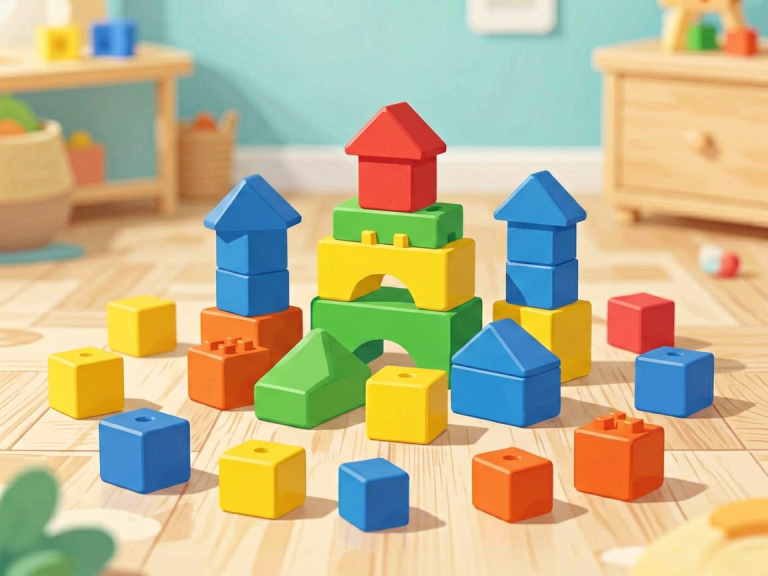
Building blocks are a timeless STEM gift, and for good reason. A set of large, lightweight blocks—such as those made by Mega Bloks, Melissa & Doug, or foam blocks—allows a two-year-old to stack, knock down, and rebuild. This seemingly simple activity teaches balance, gravity, and structural integrity. When a tower falls, the child learns that the base must be wider or the blocks need to be aligned properly. They also develop hand-eye coordination and spatial awareness as they figure out how to fit blocks together. Look for blocks that are large enough to be safe (no smaller than 2 inches in any dimension) and easy to grasp. Some sets include shapes like arches, triangles, and cylinders, which introduce basic geometry. To make it more engaging, you can build simple structures and ask the child to copy them, or let them create their own designs while narrating what they are doing.
Magnetic Tiles
Magnetic tiles have become a modern classic in the world of STEM toys, and they are surprisingly appropriate for two-year-olds when chosen carefully. The best sets for this age feature large, chunky tiles with strong magnets encased in plastic. Children can attach them to each other to create flat shapes or three-dimensional structures like houses, towers, and tunnels. The magnetic connection provides immediate feedback—the tiles click together satisfyingly—and the transparent colors allow children to see how the magnets work. This builds an intuitive understanding of magnetic attraction and repulsion, as well as geometry and symmetry. Brands like Magna-Tiles and Picasso Tiles offer sets with large pieces that are safe for toddlers. Always supervise magnetic play to ensure no pieces are swallowed, but with proper supervision, these tiles can provide years of learning.
Technology and Simple Machines
Cause-and-Effect Toys
Technology for a two-year-old should never involve screens; instead, it should focus on mechanisms that demonstrate cause and effect. Toys with buttons, levers, gears, and switches are perfect. For example, a simple wooden gear set where turning one gear makes another spin teaches mechanical relationships. A ball run or marble track—with large, safe balls and wide chutes—demonstrates gravity and trajectory. A toy lawn mower that makes popping sounds as it rolls shows the connection between motion and sound. These toys help a child understand that their actions have predictable outcomes, which is the essence of scientific reasoning. Look for toys that are sturdy and have no small parts that could break off. The "Battat Bristle Blocks" or "Learning Resources Gears! Gears! Gears!" sets are excellent choices, though ensure the pieces are large enough for a two-year-old.
Musical and Light-Up Exploration
While not traditionally "tech," toys that combine sound and light with physical interaction are a wonderful entry point for technology understanding. A simple xylophone or a set of colorful drums teaches about vibrations and sound waves. Light-up toys that respond to touch—like a touch-sensitive lamp or a ball that glows when rolled—introduce basic circuits and sensors. For a two-year-old, the goal is not to explain electricity but to let them discover that pressing a button makes a light turn on. This builds a mental model of control and feedback. Choose toys with bright, primary colors and soft, safe materials. Avoid anything with flashing lights that could overstimulate.
Mathematics: Patterns, Sorting, and Counting
Shape Sorters and Puzzles
Shape sorters are a classic STEM toy that teaches geometry and problem-solving. A two-year-old must recognize the shape, rotate it, and insert it into the corresponding hole. This builds spatial reasoning, fine motor skills, and persistence. Look for sorters with knobs on the pieces for easy gripping, and with shapes that are simple (circle, square, triangle) as well as more advanced (star, hexagon, cross). Some shape sorters also include a lid that opens and closes, adding an element of surprise. Puzzles with large, chunky pieces are also excellent. A three-piece puzzle of a car or an animal helps a child understand that parts fit together to make a whole, which is a foundational math concept.
Stacking and Nesting Toys
Stacking rings, nesting cups, and stacking towers introduce concepts of size, order, and seriation. When a child tries to stack rings from largest to smallest, they are practicing ordinality and measurement. Nesting cups that fit inside one another teach volume and size relationships. These toys also encourage problem-solving: if the rings are stacked in the wrong order, the tower will wobble or fall. The child must adjust their strategy. Choose sets that are brightly colored and have different textures or patterns to engage multiple senses. Melissa & Doug and Fisher-Price offer excellent stacking toys.
Counting and Number Play
At age two, children are not ready for formal counting, but they can begin to associate numbers with quantities. A toy that has numbered buttons or dials, or a simple abacus with large beads, can introduce the concept of "more" and "less." For example, an abacus where children slide beads from one side to the other gives them a visual and tactile representation of numbers. A counting caterpillar where each segment is a different color and number helps with one-to-one correspondence. Keep it playful—do not quiz the child; let them explore freely. The goal is to build familiarity and comfort with numbers.
Outdoor and Physical STEM
Ride-On Toys and Balance Bikes
STEM is not confined to the indoors. A balance bike—a bicycle without pedals—is an engineering marvel for a toddler. It teaches physics principles like center of gravity, balance, and momentum. As the child glides, they learn to steer, lean, and control speed. This early exposure to physical mechanics builds confidence and prepares them for a pedal bike later. Other ride-on toys, like a small wagon or a push car, also teach cause and effect: pushing harder makes the toy go faster, and steering changes direction. Look for ride-on toys with wide bases for stability and no sharp edges.
Gardening and Nature Exploration
A simple child-sized gardening set—a small trowel, a watering can, and a pair of gloves—introduces biology and ecology. Planting seeds, watering them, and watching them grow teaches life cycles, photosynthesis, and the needs of living things. Even a two-year-old can help dig a hole, drop in a seed, and cover it with soil. They learn patience and observation. A magnifying glass (with a wide, plastic lens) allows them to examine leaves, bugs, and rocks up close, fostering scientific observation skills. Nature walks where you collect leaves, sticks, and pinecones turn into impromptu sorting and classification games. These activities are free, but a gift that provides the tools for exploration is invaluable.
Safety and Selection Tips
When choosing any STEM gift for a two-year-old, safety is paramount. Always check the age recommendation on the packaging. Avoid toys with small parts that could be choking hazards—anything smaller than a toilet paper tube should be used with supervision. Look for toys made of non-toxic materials, with smooth edges and no sharp points. Batteries should be securely enclosed. Also consider the child’s temperament: some toddlers love loud, active toys, while others prefer quiet, focused play. Choose gifts that match the child’s current interests. Finally, remember that the best STEM gift is often the simplest one. A cardboard box can be a rocket ship, a castle, or a car. Combine that with a few blocks and a measuring cup, and you have a complete STEM laboratory.
Conclusion: The Gift of Curiosity
The best STEM gifts for two-year-olds are not about teaching advanced concepts; they are about nurturing a mindset of curiosity, experimentation, and joy. Every time a toddler drops a ball, stacks a block, or fills a cup with water, they are building neural connections that will serve them for a lifetime. As you select gifts, think beyond the immediate entertainment value. Consider how a toy encourages exploration, problem-solving, and creativity. Whether it is a water table, a set of magnetic tiles, a balance bike, or a simple shape sorter, the right STEM gift can spark a love for learning that lasts far beyond the toddler years. So go ahead—give the gift of discovery. Your two-year-old will thank you with every smile, every "wow," and every newly constructed tower that stands just a little bit taller than the one before.