Top Educational Toys for 2-Year-Olds: Nurturing Growth Through Play
Introduction
The second year of life is a whirlwind of discovery. At age two, children are transitioning from passive observers into active explorers who crave independence, language, and problem-solving. Their brains are forming more than 700 neural connections per second, making every interaction a potential learning moment. Choosing the right educational toys can harness this rapid development, turning playtime into a powerful tool for cognitive, motor, social, and emotional growth. However, not all toys labeled “educational” deliver genuine learning opportunities. The best toys for two-year-olds are those that align with their natural curiosity, support emerging skills, and, most importantly, are safe and engaging. This article explores the key developmental areas for toddlers and recommends specific types of toys that foster growth while keeping little hands and minds happily occupied.
—
The Cognitive Benefits of Educational Toys for Toddlers
From ages two to three, children begin to understand cause and effect, develop memory, and practice simple reasoning. Educational toys that challenge these abilities help build a strong foundation for later learning.
Shape sorters and simple puzzles are classic cognitive toys. A two-year-old learns to match shapes to corresponding holes, which requires visual discrimination, spatial awareness, and problem-solving. When a square block doesn’t fit into the round hole, the child must try again—a lesson in persistence and logical thinking. Similarly, jigsaw puzzles with just a few large pieces teach pattern recognition and the concept of part-to-whole relationships.
Stacking and nesting toys (like rings on a peg or colorful cups that fit inside each other) introduce concepts of size, order, and seriation. The toddler discovers that the largest ring must go on the bottom to build a stable tower, or that small cups nest inside larger ones. These actions reinforce mathematical thinking before numbers are even introduced.
Cause-and-effect toys—such as a hammer-and-bench set where hitting a peg makes another pop up, or a pull-back car that zooms forward—teach toddlers that their actions produce predictable outcomes. This understanding is crucial for later scientific reasoning. Look for toys that offer clear, immediate feedback without overstimulation.
—
Top Picks for Sensory and Motor Skill Development
Fine and gross motor skills explode during the second year. Two-year-olds are learning to run, jump, climb, and manipulate small objects with increasing precision. Toys that engage both large muscle groups and hand-eye coordination are essential.
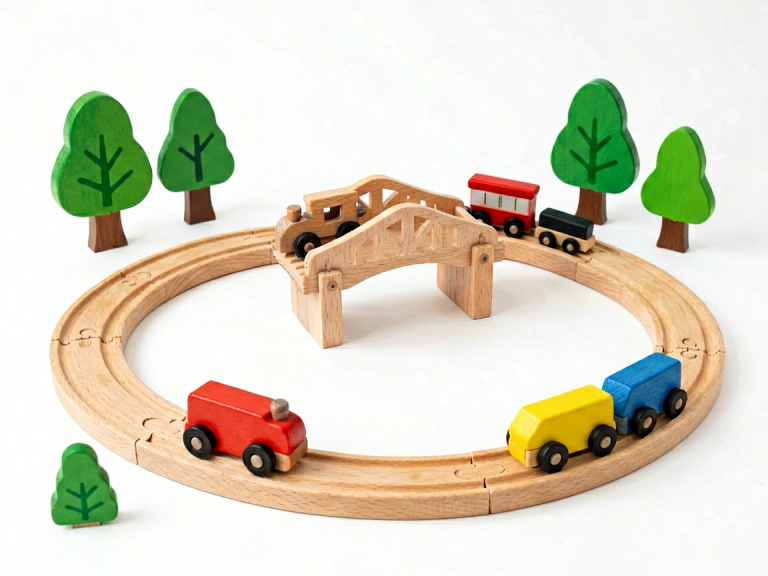
Push-and-pull toys (like a wooden wagon or a toy lawn mower) encourage walking and balance. As a toddler pulls a string of blocks behind her, she practices coordinating her steps while maintaining grip and direction. These toys also build arm and leg strength.
Ride-on toys without pedals (such as balance bikes or small scooters) help develop leg muscles and spatial awareness. Pushing with feet and steering teaches the child how to control movement, which is a precursor to pedaling and later cycling.
Building blocks (especially large, lightweight ones) are superb for fine motor development. Stacking requires a pincer grasp, wrist rotation, and careful placement. Beyond motor skills, blocks encourage creativity—a tower can become a castle, a bridge, or simply a satisfying crash.
For sensory play, textured balls, play dough, and water/sand tables offer tactile stimulation. Rolling play dough into a snake strengthens hand muscles, while scooping sand improves bilateral coordination (using both hands together). These activities also soothe and focus toddlers, providing a calming outlet for high energy.
—
Language and Communication Toys That Spark Conversation
At two, most children have a vocabulary of 50 to 200 words and are beginning to combine them into short phrases. Educational toys that promote language development do so by creating natural opportunities for dialogue.
Picture books with sturdy pages are the quintessential language toy. Reading together exposes toddlers to new vocabulary, sentence structure, and storytelling. Choose books with simple, repetitive text and vivid illustrations. Pointing at a picture and saying “dog” encourages the child to repeat the word, while asking “Where’s the ball?” builds comprehension. Board books with flaps or touch-and-feel elements add an interactive layer that keeps attention.
Pretend-play sets (such as a toy phone, kitchen set, or doctor’s kit) invite imitation of adult conversations. When a toddler says, “Hello, Mommy” into a plastic phone, she is practicing turn-taking in dialogue. Playing with a play kitchen encourages naming foods (“apple,” “cup”) and simple actions (“stir, pour”). These toys also support social-emotional skills as the child acts out real-life scenarios.
Musical instruments like maracas, tambourines, or a small xylophone introduce rhythm and new vocabulary (“shake,” “loud,” “soft”). Singing along to simple songs reinforces phonemic awareness and helps toddlers learn sounds. Even more, making music together with a parent or sibling fosters bonding and shared attention.
Flashcards are not typically recommended for forced memorization, but animal or object flashcards used in a playful way can be effective. Hold up a card featuring a cow and say “moo”—the child may later try the sound. Avoid drilling; instead, turn it into a game of naming what they see.
—
Creative and Imaginative Play Toys
Imagination blossoms at age two. Children begin to engage in symbolic play—using a block as a phone or a blanket as a cape. This type of play is crucial for cognitive flexibility, empathy, and problem-solving.
Dollhouses and action figures (with no small parts that pose a choking hazard) allow toddlers to create stories. They can put a doll to bed, feed it, or drive it in a tiny car. Through these narratives, children explore emotions, relationships, and daily routines.
Art supplies like chunky crayons, washable markers, and large sheets of paper encourage self-expression. Scribbling may look random, but it develops pre-writing skills and hand strength. Later, drawing a circle or a line represents the child’s attempt to represent ideas. Finger painting adds a sensory component that many two-year-olds adore.
Dress-up clothes (simple hats, scarves, or child-sized vests) transform a toddler into a firefighter, a princess, or a doctor. This role-play builds language, social awareness, and creativity. Importantly, it also gives the child a sense of control over their world—a powerful feeling at an age when so much is decided by adults.
Construction sets like large interlocking blocks or magnetic tiles encourage open-ended building. Unlike puzzles, there is no right or wrong way to play. A toddler may simply stack two blocks and call it a “cake,” or connect a few squares into a “house.” This freedom nurtures divergent thinking, which is the foundation of innovation.
—
How to Choose the Right Toy for Your 2-Year-Old
With countless products on the market, selecting educational toys can feel overwhelming. Here are key criteria to keep in mind:
- Safety first. Avoid toys with small parts that can be swallowed, sharp edges, or long cords that pose strangulation risks. Check for non-toxic materials (BPA-free, lead-free) and sturdy construction. The American Academy of Pediatrics recommends that toys for this age be at least 1.25 inches in diameter to prevent choking.
- Open-ended over single-purpose. A toy that can be used in multiple ways (blocks, play dough) offers longer-lasting educational value than a toy that does only one thing (e.g., a battery-operated singing robot). Open-ended toys encourage creativity and adapt as the child’s skills grow.
- Appropriate challenge level. The toy should be just slightly beyond the child’s current ability—not so easy that it bores, not so hard that it frustrates. A two-year-old who can stack two blocks should try stacking four; a pincer grip just developing can handle larger beads for threading.
- Minimize electronic distractions. While some electronic toys have educational apps, many overstimulate toddlers with flashing lights and sounds, reducing the need for active thinking. Simple, hands-on toys typically engage deeper cognitive processing.
- Follow the child’s lead. Observe what your toddler enjoys. If they love moving, prioritize ride-on toys. If they are fascinated by details, choose puzzles or sorting games. The best toy is one the child actually wants to play with repeatedly.
—
Conclusion
The best educational toys for two-year-olds are not necessarily the most expensive or high-tech. They are tools that invite curiosity, challenge growing skills, and spark joy. From stacking blocks that teach physics to a simple phone that fuels language, each toy plays a role in shaping a toddler’s understanding of the world. By choosing toys that support cognitive development, motor skills, language, and imagination, parents and caregivers can transform everyday play into a rich learning experience. Remember that the most important “toy” is the engaged adult who plays alongside—asking questions, narrating actions, and sharing the delight of discovery. With thoughtful selection and loving interaction, play becomes the foundation for a lifetime of learning.