Unlocking Your Newborn’s Potential: The Best Puzzle Toys for the First Months
The first few months of a baby’s life are a whirlwind of rapid neurological growth, sensory awakening, and motor skill development. While the word “puzzle” might conjure images of jigsaw pieces or complex logic games, for newborns, a puzzle toy is any object that invites exploration, problem-solving, and cause-and-effect learning in the gentlest, safest way possible. Unlike older infants who can manipulate shapes and sort objects, newborns rely on their innate reflexes, budding vision, and tactile curiosity to engage with their environment. Choosing the best puzzle toys for newborns requires understanding that these toys should stimulate without overwhelming, challenge without frustrating, and above all, be completely safe for tiny mouths and delicate hands. In this article, we will explore the top categories of puzzle toys designed specifically for newborns, explaining how each supports key developmental milestones and why they deserve a place in your baby’s nursery.
The Sensory Foundation: High-Contrast Visual Puzzles
At birth, a newborn’s vision is blurry and limited to about 8–12 inches – the perfect distance for a parent’s face. Their retinas are still developing, and they are most responsive to high-contrast patterns, especially black, white, and red. Puzzle toys in this category are not traditional puzzles but rather visual stimulation kits that encourage focus, tracking, and early problem-solving. Look for soft fabric books or cards featuring bold geometric shapes, checkerboards, and simple faces. When a newborn stares at a black-and-white spiral mobile or a set of contrast cards, they are essentially “solving” the puzzle of visual perception: learning to differentiate edges, track movement, and make sense of their visual world. These toys promote visual acuity and attention span, and they are often the first puzzle experience a baby can engage with independently. The best ones are washable, free of sharp corners, and can be placed in a diaper bag or hung on a baby gym. For an extra layer of engagement, choose contrast puzzles that include crinkle textures or gentle mirrors, adding a tactile and self-discovery element that keeps the baby’s attention longer.
Tactile and Auditory Exploration: Soft Sensory Blocks and Crinkle Toys
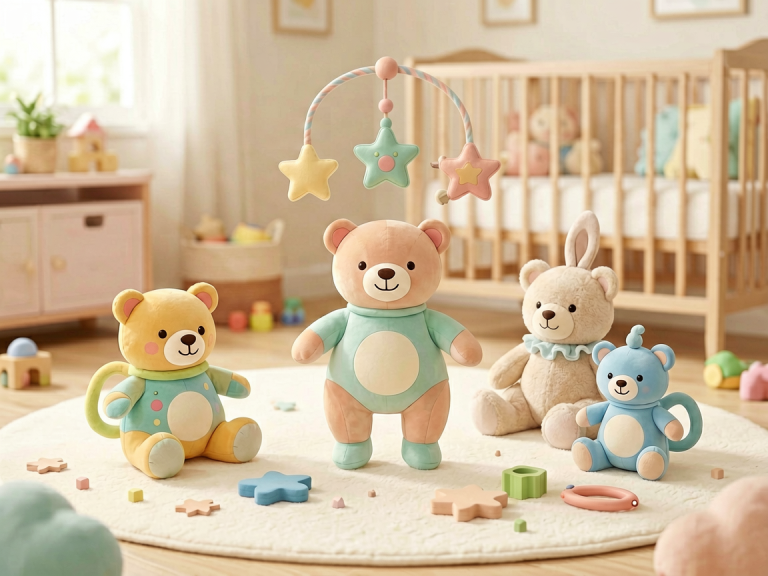
As a newborn’s grasp reflex begins to mature, they instinctively clutch objects placed in their palms. Soft, lightweight puzzle toys that combine texture, sound, and simple shapes are ideal for this stage. Consider fabric cubes or blocks that are filled with tissue paper, rattles, or squeakers. These are not rigid wooden blocks; they are squishable, chewable, and safe for flailing arms. While a newborn cannot yet stack or sort, the act of holding, squeezing, and releasing these toys is a fundamental puzzle: “What happens when I squeeze? It makes a sound!” This cause-and-effect discovery is the earliest form of cognitive problem-solving. Some puzzles in this category come with attached ribbons or loops that encourage batting and swiping, helping to develop hand-eye coordination. For example, a soft activity cube with a different texture on each side – smooth silk, bumpy corduroy, crinkly plastic – presents a multi-sensory puzzle that invites the baby to explore through touch and sound simultaneously. Always choose toys that are machine washable, have no loose parts that could become a choking hazard, and are made from non-toxic materials.
Motion and Cause-Effect: Activity Gyms and Hanging Puzzle Racks
An activity gym is essentially a puzzle playground for a newborn. The curved arch holds hanging toys that dangle just within reach, prompting the baby to bat, swipe, and eventually grasp. The best puzzle toys for newborns in this category include ones that react to movement: a soft rattle that jingles when tapped, a mirror that reflects the baby’s own face (a fascinating puzzle of self-recognition), or a ring that spins when brushed. Each of these hanging elements is a mini-puzzle: “How do I make that noise again? What happens if I hit this one instead?” Over time, the baby learns to intentionally target specific toys, developing motor planning and problem-solving skills. Some activity gyms offer detachable puzzle mats with high-contrast patterns and different textures, so the baby can also enjoy tummy time while solving visual and tactile puzzles. When selecting a gym, ensure the structure is stable, the toys are securely attached, and the fabrics are soft and washable. For newborns, the best puzzle is one that gradually reveals its mechanics – a toy that responds consistently to touch helps build a sense of control and predictability, which is the foundation of logical thinking.
Self-Discovery Puzzles: Mirrors and Facial Recognition Toys
One of the most profound puzzles for a newborn is the human face – especially their own. Puzzle toys that incorporate safe, shatterproof mirrors are exceptional tools for social and cognitive development. A baby gazing at their reflection is not just seeing a moving image; they are gradually solving the puzzle of identity: “That person moves when I move. Is that me?” This early self-recognition is a complex cognitive leap. Look for floor mirrors with soft, padded frames that can prop up during tummy time, or mirror panels attached to activity mats. Some toys combine a mirror with high-contrast frames or dangling beads that the baby can touch, creating a multi-layered puzzle where the baby must coordinate visual tracking with reaching. Additionally, soft plush toys with embroidered or printed faces – wide eyes, a simple smile – serve as puzzles for emotional recognition. A newborn may stare intently at these faces, learning to distinguish features and emotions, which is the precursor to social interaction. When choosing mirror-based puzzles, ensure they are made from acrylic (not glass), and that the frame is thick enough to prevent bending or breaking.
Auditory Puzzles: Rattles, Bells, and Shakers with Purpose
While any rattle is fun, puzzle-oriented rattles add an extra layer of cognitive challenge. The best auditory puzzle toys for newborns are those that require the baby to produce a sound intentionally – for example, a fabric wrist band with a jingle bell, or a soft gripping toy that only rings when squeezed in a certain way. Some sets include several small shakers with different sounds (soft jingle, loud rattle, crinkle) so that the baby can, over time, begin to discriminate between them. This is auditory discrimination, a key early math and language skill. Another excellent puzzle is a “sound tube” – a clear, sealed cylinder with beads that moves when tilted. Even though a newborn cannot actively control the tilt, when the parent shifts the tube during play, the baby learns to follow the moving objects with their eyes and associate movement with sound. For maximum benefit, choose rattles that are ergonomic for tiny hands, easy to grasp, and free from sharp edges. Avoid anything with small beads that could spill out if broken.
Safety and Age Considerations: What to Avoid
When selecting puzzle toys for newborns, safety is paramount. The American Academy of Pediatrics recommends avoiding any toy with small parts that could fit through a toilet paper tube (a choking hazard), strings longer than 12 inches (strangulation risk), or loud noises that could damage a baby’s delicate hearing. All materials should be BPA-free, phthalate-free, and free from lead or other toxins. Additionally, avoid puzzles that require fine motor skills beyond a newborn’s capacity – such as small pegs, sharp edges, or pieces that must be inserted precisely. Newborns explore primarily through mouthing, so any puzzle toy must be large enough not to be swallowed, and should be easy to clean. Look for certifications like ASTM or CPSC compliance. Finally, remember that a newborn’s attention span is very short – minutes at a time. The best puzzle toy is one that can be engaged with briefly, then put aside without frustration. Rotating toys every few days helps maintain novelty and interest.
Making Play Time Interactive: The Role of the Caregiver
No puzzle toy can replace the warmth and engagement of a caregiver. For newborns, the true magic happens when an adult presents the toy, describes what is happening, and responds to the baby’s cues. For example, while holding a high-contrast card, slowly move it left and right, saying, “Look at the black and white smiley face! Can you follow it?” This turns the visual toy into an interactive puzzle of tracking. When the baby accidentally bats a hanging toy and hears a jingle, celebrate with exaggerated joy: “You made the bell ring! That’s so clever!” This positive reinforcement encourages the baby to repeat the action, solidifying the cause-and-effect connection. Caregivers can also create simple DIY puzzle toys, like a sock filled with rice and tied securely (for auditory and tactile stimulation), or a cardboard tube covered in contrasting patterns. The goal is not to overwhelm the newborn with dozens of options, but to provide a few carefully chosen puzzle toys that spark curiosity and encourage the earliest forms of problem-solving.
Conclusion: Choosing Quality over Quantity
The best puzzle toys for newborns are not the most expensive or the most complex; they are the ones that align perfectly with a baby’s developmental stage. Visual contrast cards, soft sensory blocks, activity gyms with responsive elements, infant-safe mirrors, and purposeful rattles all offer age-appropriate puzzles that build the neural pathways for attention, coordination, and logical thinking. As your newborn grows, these initial puzzles lay the groundwork for more advanced play – shape sorters, stacking rings, and eventually jigsaw puzzles. By investing in a small collection of high-quality, safe, and stimulating puzzle toys, you are giving your baby the gift of early learning wrapped in joy. Remember to follow your baby’s lead: if they seem frustrated or overstimulated, put the toy away and try again later. The puzzle of infancy is best solved slowly, with patience, love, and a gentle hand.