Unlocking Potential: The Best Learning Toys for 7-Year-Olds
Introduction
At the age of seven, children stand at a fascinating crossroads of development. They have left behind the pure fantasy of early childhood and are now stepping into a world of logic, rules, and structured thinking. Their cognitive abilities are blossoming: they can understand cause and effect, solve simple math problems, read fluently, and follow multi-step instructions. Yet they still crave play—the kind that is imaginative, hands-on, and social. This is precisely why learning toys for 7-year-olds are so powerful. Unlike passive entertainment, well-designed educational toys engage a child’s natural curiosity, turning playtime into a rich learning experience. The right toy can sharpen critical thinking, nurture creativity, build emotional resilience, and even strengthen social bonds. But with an overwhelming array of options on the market, how do parents and educators choose wisely? This article explores the key categories of learning toys that suit the developmental needs of a seven-year-old, explains why they work, and offers practical guidance for selecting the best ones.
The Cognitive Leap at Age Seven: What Makes Learning Toys Essential
By age seven, most children have developed what psychologists call “concrete operational thinking.” They can mentally manipulate objects, understand conservation (that the amount of water remains the same even if poured into a different-shaped glass), and classify items by multiple attributes. Their attention span has lengthened to about 15–20 minutes for a focused task, and they begin to enjoy games with rules, challenges, and goals. Furthermore, seven-year-olds are increasingly aware of peer relationships and often engage in cooperative play.
Learning toys that cater to this stage do more than just teach a single skill—they integrate multiple domains. For instance, a construction set that requires following a blueprint trains spatial reasoning, reading comprehension, and fine motor control simultaneously. A board game that involves dice and money teaches arithmetic while promoting turn-taking and emotional regulation. The best toys for seven-year-olds are therefore those that challenge without causing frustration, encourage persistence, and allow for open-ended exploration alongside structured tasks. They should also spark a sense of accomplishment, because at this age, self-esteem is closely tied to mastery.
Top Categories of Learning Toys for 7-Year-Olds
1. STEM Building Kits: Engineering the Future
STEM (Science, Technology, Engineering, Math) toys are particularly valuable for seven-year-olds because they transform abstract concepts into tangible experiences. Magnetic tile sets, like Magna-Tiles, allow children to build 3D structures while intuitively learning about geometry, symmetry, and stability. More advanced options include gears and pulleys kits, which introduce simple machines and mechanical advantage. For example, a Kid K’NEX set for building a working Ferris wheel teaches cause and effect—turning one gear makes the whole structure rotate.
Another standout is the Snap Circuits Junior kit, where children snap electronic components onto a plastic grid to create working circuits that power lights, buzzers, and fans. This type of toy demystifies electricity and fosters a “tinkering” mindset. Seven-year-olds often enjoy the repetition of testing different configurations, which builds scientific thinking: hypothesizing, testing, observing, and adjusting. Moreover, STEM kits often come with challenges or project ideas, giving children a clear goal while leaving room for creativity.
2. Language and Literacy Games: Building Readers and Writers
Reading fluency is a major milestone at age seven. Children move from decoding words to comprehending complex sentences and stories. To support this growth, learning toys that combine literacy with play are excellent. One popular category is construction-based word puzzles, such as “Magnetic Poetry for Kids” or “Scrabble Junior.” These toys encourage children to form sentences, recognize spelling patterns, and expand vocabulary in a low-pressure setting.
Board games like “Boggle Jr.” or “Zingo! Word Builder” turn word recognition into a fast-paced, social activity. Another highly effective tool is a subscription box that pairs a physical book with a hands-on activity. For instance, a treasure-hunt-style game that requires reading clues to find hidden objects can dramatically boost a child’s motivation to read. Additionally, storytelling kits—like sets of picture cards or story cubes—spark narrative thinking and oral language skills. By rolling dice with pictures and inventing a story, seven-year-olds practice sequencing, descriptive language, and creativity.
3. Creative Arts and Craft Kits: Expressing and Problem-Solving
Creativity is not just about art; it is a cognitive process that involves planning, experimentation, and reflection. For seven-year-olds, arts and crafts kits that offer guided projects with open-ended variations are ideal. Take, for example, a “Make Your Own Soap” or “Candle Making” kit. Following the instructions teaches procedural thinking, while choosing colors and scents allows personal expression. Similarly, weaving looms, friendship bracelet kits, or “Pottery Wheel” sets require fine motor coordination and patience.
One particularly innovative category is “circuit art” kits, where children use conductive tape and LED lights to make their drawings glow. This blends artistic expression with basic electronics, appealing to both the right and left hemispheres of the brain. For some seven-year-olds, process art—where the focus is on the experience rather than a perfect outcome—can be deeply calming. Others thrive on kits that produce a functional item, like a homemade birdhouse or a working catapult, giving them a concrete sense of achievement.
4. Strategy Board Games: Sharpening Logical Thinking
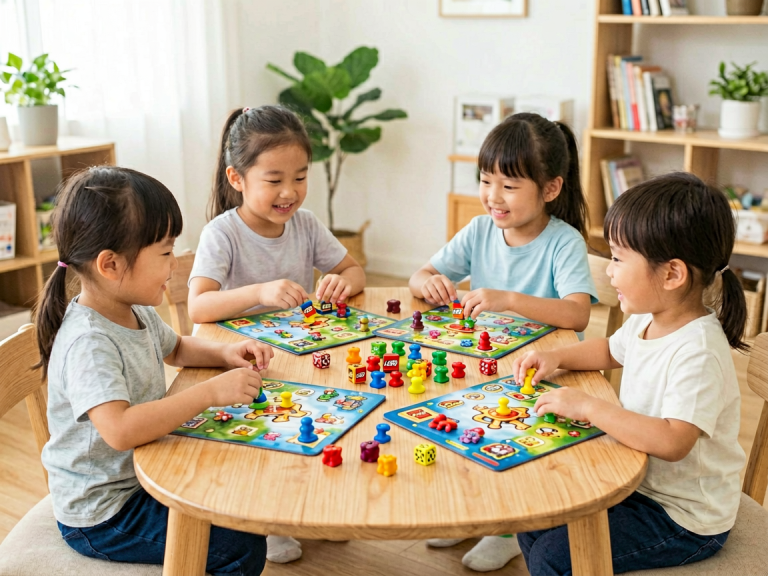
Board games have stood the test of time for good reason. They teach turn-taking, sportsmanship, strategic planning, and flexible thinking. For seven-year-olds, games that involve a moderate level of strategy without being overly complex are perfect. “Ticket to Ride: First Journey” is a simplified version of the classic route-building game; children collect train cards and claim routes across a map, learning geography and basic probability. “Blokus” is a geometric tile-placement game that demands spatial awareness and forward planning. “DragonWood” is a cooperative game where players work together to protect a magical forest, fostering collaboration and empathy.
Many modern board games also incorporate math skills naturally. “Sum Swamp” uses dice and addition/subtraction to move along a board; “Money Bags” teaches coin values and making change. The social aspect is equally important: a child learns to handle disappointment when they lose and to celebrate others’ successes. These emotional skills are as valuable as academic ones.
5. Logic Puzzles and Brain Teasers: Training the Mind
Puzzles that require deduction, pattern recognition, and systematic thinking are excellent for seven-year-olds. Rubik’s Cubes designed for young children (with fewer squares and simpler mechanisms) introduce the concept of algorithms in a playful way. 3D wooden puzzles, like interlocking animal shapes or brain teaser ring puzzles, challenge fine motor skills and perseverance.
Another wonderful category is “maze books” or “labyrinth” games where children must guide a marble through a tilting board. These develop hand-eye coordination and concentration. Logic grid puzzles, such as “Logic Links” or “Clue Jr.,” require children to read clues and deduce the correct arrangement of items. These activities build critical thinking and can be done solo or with a partner.
How to Choose the Right Learning Toys for Your 7-Year-Old
With so many options, selection can be daunting. The following criteria can help:
- Follow their interests. A child who loves dinosaurs might engage more with a fossil-digging kit than with a coding robot. Intrinsic motivation is the strongest driver of deep learning.
- Balance challenge and skill. A toy that is too easy will bore; one that is too hard will frustrate. Look for toys with adjustable difficulty levels or open-ended possibilities.
- Prioritize open-ended play. Toys that can be used in multiple ways—like building blocks, craft materials, or a deck of cards—offer more long-term value than single-function gadgets.
- Consider the social context. Does your child prefer independent play or playing with friends? Choose accordingly. Cooperative games are wonderful for building teamwork, while solo puzzles build independence.
- Check for durability and safety. Seven-year-olds can be rough on toys. Opt for sturdy materials, and always verify that paints and plastics are non-toxic.
- Limit screen-based toys. While there are excellent educational apps, physical toys that require manipulation, movement, and face-to-face interaction are particularly important for this age group.
Conclusion
Learning toys for 7-year-olds are far more than just “educational” gadgets—they are tools that shape the way a child thinks, feels, and relates to the world. A well-chosen toy can ignite a passion for science, transform a reluctant reader into a book lover, or teach a child how to lose gracefully. The key is to look beyond the packaging and flashy claims, and to focus on the toy’s ability to engage the child’s mind in a meaningful way. Whether it is a construction set that sparks engineering curiosity, a board game that teaches negotiation, or a craft kit that encourages creative problem-solving, the best learning toy is one that makes a child forget they are learning at all. As parents, educators, and caregivers, we have the privilege of selecting these tools—and watching, with awe, as our seven-year-olds grow into curious, capable, and resilient learners.