Unlocking Words Through Blocks: The Best Building Toys for Language Development
Introduction
Language development is one of the most critical milestones in early childhood, laying the foundation for literacy, social connection, and cognitive growth. While reading books and engaging in conversation are widely recognized as essential, an often-overlooked catalyst for language learning is play—specifically, play with building toys. From classic wooden blocks to advanced magnetic tiles, building toys offer a unique, hands-on environment where children naturally practice vocabulary, sentence structure, narrative skills, and social communication. Unlike passive screen-based activities, building toys demand active problem-solving, spatial reasoning, and, most importantly, verbal interaction. This article explores the best building toys for language development, explaining how each type fosters specific linguistic competencies and providing practical insights for parents, educators, and speech-language professionals. By understanding the mechanisms behind these toys, we can deliberately select and use them to turn playtime into a rich language-learning laboratory.
—
The Linguistic Magic of Construction Play: Why Building Toys Work
Before diving into specific products, it is essential to understand why building toys are so effective for language development. The key lies in the reciprocal nature of construction play. When a child stacks blocks, connects magnetic rods, or snaps together interlocking bricks, they are inherently engaging in a process that demands planning, description, and communication. This process naturally elicits what linguists call “self-talk” or “private speech”—the internal dialogue that guides action. For example, a child might murmur, “I need a red block next,” or “This tower is too tall; it will fall.” This self-directed speech strengthens neural pathways related to language production and cognitive self-regulation.
Moreover, building toys often involve shared attention when played with peers or adults. A parent or sibling might say, “Look, you made a bridge! What goes over the bridge?” Such prompts invite the child to respond, expanding vocabulary (e.g., “bridge,” “car,” “goes under”) and grammatical complexity. The open-ended nature of building toys also encourages decontextualized language—the ability to talk about things that are not immediately present. A child who builds a castle may later describe it to a grandparent, using words like “tower,” “drawbridge,” and “knight.” This skill is directly correlated with later reading comprehension and academic success.
Research from the field of developmental psychology, such as studies by Dr. Karen Wohlwend and others, has shown that block play is associated with higher scores on measures of phonological awareness, vocabulary, and narrative ability. The tangible, three-dimensional quality of building toys provides concrete referents for abstract concepts: “balance,” “weight,” “symmetry,” “support.” Children learn these words not through rote memorization but through embodied experience—a principle that aligns with the theory of embodied cognition. Therefore, the best building toys for language development are those that maximize opportunities for verbal interaction, open-ended creativity, and collaborative problem-solving.
—
Open-Ended Wooden Blocks: The Foundation of Vocabulary and Descriptive Language
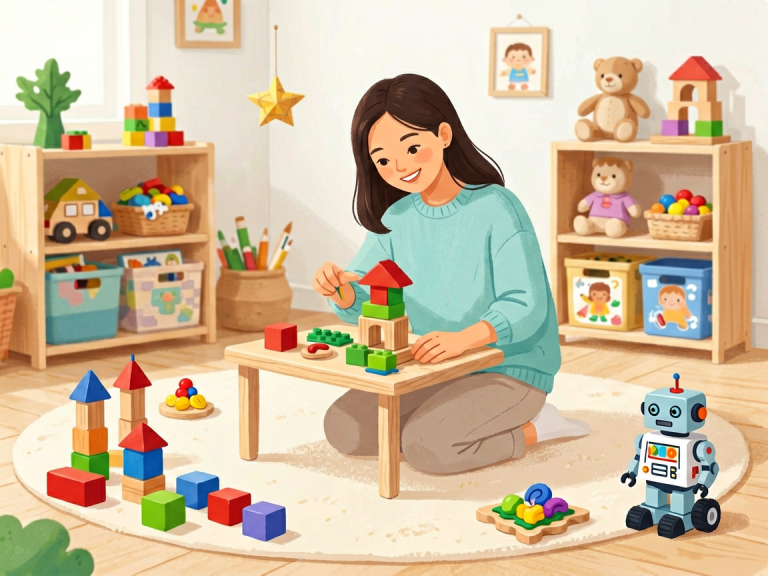
Wooden unit blocks are the quintessential building toy, and for good reason. Their simplicity is their genius. Unlike sets with predetermined instructions, wooden blocks (such as those made by Melissa & Doug, Grimm’s, or traditional classroom unit blocks) have no fixed purpose. This ambiguity forces children to invent structures and, in doing so, generate language to describe their creation. A child who builds a “house” for a toy animal must name the parts: “roof,” “door,” “window.” As they play, they naturally practice prepositions (“on top of,” “under,” “beside”), adjectives (“big,” “small,” “heavy,” “stable”), and action verbs (“stack,” “balance,” “knock down”).
Perhaps the most powerful linguistic feature of wooden blocks is the opportunity for collaborative storytelling. When two children build together, they must negotiate: “Let’s put the blue block here first,” “No, we need a flat one for the floor.” This negotiation requires turn-taking, polite request forms (“Can I have that?” “Please pass the small one”), and argumentation (“If we put that there, it will fall”). All of these exchanges are goldmines for pragmatic language development—the social use of language.
Furthermore, wooden blocks can be used to teach sequence and order—key components of narrative language. A caregiver can prompt, “First we built the foundation, then we added the walls. What should we do next?” This scaffolds a child’s ability to recount events in temporal order, a skill essential for storytelling. For children with language delays, the concrete nature of blocks allows them to physically demonstrate what they might struggle to verbalize, reducing frustration and building confidence.
Recommendation: Invest in a set of unpainted, natural wooden blocks in various shapes (rectangles, squares, triangles, cylinders, arches). Avoid sets with letters or numbers printed on them, as these can distract from open-ended play. The plain surface encourages imaginative naming and description.
—
Interlocking Construction Sets (e.g., LEGO Duplo, Mega Bloks): Building Grammatical Complexity
LEGO Duplo and similar large interlocking blocks are a staple in many households. Their unique feature is the connectivity system, which creates a sense of cause and effect that is linguistically rich. When a child pushes two blocks together, they might say, “I’m clicking them.” When they pull them apart, “It’s stuck—help me unclick.” These simple verbs (“click,” “snap,” “lock,” “unlock”) become part of the child’s functional vocabulary.
Beyond single words, interlocking sets often come with themed pieces—animals, vehicles, people. This allows for the creation of miniature worlds that demand complex sentences. A child building a farm with Duplo must describe relationships: “The cow is drinking from the trough,” “The tractor is behind the barn,” “The farmer feeds the chickens.” These sentences require subject-verb-object structures and prepositions, all of which are practiced repeatedly in a motivating context.
One of the most valuable aspects of interlocking sets is the use of manuals or visual instructions, which older preschoolers (ages 3+) can follow. Reading a step-by-step paper or digital guide introduces language of order: “First step,” “Next,” “Then,” “Finally.” Children learn to interpret visual symbols and match them to verbal cues. Moreover, when a child cannot figure out a step, they must ask for help—a critical social language skill. For example, “Where does this piece go?” “I need the blue 2×4 brick.” This forces precise vocabulary and clear articulation.
For language development, the best interlocking sets are those that include human or animal figures, as these encourage role-play and dialogue. A child might make the figure “talk” to another figure, practicing different voices and conversational scripts. This kind of pretend play is strongly linked to the development of theory of mind and narrative skills.
Recommendation: Choose Duplo sets that have a variety of pieces—not just building blocks but also wheels, windows, doors, and character minifigures. Avoid sets that are purely decorative or that have only one possible build; variety sparks verbal creativity.
—
Magnetic Tiles (e.g., Magna-Tiles, Picasso Tiles): Fostering Descriptive and Spatial Language
Magnetic tiles have exploded in popularity, and for language development, they are among the most effective building toys available. Their translucent, colorful panels and strong magnets allow children to construct three-dimensional structures with remarkable ease. The unique property of magnetism introduces a novel vocabulary: “magnetic,” “attract,” “repel,” “pole,” “stick,” “slide.” Children quickly learn to say, “The magnets are pulling together,” or “These two don’t stick because they’re both positive.”
The geometry of magnetic tiles naturally elicits shape names (square, triangle, diamond, rectangle) and spatial concepts (“corner,” “edge,” “face,” “side”). When building a cube, a child must understand that six square tiles are needed—a concept that can be verbally reinforced. Moreover, because magnetic tiles are often used to build enclosures (houses, castles, caves), children learn words like “enclosed,” “inside,” “outside,” “through,” and “across.”
One of the most remarkable language benefits comes from light play. Many magnetic tiles are translucent, and when held up to a window or used with a light table, they create colored shadows and patterns. This sparks descriptive language: “The red triangle makes a pink shadow,” “Look, the light shines through the blue square.” Such sensory-rich experiences encourage children to articulate observations, a skill that underpins scientific thinking and literacy.
Magnetic tiles also lend themselves to group play because they are easy to attach and detach, reducing frustration. Children building a shared structure must communicate: “You hold that side, I’ll put the roof on,” “Careful, it’s wobbling—we need a brace.” This collaborative dialogue is full of directive, descriptive, and persuasive language.
Recommendation: Purchase a set with a variety of shapes, including squares, triangles, and equilateral triangles. Clear sets (without painted patterns) are better for language because they allow children to focus on shape and light rather than distracting graphics. Consider adding a light table or a flashlight to extend the language opportunities.
—
Magnetic Building Rods and Balls (e.g., Magformers, Geomag): Encouraging Complex Language and Problem-Solving
While magnetic tiles are planar, magnetic rod-and-ball systems (like Geomag or Magformers) allow for the creation of skeletal, three-dimensional structures. These toys introduce verbs of connection such as “click,” “attach,” “connect,” “rotate,” “swivel,” and “hinge.” Building a sphere or a cube with rods requires precision and verbal planning: “I need four rods to make a square face,” “We need two more rods to finish the pyramid.”
Because these structures are more delicate, children often discuss stability and balance—a rich linguistic domain. “It’s leaning to the left,” “That side is heavier,” “We need a triangular base to make it strong.” These observations employ comparative adjectives (“heavier,” “stronger,” “more stable”) and cause-effect language (“If we add this rod, it will hold up the tower”).
Perhaps the most powerful language feature of magnetic rod toys is their use in following and giving directions. A parent can say, “Take a blue rod and connect it to a silver ball. Now attach a red rod at a 90-degree angle.” This type of multi-step instruction challenges auditory processing and memory, and when the child later gives similar instructions to a friend, they practice sequencing and clarity. For children with language delays, the concrete, visual nature of the rods makes abstract concepts like “angle” and “parallel” more accessible.
Recommendation: Choose a set with a good number of balls (connectors) and rods of different lengths. Avoid sets with very small parts for children under 3 due to choking hazards. Sets that include wheels or bases also encourage narrative play (e.g., building a ferris wheel or a robot).
—
The Social Dimension: Building Toys and Interactive Language
No discussion of building toys for language development would be complete without addressing the social context in which they are used. The most linguistically beneficial play occurs when a child is interacting with a more capable peer or an adult who provides scaffolding—support that is just above the child’s current level. For example, a parent might model an expanded sentence: “You built a tall tower. That’s a very tall, wobbly tower! What can we do to make it stronger?” This questioning technique encourages the child to use comparative language (“wobbly,” “stronger”) and to formulate solutions.
Group play with building toys is especially powerful for pragmatic language—the rules of conversation. Children learn to interrupt politely, to disagree without aggression, to suggest rather than command. For instance, a child might say, “Maybe we could put a green block there instead?” instead of grabbing the block. These social language skills are as important as vocabulary size for later academic and social success.
Given that many building toys are now available in magnetic or interlocking varieties that are quiet and clean, they are also ideal for inclusive settings where children with autism or speech delays benefit from the predictable, repetitive motor actions. The toys provide a safe, low-pressure way to initiate communication.
—
Conclusion: Beyond the Blocks—Maximizing Language Potential
Choosing the best building toys for language development is not just about the product itself but about how it is used. Wooden blocks, LEGO Duplo, magnetic tiles, and magnetic rods each offer unique linguistic opportunities—from foundational vocabulary to complex narrative and social language. The key is to actively engage with the child during play: describe what you see, ask open-ended questions, model new words, and encourage storytelling. Avoid directing every moment; sometimes the richest language emerges when a child is left alone to mutter to themselves as they construct a masterpiece.
For parents and educators, consider rotating toys to maintain novelty and challenge. A child who has mastered basic stacking might benefit from a new type of building system that introduces terms like “hinge” or “axis.” Likewise, provide a variety of props (small toy animals, cars, people) to expand the imaginative play that drives language.
In an age of digital dominance, building toys remind us that language grows best in hands, not screens. By selecting the right building toys and using them thoughtfully, we can unlock not only structures of plastic or wood but the structures of language itself. So the next time your child reaches for a block, remember: they are not just building; they are building their world with words.