Unplugged Play: How Coding Toys for Toddlers Build Logic, Creativity, and Future-Ready Skills
In the age of screens and digital saturation, the idea of teaching coding to toddlers might sound like a precocious push toward early specialization. Yet a quiet revolution in early childhood education is changing what we mean by “coding toys for toddlers.” These are not keyboards or screens—they are colorful blocks, plush robots, sequencing cards, and interactive puzzles that introduce the fundamental principles of programming without a single line of code. Coding toys for toddlers are designed to be tactile, sensory, and joyfully playful. They tap into a child’s natural curiosity about how things work, encouraging them to think in steps, recognize patterns, and solve problems through trial and error. This article explores the developmental benefits, key features, and practical considerations of these toys, arguing that they offer far more than early STEM exposure—they nurture the very cognitive building blocks that underpin lifelong learning.
Why Coding Concepts Matter Before the Age of Three
Many parents wonder: can a two-year-old really understand logic? The answer is no—not in an abstract sense. But toddlers are wired to learn through repeated actions, cause-and-effect relationships, and simple sequences. For example, when a toddler repeatedly presses a button to hear a sound, they are exploring a basic if-then relationship: “If I press this button, then the music plays.” Coding toys for toddlers formalize this instinct into structured play. They introduce sequencing (putting steps in order), loops (repeating actions), and debugging (figuring out why something didn’t work) through physical manipulation.
The developmental window from 18 months to 3 years is critical for building executive function skills—working memory, impulse control, and cognitive flexibility. Coding toys directly exercise these muscles. A toy that requires a child to arrange three picture cards in the correct order to make a robot dance, for instance, trains working memory (remembering the sequence) and impulse control (resisting the urge to simply press random buttons). When the robot fails to move, the child must pause, observe, and try a different arrangement—a miniature version of debugging. Research from the University of Chicago’s Center for Early Childhood Research suggests that even simple cause-and-effect toys can boost problem-solving persistence in children as young as 15 months. Coding toys merely amplify that effect by introducing structure and intentionality.
Anatomy of a Good Toddler Coding Toy: What to Look For
Not every toy labeled “coding” is appropriate for a toddler. The best coding toys for toddlers share several design principles that align with how young children learn. First, they are open-ended rather than prescriptive. A rigid step-by-step kit with only one correct solution may frustrate a two-year-old whose attention span and fine motor skills are still developing. Instead, look for toys that allow multiple ways to play, such as a set of wooden blocks that can be arranged into different paths for a magnetic car. The child chooses where to place each block, learns that the order matters, and can experiment without fear of “failure.”
Second, sensory richness is crucial. Toddlers explore the world through touch, sight, sound, and even taste (though we hope not!). A good coding toy incorporates bright colors, varied textures, satisfying clicks or beeps, and perhaps a gentle light-up feature. For example, a toy that lights up in sequence when the correct cards are placed engages both visual and auditory cues, reinforcing the concept of order. Third, the toy must be physically safe and durable. Avoid small parts that can be choking hazards, sharp edges, or loud noises that could startle a young child. Look for toys made from non-toxic materials with rounded corners and sturdy construction—because toddlers are not gentle.
Finally, the toy should encourage adult-child interaction. The most valuable coding toy is one that a parent or caregiver can play alongside the child, modeling language like “First we put the red block, then the blue block—now watch!” This linguistic scaffolding helps the child internalize concepts. Many coding toys for toddlers come with parent guides that explain how to extend the play into everyday activities, such as making a “coding snack” by arranging pieces of fruit in a sequence.
Top Coding Toy Categories That Work for Toddlers
Understanding the types of coding toys available helps parents make informed choices. Broadly, they fall into three categories: screen-free programmable robots, sequencing and logic puzzles, and building sets with action rules.
Screen-free programmable robots are perhaps the most iconic. Examples include Fisher-Price’s Code-a-Pillar (a caterpillar that moves in different directions based on how its body segments are connected) or Botley the Coding Robot (though Botley is better for ages 3+, some simplified versions exist for younger children). These robots have large, easy-to-press buttons or snap-together segments that a toddler can manipulate. The child learns that changing the order of segments changes the robot’s path. A great feature of these toys is the immediate, visible feedback: the robot actually moves, which delights toddlers and reinforces cause and effect.
Sequencing and logic puzzles include toys like magnetic tiles with directional arrows, wooden lacing cards that form a story, or board games that require moving a character along a path by flipping cards. Think of “Coding Critters” from Learning Resources—a set of animal figures and play mats where the child uses puzzle pieces to guide the critter to its destination. These toys develop spatial awareness and the concept of “step-by-step.” They also often incorporate counting and color recognition, making them cross-curricular.
Building sets with action rules blend construction with coding. For instance, a set of blocks that have embedded magnets or switches: placing a block in a certain orientation closes a circuit and activates a light or sound. Magna-Tiles, while not explicitly “coding,” can be used to create simple mazes or towers with a “code” of how to build them. Some newer products like Tegu magnetic wooden blocks allow children to explore balance and sequence through trial and error. The key is that the child must follow a pattern or repeat a successful arrangement—the very essence of coding logic.
The Role of Parents: Guiding Without Over-Teaching
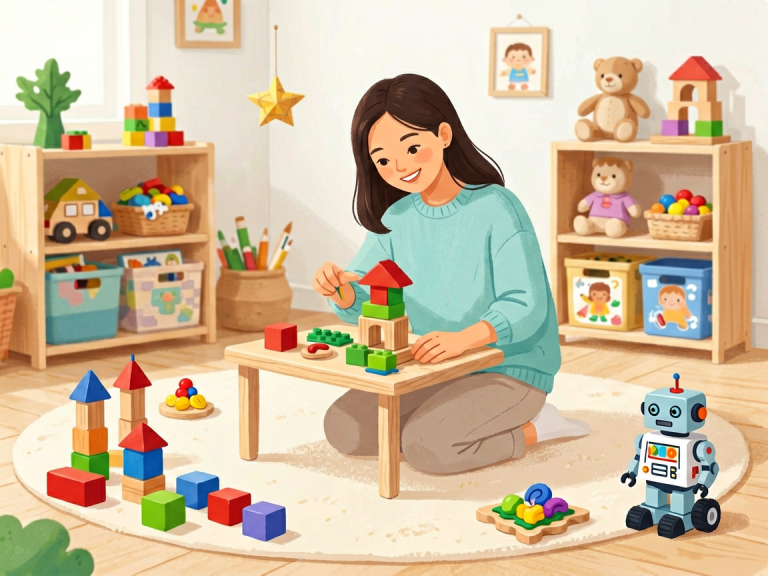
One common pitfall when introducing coding toys for toddlers is the impulse to “teach” like a computer science instructor. This approach often backfires. Toddlers learn best through self-directed exploration and playful repetition. A parent’s role is not to explain algorithms but to create a supportive environment for discovery. Instead of saying, “You must put the blue block first,” try saying, “I wonder what happens if we put the blue block here? Let’s see!” Then wait. The child may try it, watch the robot move, and giggle. That moment of cause-and-effect delight is far more powerful than any lecture.
Another strategy is to ask open-ended questions during play: “How can we get the dog to the bone?” “What if we swap these two pieces?” “Why didn’t the light turn on?” This promotes metacognition—thinking about thinking—at an age when it is just emerging. Also, celebrate mistakes enthusiastically. When the toddler puts the red block in the wrong spot and the robot crashes into a wall, clap and say, “Oops! That was different! What could we try next?” This normalizes debugging as a fun part of the process.
Parents should also recognize that attention spans are short. A 15-minute session with a coding toy is excellent; anything longer may lead to frustration. Rotate toys to keep novelty alive. And never force a child to play with a coding toy if they are uninterested; forced learning at this age can create negative associations. Instead, integrate coding concepts into daily life: while dressing, talk about “first sock, then shoe”; while eating, sequence the steps of getting a snack. The toy is just a tool; the real learning happens in everyday conversation.
Potential Drawbacks and How to Avoid Them
Despite their benefits, coding toys for toddlers are not a panacea. Critics rightly point out that an overemphasis on structured logic can crowd out other essential forms of play—imaginative, social, and physical. A toddler who spends all her time sequencing blocks may miss out on the messy, open-ended creativity of playing with clay or pretend cooking. The solution is balance. Coding toys should represent only one portion of a diverse play diet that includes art, gross motor activities, sand and water play, and social games.
Another concern is commercial hype. Many toys are marketed as “coding” but offer little more than cause-and-effect in a fancy package. A simple light-up button that plays a tune is not a coding toy—it is a battery-operated toy. True coding toys require the child to make choices that affect an outcome in a meaningful, sequential way. Parents should read reviews, watch demonstration videos, and ideally try the toy in a store or borrow from a friend before purchasing. Also, avoid toys that claim to “teach coding” with no screen-free component; toddlers should not be exposed to tablets or smartphones for extended periods, as the American Academy of Pediatrics recommends limiting screen use for children under 2 to video chatting only.
Finally, beware of gender stereotypes. Coding toys are often marketed in blue packaging with robots and cars, subtly discouraging girls. Look for neutral or colorful designs that appeal to all children. Some research suggests that girls benefit even more from spatial and sequencing play at an early age, as it can boost confidence in STEM fields later. Choose toys that your toddler—regardless of gender—finds captivating. If your daughter loves dinosaurs, find a coding toy with dinosaur characters. If your son loves cooking, look for a toy that sequences steps for a pretend recipe. Personalization increases engagement.
Conclusion: Laying the Foundation, One Block at a Time
Coding toys for toddlers are not about turning our youngest children into junior developers. They are about nurturing a mindset—curiosity, persistence, pattern recognition, and the joy of making things work. When a two-year-old arranges colored blocks so that a little robot spins and plays a cheerful tune, she is not learning Python; she is learning that actions have consequences, that order matters, and that mistakes are invitations to try again. These are skills that transcend any one discipline, forming the bedrock of creative problem-solving in every aspect of life.
As the toy industry continues to innovate, parents and educators must remain discerning, choosing tools that are developmentally appropriate, sensorially engaging, and joyfully interactive. The best coding toy is the one that a toddler reaches for again and again, not because it is “educational” but because it is fun. In that fun, the seeds of computational thinking are planted gently, without pressure. And when those seeds eventually grow into structured reasoning, algorithmic thinking, and a love for learning, we will look back and see that it all began with a simple block, a cheerful robot, and a delighted laugh.
So unplug the screens, clear the floor, and let the coding begin—one toddler-sized step at a time.