The Ultimate Guide to the Best Animal Toys for Newborns: Safety, Development, and Delight
Introduction: Why Animal Toys Matter for the Tiniest Learners
The arrival of a newborn transforms a home into a universe of wonder, and every parent wants to fill that universe with objects that are not only safe but also nurturing. Among the countless baby products on the market, animal toys hold a special place. They are the first teachers of empathy, the first sparks of curiosity, and the first friends in a child’s waking world. But choosing the best animal toys for newborns is far from a simple shopping trip. Newborns lack motor control, have extremely sensitive skin, and rely almost entirely on sensory input—sight, sound, touch, and eventually mouthing—to understand their environment. The wrong toy can be a choking hazard, a source of toxic materials, or simply too complex for a baby who cannot yet grasp or track objects. This comprehensive guide explores the criteria for ideal animal toys for the 0–6 month range, highlights top-rated categories, and offers actionable advice for parents who want to combine safety with developmental stimulation. From plush forest friends to crinkly farm animals, the best options engage a newborn’s natural instincts while respecting their fragility.
—
1. Core Safety Considerations for Newborn Animal Toys
Before diving into specific products, it is essential to establish a non-negotiable safety framework. Newborns explore primarily through their mouths, so every toy must be free of small parts, sharp edges, and toxic chemicals. The best animal toys for newborns always carry certifications such as ASTM (American Society for Testing and Materials) or EN71 (European standard for toy safety). Look for labels that confirm the absence of BPA, phthalates, lead, and formaldehyde in plastics, paints, and fabrics. For plush toys, ensure that eyes and noses are embroidered rather than glued or attached with plastic buttons—these can detach and become choking hazards. The fabric should be machine-washable because newborns drool, spit up, and transfer germs easily. Even a seemingly harmless “squeeze” element inside a soft toy—like a squeaker—must be firmly encased. Furthermore, avoid any toy with long strings, loose ribbons, or loops that could wrap around a tiny finger or neck. For newborns under three months, toys should be too large to fit inside a toilet paper roll (a standard choking test) and weigh less than a few ounces to prevent accidental injury if swung or dropped. When in doubt, consult the Consumer Product Safety Commission (CPSC) database or manufacturer recalls. Safety is not a luxury; it is the foundation upon which every delightful play experience must be built.
—
2. Sensory Development: What a Newborn’s Brain Craves
A newborn’s visual system is still maturing. At birth, babies can see only 8 to 12 inches away—roughly the distance to a parent’s face during feeding. High-contrast patterns, especially black, white, and red, attract their attention because the retinal cones are not yet fully sensitive to subtle color variations. Therefore, the best animal toys for newborns often feature bold, high-contrast animal silhouettes. For example, a black-and-white zebra or a red-and-white ladybug stimulates visual tracking and helps strengthen the neural pathways responsible for focus. Auditory stimulation is equally critical. Simple, gentle sounds—a soft rattle, a crinkle of fabric, a chime—teach cause and effect and soothe anxiety. Animal toys that incorporate a gentle bell inside a plush bear or a crinkle panel in the ear of a bunny reward a baby’s accidental swat with a pleasing noise. Tactile exploration rounds out the sensory triad. Newborns need varied textures: smooth satin, soft fleece, bumpy corduroy, or ridged silicone. A plush elephant with a velvety trunk, a rubbery tail, and a satin belly offers a “texture safari” that introduces the concept of different surfaces. Because the hands and mouth are the primary sensory organs at this age, toys that combine multiple touch sensations in a single animal shape—such as a fabric giraffe with a crinkly mane and a silicone teething hoof—maximize developmental payoff.
—
3. Top Categories of Animal Toys for Newborns
3.1 Soft Plush Animals with Multi-Sensory Features
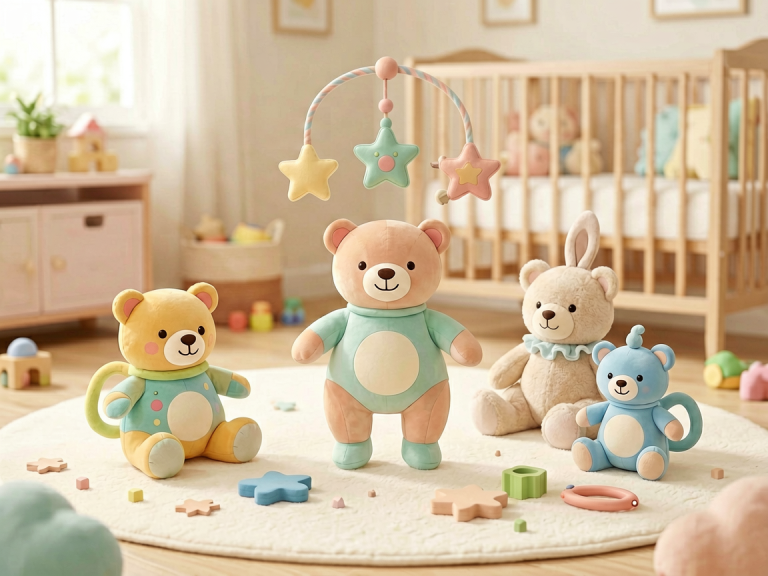
Classic plush toys remain a staple, but not all stuffed animals are created equal. The best animal toys for newborns in this category are specifically designed for infancy. Look for “activity plush” or “sensory plush” that integrates tags, crinkle paper, a gentle rattle, and a teether in one convenient animal body. For instance, a “sensory snail” might have a detachable leaf teether, a rattle inside its shell, and a number of textured ribbons attached to its sides. These toys are lightweight enough for a newborn to accidentally bat and can later be grasped and gnawed as the baby grows. Brands like Manhattan Toy’s “Winkel” or “Skwish” series, while not strictly animal-shaped, have inspired similar designs featuring bears, foxes, and owls. Another excellent option is the “Blossom Farm” collection by Lamaze, which includes a brightly colored giraffe with multiple textures and a mirrored foot. The mirror is a bonus: newborns are fascinated by faces, and a safe, shatterproof mirror attached to a soft toy encourages self-awareness.
3.2 Crinkle and Sound Books with Animal Characters
Cloth books are a brilliant format for animal-themed sensory play. They are chewable, washable, and packed with interactive elements. The best animal toys for newborns in this subcategory combine simple animal illustrations with hidden surprises. For example, a crinkle book titled *“Hello, Farm!”* might have a chicken that squeaks when pressed, a cow whose tail is a satin ribbon, and a sheep whose wool is made from fluffy fleece. The act of turning pages—even if the baby only gums the corner—builds early pre-reading skills and hand-eye coordination. High-contrast cloth books with black-and-white animal patterns are especially effective for newborns under three months. As the baby grows, the same book can be used to introduce animal sounds (“Moo!” “Baa!”) and simple vocabulary. Because these books are typically attached with a clip or a fabric ring, they can be strapped to a car seat, stroller, or play gym, making them versatile companions.
3.3 Teething Animal Toys Made from Safe Silicone or Natural Rubber
Teething begins as early as three months, and newborns often find relief by chewing on soft, flexible objects. The best animal toys for newborns that double as teethers are made from 100% food-grade silicone or natural rubber (often derived from Hevea trees). These materials are free of BPA, PVC, and phthalates, and they are easy to clean. Animal-shaped teethers—such as a whale, a giraffe, or a hedgehog—offer multiple “chewing zones” like fins, ears, or spikes that massage sore gums. The texture variety also provides sensory input. A popular example is the “Sophie la Girafe” teether, which has been a beloved classic for decades. While Sophie is a single animal, brands now produce entire sets of teething animals, including a banana-shaped monkey or a stackable ring of forest creatures. Some teething toys are also freezer-safe, offering extra cooling relief. Because these toys are small enough for tiny hands to grip but large enough to prevent swallowing, they are among the safest and most effective options for the 3–6 month window.
3.4 Play Gyms and Activity Mats with Hanging Animal Friends
A play gym transforms a simple mat into a world of hanging animals. The best animal toys for newborns in this category are those that hang at the correct height—just within the baby’s eye line—and are detachable for independent play. The hanging toys should be easily graspable (or at least bat-able) and should feature contrasting colors, mirrors, and gentle sounds. For example, a woodland-themed gym might include a dangling owl with a bell, a fox with crinkle ears, and a hedgehog with a rattle inside. The mat itself often incorporates sensory elements like a large animal face printed on it or a textured tummy-time pillow. When the baby lies on her back, she learns to coordinate her arms and legs; the animal toys provide a target for those early swipes. Later, during tummy time, the same toys can be positioned in front to encourage head lifting. A high-quality play gym grows with the child, with adjustable straps and the ability to reposition toys. Brands such as “Lovevery” and “Fisher-Price” offer animal-themed play gyms that are well-researched for developmental stages.
3.5 Mirror Toys and High-Contrast Animal Cards
While not “stuffed” toys, animal-themed mirrors and flash cards deserve mention. Newborns are naturally drawn to faces, and a soft, unbreakable mirror surrounded by animal characters—like a lion’s mane or a panda’s ears—creates a captivating focal point. The best animal toys for newborns that incorporate mirrors often have a fabric frame that can be gripped. Similarly, high-contrast animal cards (black-and-white or red-and-black) can be propped up around the changing table or crib. These cards are not toys in the traditional sense, but they provide essential visual stimulation and can be part of a “gallery” that changes as the baby grows. Some parents attach these cards to a wooden ring or a clip-on stroller toy, effectively turning them into interactive playthings.
—
4. Recommended Brands and Specific Products
Navigating the vast market can be overwhelming, so here are some concrete examples that consistently earn high marks from child development experts and parent reviews.
- Manhattan Toy Winkel Rattle & Sensory Teether (with Animal Adaptations): While the classic Winkel is a colorful ring, the brand also offers a “Winkel Bunny” and “Winkel Bird” that incorporate the same interconnected loop design. These are extremely lightweight, easy for newborns to hold, and feature harmless loops that are impossible to swallow.
- Lamaze Mortimer the Moose: This moose has it all: a crinkly antler, a rattle in its body, a squeaker in its hoof, a mirror on its belly, and a variety of fabrics including corduroy and faux fur. It attaches to a stroller or carrier and is machine-washable.
- Sassy Stacks of Circles (Animal-Themed Version): While not strictly a plush animal, the Sassy stacking rings feature a smiling elephant on the top piece and are made from BPA-free materials. The rings provide different textures and a wobbly base that delights newborns who are just beginning to reach.
- Hape Woodland Friends Soft Book: Made from fabric, this book features a fox, a hedgehog, a deer, and a bear. Each page has a different sensory element: crinkle, squeak, rattle, and a peek-a-boo flap. The fabric is non-toxic and stitched securely.
- Baby Jack&Co. Teething Toy – The Hedgehog: A silicone hedgehog with multiple “spikes” that are soft yet firm, this toy can be chilled and is easy for tiny fists to hold. It is dishwasher-safe and comes in high-contrast colors.
- Lovevery Play Gym (The Charmer Play Gym): While expensive, this gym includes a full set of animal-themed developmentally appropriate toys—a wooden ring with a felt snail, a crinkle fox, a wooden teething ring shaped like a bird, and high-contrast cards. The mat is large and reversible, with a black-and-white side for newborns and a colorful side for older infants.
—
5. Practical Tips for Choosing and Using Animal Toys
Selecting the perfect toy is only half the journey. To maximize benefits and safety, follow these guidelines:
- Rotate toys regularly. Newborns quickly habituate to their environment. Introducing a “new” animal every few days (even if it is a toy they have seen before but put away for a few days) renews their interest and encourages exploration.
- Wash before first use and often. Most soft animal toys can go in a mesh bag in the washing machine on a gentle cycle. Silicone teethers should be boiled or sterilized. Follow manufacturer instructions.
- Observe your baby’s cues. If a toy makes a very loud sound, it may overstimulate a tired newborn. If a texture seems to cause a startle reflex, set it aside and try again in a few weeks. Every baby is unique.
- Never leave a newborn unsupervised with any toy. Even the safest animal toy can become a risk if parts loosen over time. Check seams, buttons, and attachments regularly.
- Use toys to build routines. A soft bunny can be part of a nursing or sleep ritual. The consistent presence of a special animal toy can become a comforting “transitional object” as the baby grows into toddlerhood.
—
Conclusion: A World of Wonder, One Animal at a Time
The best animal toys for newborns are those that honor both safety and stimulation. They are not merely distractions; they are tools for growth, comfort, and connection. By choosing well-designed plush companions, textured teethers, sensory books, and activity gyms that feature animals with high-contrast colors and gentle sounds, parents can lay a foundation for cognitive, emotional, and motor development. As you fill your nursery or living room with these delightful creatures—a crinkly fox, a squeaky lamb, a mirror-faced owl—remember that you are not just buying toys. You are giving your newborn a silent language of discovery, a gallery of early friendships, and an invitation to say hello to the world. Whether it is the soft ear of a bunny during a diaper change or the rattle of a giraffe in a bouncing play gym, each small interaction builds a brain and a bond. Choose wisely, play often, and enjoy the journey of watching your baby’s first smiles and swipes as they meet their new animal friends.