The Best Educational Toys for 6-Year-Olds: A Comprehensive Guide to Playful Learning
The age of six marks a thrilling leap in a child’s development. Kindergarten is either behind them or well underway, and their world expands from simple play to structured learning. Their brains are like sponges, absorbing new concepts, languages, and social skills at an astonishing rate. Yet, they are still young—they learn best through play. The best educational toys for six-year-olds do not feel like homework; they feel like adventure, creativity, and discovery. These toys bridge the gap between pure fun and meaningful cognitive growth, nurturing everything from fine motor skills and logical reasoning to emotional intelligence and collaboration. Choosing the right toys can set the stage for a lifelong love of learning, but with so many options on the market, parents and educators need a clear roadmap. This guide dives deep into the categories of toys that truly make a difference at this pivotal age, offering specific recommendations and explaining the developmental science behind each type.
Building Blocks and Construction Sets: Engineering the Future
Children are natural builders. At six, their spatial reasoning and fine motor control have matured enough to tackle more complex construction sets. These toys go beyond simple stacking; they introduce principles of balance, symmetry, geometry, and even early physics. Magnetic tiles, for example, allow kids to create three-dimensional structures that hold together through magnetism, teaching concepts of attraction and repulsion. Brands like Magna-Tiles or Picasso Tiles offer sets with squares, triangles, and windows that can be combined into bridges, castles, or abstract sculptures. The best part is the open-endedness: there is no single “right” way to build, which fosters divergent thinking.
More traditional building systems like LEGO Classic or DUPLO (though DUPLO may be slightly too simple for many six-year-olds) remain excellent, but consider the LEGO Classic series, which provides a massive box of bricks without a specific theme, encouraging children to follow their own imagination. For a more advanced challenge, K’NEX or Strawbees introduce connectors and rods that allow for moving parts, hinges, and wheels. A six-year-old can construct a working catapult, a windmill, or even a simple vehicle. These activities strengthen hand-eye coordination and patience. When a tower falls or a wheel won’t spin, the child learns cause and error correction—an invaluable lesson in persistence. Moreover, building with others encourages turn-taking, verbalizing ideas, and compromise.
STEM Kits and Science Experiments: Cultivating Curiosity
The acronym STEM (Science, Technology, Engineering, Math) has become a household term, but for six-year-olds, the key is making these subjects tangible and exciting. The best educational toys in this category transform abstract concepts into hands-on experiments. A classic example is a chemistry set designed for young children—one that uses safe, household materials like baking soda, vinegar, and non-toxic dyes. The “Learning Resources Primary Science Lab Set” includes real beakers, test tubes, and a magnifying glass, allowing kids to mix concoctions and observe reactions. The thrill of a fizzy volcano or a color change ignites a natural curiosity that no textbook can match.
For technology, consider programmable robots that are screen-free or simple to code. The “Botley the Coding Robot” is a favorite: it comes with remote control arrows that children can sequence to guide Botley through obstacles, teaching logic and algorithm thinking without a screen. Similarly, “Code-a-Pillar” by Fisher-Price has segments that kids plug together in different orders to control the toy’s movement, introducing the concept of commands and debugging. For engineering, a marble run set (like “ThinkFun Gravity Maze” or “Hape Quadrilla”) combines physics and building. Children design tracks with ramps, tunnels, and spirals, learning about gravity, momentum, and velocity. They must test their designs, tweak angles, and reload marbles—a perfect mix of trial and error. These STEM toys nurture problem-solving and a growth mindset, showing that failure is simply a step toward success.
Board Games and Strategy Games: Social and Cognitive Skills
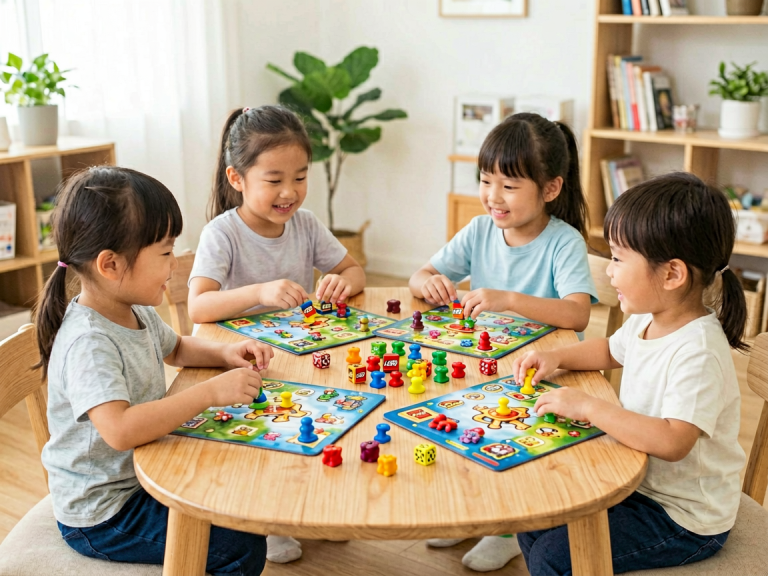
At six, children are increasingly capable of understanding rules, taking turns, and managing emotions like winning and losing. Board games are phenomenal educational tools because they embed learning in social interaction. The best games for this age strike a balance between luck and strategy, ensuring that a child can sometimes win without needing advanced tactics, but also can improve through practice. “Zingo!” is a fast-paced bingo game that reinforces word recognition and vocabulary. “Hoot Owl Hoot!” by Peaceable Kingdom is a cooperative board game where players work together to help owls reach their nest before sunrise—a brilliant way to teach teamwork, empathy, and shared goals.
For more strategic thinking, “Blokus” challenges players to place geometrically shaped pieces on a board while blocking opponents, promoting spatial awareness and planning. “Sequence for Kids” simplifies the classic game, using pictures of animals and cards, helping children with pattern recognition and memory. “Uno” remains a timeless classic, teaching color and number matching, as well as the nuances of skipping, reversing, and wild cards. These games strengthen executive function skills: working memory (remembering whose turn it is, what cards are in hand), cognitive flexibility (adapting to a draw that changes the game), and inhibitory control (resisting the urge to break rules). Moreover, the social rituals—setting up, explaining rules, shaking hands after a game—build emotional intelligence and grace. Every game ended with a friendly “good game” is a lesson in sportsmanship.
Art and Creativity Supplies: Unleashing Imagination
While academic skills matter, creativity is the engine of innovation. Six-year-olds have a blossoming imagination and a desire to represent their world through drawing, painting, modeling, and crafting. The best educational toys in this category are not pre-made kits with a single outcome; rather, they are raw materials that invite open-ended creation. A set of high-quality watercolor paints, a thick pad of paper, and a few brushes can provide hours of exploration in color mixing, texture, and expression. Art supplies that include water-soluble pastels, acrylics, and chalk encourage experimentation.
Sculpting materials like Play-Doh are still loved, but consider “Model Magic” or “Crayola Air Dry Clay” which produce longer-lasting creations. Children can sculpt animals, bowls, or abstract forms, developing fine motor strength and spatial understanding. For a different tactile experience, “Melissa & Doug” stamp sets with ink pads let children create patterns and scenes, which can later be used to tell stories. Also, “Sticky Mosaics” (like “Make Your Own Stained Glass”) use peel-and-stick foam shapes, teaching geometry and color coordination while producing a beautiful result. For children who love to build in 3D, “Tinkertoys” or building straws with connectors allow for the creation of airplanes, houses, or giant structures that double as art. Importantly, art toys reduce perfectionism: there are no wrong colors, no mistakes, only opportunities to express feelings. Process-oriented art activities boost self-esteem and cognitive flexibility, as children constantly decide what to add or change.
Reading and Literacy Tools: Developing a Love for Stories
Literacy is the cornerstone of all future learning. At six, many children are beginning to read independently, but they still need engaging, playful tools to reinforce phonemic awareness, vocabulary, and comprehension. The best educational toys for reading do not feel like drill work. “SnapWords” cards are a wonderful tool: they are sight-word cards with pictures embedded in the letters, making word recognition intuitive and fun. Similarly, “Boggle Jr.” or “Alphabet Soup” games turn spelling into a competitive or cooperative challenge.
A more classic choice is “LeapFrog LeapReader” or “Tag Reading System,” where a special pen interacts with specially printed books, reading words aloud and asking comprehension questions. For children who are more advanced, a subscription to “Highlights Magazine” or “Zoobooks” provides short nonfiction articles with puzzles and activities, expanding knowledge while practicing reading. Audiobooks also count as educational toys: listening to stories on a Yoto Player (a screen-free audio device using magnetic cards) builds listening comprehension, vocabulary, and the ability to visualize narrative. For writing, consider “Magnetic Story Boards” where kids arrange magnetic characters and backgrounds to create their own story scenes and then dictate or write a caption. This type of play connects oral language with written expression.
Puzzles and Problem-Solving Toys: Sharpening the Mind
Finally, puzzles remain an essential category for six-year-olds. They challenge the brain in unique ways, encouraging pattern recognition, logical sequencing, and patience. The best puzzles for this age have between 60 and 150 pieces, often with vibrant images of animals, landscapes, or favorite characters. “Ravensburger” produces high-quality puzzles with sturdy pieces that fit precisely, teaching children to categorize by color, shape, and edge pieces.
Beyond traditional jigsaws, logic puzzles like “SmartGames” offer a series of challenges that increase in difficulty. For example, “Smart Farmer” asks children to place fences on a grid so that certain animals are separated, teaching spatial logic and planning. “IQ Puzzler Pro” is a compact travel game with layered pieces that must fit perfectly. These puzzles develop critical thinking and the ability to hold multiple possibilities in mind. Also, “Pattern Blocks” and “Tangrams” teach geometric relationships as children recreate shapes from a picture or design their own. The satisfaction of solving a puzzle instills a sense of accomplishment and resilience. When a piece doesn’t fit, the child learns to look at the problem from a different angle—a skill that transfers directly to math, science, and everyday challenges.
Conclusion
Selecting the best educational toys for six-year-olds is not about buying the most expensive or the trendiest items; it is about understanding the child’s developmental stage and providing opportunities for growth across multiple domains. The toys discussed here—building sets, STEM kits, board games, art supplies, reading tools, and puzzles—each play a unique role in nurturing a balanced, curious, and capable learner. They encourage children to ask questions, try again, cooperate, and express themselves. In a world dominated by screens, these tangible, hands-on toys offer irreplaceable benefits: they slow down time, deepen focus, and create moments of genuine wonder. Invest in play that educates, and you give a child not just a toy, but a foundation for a lifetime of learning.