The Essential Guide to Age-Appropriate Toys for Newborns: Stimulating Development Safely
Introduction
The arrival of a newborn transforms a home into a world of wonder, where every coo, gaze, and tiny movement becomes a milestone. Amid the joy, new parents often find themselves surrounded by an avalanche of baby products, with toys being among the most eagerly purchased. However, not all toys are created equal—especially for the youngest members of the family. Newborns, typically defined as infants from birth to around three months, have unique developmental needs and vulnerabilities that demand carefully chosen playthings. Age-appropriate toys are not merely about entertainment; they are essential tools for sensory stimulation, motor skill development, and cognitive growth. More critically, they ensure safety by eliminating choking hazards, toxic materials, and other risks. This article offers a comprehensive guide to understanding what makes a toy suitable for a newborn, why age appropriateness matters, and how parents can select and use these toys to nurture their baby’s early development without compromising well-being.
The Importance of Age-Appropriate Toys for Newborns
Selecting toys that match a newborn’s developmental stage is far more than a marketing guideline—it is a fundamental principle of safe and effective early childhood play. Newborns possess limited physical control; their vision is blurry beyond 8–12 inches, they cannot grasp objects intentionally, and their neck muscles are still weak. Age-appropriate toys account for these limitations by offering simple, high-contrast visual stimuli, soft textures, and gentle sounds that do not overwhelm their immature nervous systems. Inappropriate toys—such as those with small detachable parts, sharp edges, or overly loud noises—can pose serious safety threats. Choking is the leading cause of injury among infants, and toys with strings longer than 12 inches or loose filling can lead to strangulation or suffocation. Beyond safety, correct toys support developmental milestones: a black-and-white pattern card encourages visual tracking, a soft rattle stimulates auditory awareness, and a textured fabric promotes tactile exploration. Conversely, a toy that is too complex may frustrate the baby or cause overstimulation, leading to crying or sleep disruption. Research in early childhood development underscores that play during the first few months builds neural connections that lay the foundation for later learning. Thus, investing in age-appropriate toys is not a luxury but a responsible choice that respects the newborn’s pace of growth.
Key Characteristics of Newborn-Friendly Toys
Understanding the essential traits of toys designed for newborns helps parents make informed purchases and avoid common pitfalls. First and foremost, contrast and color are critical. Newborns’ visual systems are still maturing; they see best in black, white, and red, and they are drawn to high-contrast patterns such as stripes, checkerboards, and bold geometric shapes. Toys featuring these elements—like black-and-white flashcards or red-and-white mobiles—capture attention and support visual development. Second, softness and safety go hand in hand. Toys should be made of non-toxic, BPA-free, and phthalate-free materials, preferably organic cotton or silicone that meets safety standards. They should have no sharp edges, loose buttons, or small embellishments that could be chewed off. Third, weight and size matter: newborns lack the strength to hold heavy items, so toys must be lightweight and easy for an adult to manipulate in front of the baby. A common rule is that no part of the toy should fit inside a toilet paper roll (approximately 1.5 inches in diameter) to prevent choking. Fourth, sound production should be gentle and low-volume. Soft rattles, crinkle fabrics, or musical toys that emit lullabies at no more than 60 decibels are ideal; loud or sudden noises can startle infants and even damage their sensitive hearing. Fifth, washability is a practical necessity. Newborns explore with their mouths, and toys quickly become covered in drool, milk, or dust. Machine-washable or easily wipeable toys help maintain hygiene. Finally, versatility is a bonus: a toy that can be used during tummy time, attached to a car seat, or hung on a play gym offers more value without overwhelming the baby with multiple items.
Recommended Toy Types for Newborns
With the key characteristics in mind, here are the most effective and safe toy categories for newborns, each designed to target a specific area of development.
High-Contrast Visual Stimuli
Black-and-white pattern cards, soft cloth books with bold images, and simple mobiles (with a focus on black, white, and red elements) are excellent for the first few weeks. Place them about 8–12 inches from the baby’s face, and slowly move them side to side to encourage visual tracking. These toys strengthen eye muscles, improve focus, and lay groundwork for hand-eye coordination.
Soft Rattles and Grasping Toys
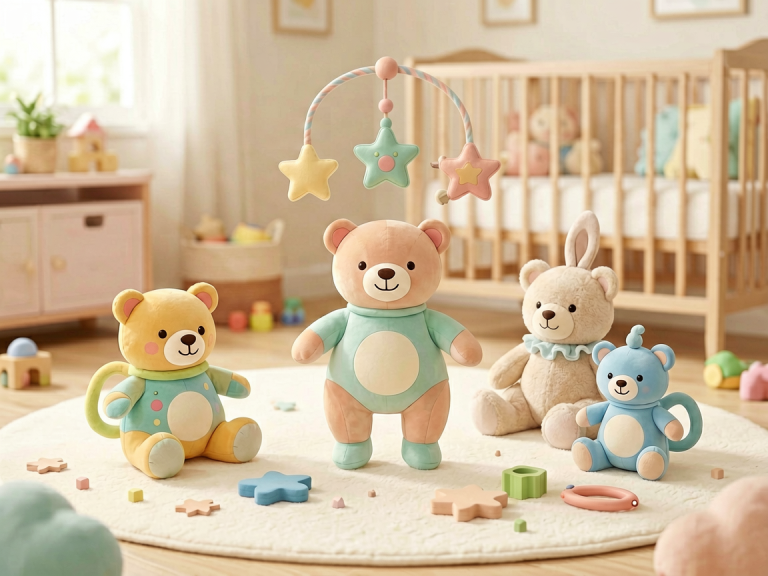
Soft rattles made of fabric or silicone, with easy-to-hold handles (often ring-shaped or dumbbell-shaped), invite the newborn to begin reflexive grasping. Even though purposeful grasping does not emerge until around 3–4 months, placing a rattle in the baby’s palm triggers the palmar reflex and introduces cause-and-effect when the toy makes a gentle sound. Ensure the rattle is lightweight and has no loose beads inside.
Play Gyms and Activity Mats
A play gym or activity mat with hanging toys, mirrors, and textured elements is a versatile investment. Lay the baby under the gym during supervised wake time; the overhead toys encourage reaching and batting. Some mats include a tummy time pillow that supports the baby’s chest while they lift their head to admire a dangling toy. Look for gyms with easily detachable toys so you can rotate them to maintain interest.
Crinkle and Texture Toys
Newborns are intensely tactile learners. Crinkle toys—fabric squares or small plush animals embedded with crinkly material—produce a soft rustling sound that delights babies. Toys with varied textures (ribbon tags, fleece, satin surfaces) encourage exploration and help develop sensory integration. Many soft books combine crinkle pages, a small mirror, and teething corners for multi-sensory play.
Mirrors and Facial Recognition Toys
Unbreakable baby-safe mirrors (often made of polished stainless steel or shatterproof plastic) captivate newborns because they are drawn to the human face. Place a mirror on the floor during tummy time or attach one to the side of a play gym. While the baby does not yet recognize their own reflection, the smiling face they see (often their parent’s reflection alongside theirs) promotes social-emotional development.
Soothing Musical Toys and White Noise Makers
Many newborns find comfort in gentle, repetitive sounds. Musical toys that play a short lullaby or nature sounds can be used during diaper changes or before sleep. Always set the volume at a low level, and avoid flashing lights or erratic melodies. Some parents prefer a simple wind-up music box or a soft plush toy that emits a heartbeat sound—these mimic the womb environment and soothe fussy babies.
Tummy Time Props
Tummy time is crucial for building neck, shoulder, and upper body strength. Age-appropriate toys for this activity include a small, firm tummy time pillow (with a flat base, not a steep incline), a soft toy that unfolds into a small ramp, or a mirror designed to prop up at a 45-degree angle. These encourage the baby to lift their head and look around, turning a necessary exercise into playful discovery.
Safety Considerations for Newborn Toys
Safety must be the non-negotiable priority when choosing toys for a newborn, as their vulnerability demands extra vigilance. The first step is to check labels and certifications. In the United States, look for “ASTM F963” (the standard for toy safety) and “CPSIA” compliance; in Europe, look for “CE” marking. These certifications indicate that the toy has been tested for phthalates, lead, and other harmful substances. Second, inspect for small parts before every use. Even if a toy is marketed for newborns, manufacturing defects or wear can cause parts to detach. Use a small-parts tester (or a toilet paper tube) to ensure no component is smaller than the opening. Third, avoid strings and ribbons. Toys with cords longer than 7 inches pose a strangulation risk; remove any ribbons from plush toys or ensure they are securely stitched and short. Fourth, choose the right size. A toy that is too small can be swallowed; one that is too large or heavy might fall on the baby’s face. Fifth, never leave a newborn alone with toys—supervision is essential because the baby cannot yet move away from a potentially hazardous position. Sixth, clean toys regularly. Follow manufacturer instructions for washing; fabric toys should be washed in hot water with mild detergent, and plastic toys can be wiped with a damp cloth and dried fully. Finally, watch for signs of overstimulation. If the baby turns away, cries, or becomes fussy during play, remove the toy and offer quiet time. Age-appropriate toys should invite calm engagement, not stress.
How to Introduce Toys to Your Newborn
Even the best toys will fail to benefit a newborn if they are introduced in a way that overwhelms or confuses the baby. Timing, environment, and the caregiver’s interaction all play vital roles. Start with one toy at a time. During an alert, calm period (often after a nap and feeding), lay the baby on a flat, safe surface—such as a play mat or a crib—and hold a high-contrast card or soft rattle about 10 inches from their eyes. Slowly move the toy from side to side, observing whether the baby’s eyes follow it. If they do, that is a positive sign; if they look away, give them a break. Use tummy time as a prime opportunity for toy introduction. Place a small mirror or a crinkle book in front of the baby to motivate short periods of head lifting. Limit tummy time sessions to one to two minutes initially, gradually increasing as the baby grows stronger. Rotate toys regularly to maintain novelty without flooding the baby’s senses. A good practice is to offer two or three different toys each day and swap them out every few days. Narrate your actions while playing: “Look, this rattle makes a soft sound. Can you hear it?” Even though the baby doesn’t understand words, they tune into your soothing tone, which builds language foundations. Respect the baby’s cues—if they coo and smile, continue; if they yawn or turn their head, stop and cuddle instead. Finally, integrate toys into daily routines, such as hanging a mobile over the changing table to calm the baby during diaper changes, or offering a textured cloth while they sit in a bouncy seat during supervised wake time. Over the first three months, these interactions will become delightful rituals that strengthen the bond between parent and child while gently nurturing the newborn’s budding abilities.
Conclusion
Choosing age-appropriate toys for newborns is a thoughtful act of love that prioritizes safety, developmental support, and joyful connection. From high-contrast cards that sharpen vision to soft rattles that kindle curiosity, each toy serves as a small window through which the baby begins to understand their world. Parents need not buy dozens of gadgets; a handful of well-selected, high-quality items—rotated and used with intention—can provide all the stimulation a newborn needs. The most important “toy” of all, however, remains the caregiver’s voice, face, and gentle touch. No manufactured plaything can replace the comfort of a parent’s lap or the sound of a lullaby sung softly. As you curate your newborn’s first toy collection, let the principles of simplicity, safety, and responsive interaction guide every choice. In doing so, you will not only support your baby’s early development but also create the foundation for a lifetime of curious, confident, and joyful learning.