Introduction
Title: Magnetic Tiles vs Building Blocks: A Comprehensive Guide to Choosing the Right Construction Toy for Child Development
In the ever-expanding universe of children’s toys, few categories hold as much educational and creative promise as construction sets. Among them, two titans have captured the attention of parents, educators, and therapists alike: magnetic tiles and classic wooden or plastic building blocks. At first glance, both seem to serve the same purpose—to stack, connect, and build. Yet beneath the surface lies a fascinating divergence in materials, mechanics, and developmental impact. Magnetic tiles, pioneered by brands like Magna-Tiles and PicassoTiles, rely on embedded magnets to create instant connections, while traditional building blocks depend on gravity, friction, and precise alignment. This article offers an in-depth comparison of magnetic tiles versus building blocks, examining their respective strengths and limitations in fostering cognitive growth, fine motor skills, creativity, social interaction, and STEM learning. Whether you are a parent assembling a playroom, a teacher designing a curriculum, or a therapist seeking the right tool, understanding these differences will help you make an informed choice tailored to a child’s unique needs.
Developmental Benefits: Fine Motor Skills and Spatial Reasoning
One of the primary reasons parents invest in construction toys is their ability to enhance fine motor control and spatial awareness. Building blocks, particularly those made of wood, require a steady hand and precise placement. A child must learn to balance a block on top of another, adjusting the angle and pressure to prevent toppling. This trial-and-error process strengthens the small muscles in the hands and fingers, and it cultivates patience and persistence. Blocks also introduce concepts of weight distribution and stability—a tower of irregularly shaped blocks demands careful planning, as an off-center placement can lead to collapse. In contrast, magnetic tiles offer a dramatically different tactile experience. The magnets click together with minimal effort, removing many of the physical challenges associated with balancing. This makes magnetic tiles exceptionally forgiving for younger children or those with fine motor delays; a three-year-old can quickly create a cube or a pyramid that would be nearly impossible with traditional blocks. However, this ease can also be a trade-off. While magnetic tiles build spatial reasoning by allowing children to visualize three-dimensional forms, they do not train the same degree of hand-eye coordination or manual dexterity that blocks require. Experts note that for children with developing motor skills, a balanced diet of both toys is ideal: blocks build foundational motor control, while magnetic tiles boost spatial visualization and confidence without the frustration of constant collapse.
Creativity and Open-Ended Play: Structure versus Freedom
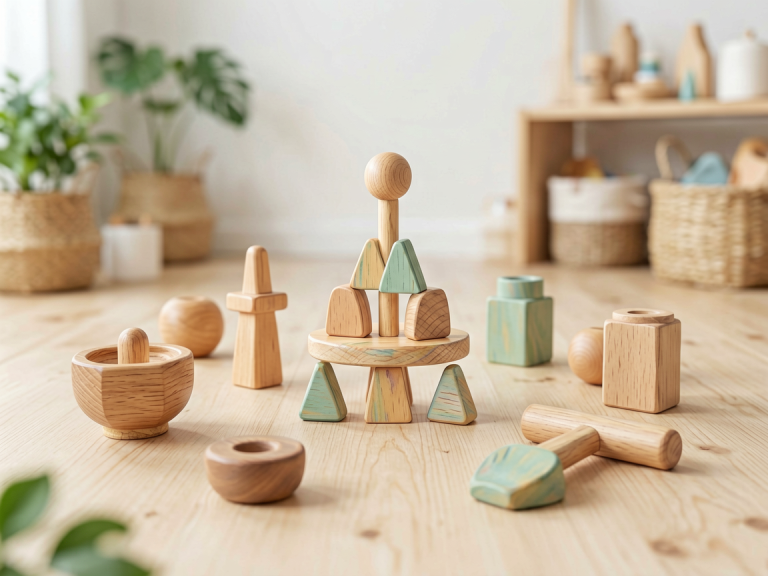
When evaluating creativity, the key question is not which toy allows more imagination, but which type of play each encourages. Building blocks are the quintessential open-ended toy. A set of plain wooden unit blocks—no colors, no magnets, no predetermined shapes—can become a castle, a bridge, a spaceship, or a pizza counter. The lack of intrinsic connectors invites children to invent their own rules of assembly. Blocks can be stacked, laid side by side, balanced on edges, or arranged in patterns. This freedom, however, comes with constraints: the need for gravity-friendly designs limits the possibilities. Arches and cantilevers are notoriously difficult to achieve with blocks alone. Magnetic tiles, on the other hand, enable constructions that defy gravity. A child can build a tower that leans at an angle, a floating bridge, or a multi-story house with cantilevered balconies. The magnets provide a structural stability that blocks cannot match, allowing for more complex and ambitious creations. Yet this comes with a subtle constraint: magnetic tiles typically have a limited set of geometric shapes (squares, triangles, rectangles), and the magnetic poles impose a binary orientation (north-south), which can frustrate young builders who inadvertently try to connect two repelling edges. Some argue that magnetic tiles, because of their predefined connection points, guide children toward particular types of structures (e.g., symmetrical, right-angled forms), whereas blocks demand more inventive problem-solving. Ultimately, the choice depends on what kind of creativity you wish to nurture. If you want a child to explore architectural balance and learn from failure, blocks are superior. If you want to encourage rapid prototyping and three-dimensional dreaming without the setback of collapse, magnetic tiles are the better fit.
Educational Applications: STEM Learning and Curriculum Integration
In the context of formal education, both toys have been embraced by STEM (Science, Technology, Engineering, and Mathematics) educators, but they serve different pedagogical roles. Magnetic tiles are a natural vehicle for teaching magnetism, polarity, and geometry. A teacher can use them to demonstrate the concept of an invisible magnetic field, or to explore symmetry by building a mirror image of a structure. They are also excellent for introducing fractions and area: two small squares combine to form a larger square, and triangles can be arranged into a rectangle, providing a tangible understanding of geometric composition. Because magnetic tiles hold together firmly, they are ideal for building models of molecules, crystals, or 3D shapes that would frustrate block-users. Building blocks, meanwhile, excel in teaching physics concepts such as gravity, friction, stability, and load-bearing. A child learns intuitively that a heavy block on a narrow base will fall, while a wider base distributes weight. Block play also integrates math skills like counting, sorting by size, and pattern recognition. Many Waldorf and Montessori classrooms rely on plain wooden blocks precisely because they strip away distracting features and emphasize pure physical relationships. For older children, blocks can be used in engineering challenges—for example, building the tallest tower using a limited number of blocks—which teaches resource management and structural engineering principles. Neither toy is inherently better for education; instead, they complement each other. Magnetic tiles are powerful for lessons involving magnetic force, 2D-to-3D transformation, and cooperative construction, while blocks are unmatched for lessons in mechanics, balance, and real-world physics.
Age Appropriateness and Safety Considerations
Safety is a critical factor when choosing between magnetic tiles and building blocks, especially for families with infants or toddlers. Traditional building blocks, especially those made of solid wood with non-toxic finishes, are generally considered safe from birth, though small blocks pose a choking hazard for children under three. Many block sets designed for infants feature larger sizes, rounded edges, and lightweight materials such as foam or cardboard. Magnetic tiles, by contrast, carry a specific risk: if a tile cracks or breaks, small powerful magnets can be released. Ingesting multiple magnets can cause severe internal injuries, as they attract each other through intestinal walls. For this reason, manufacturers label magnetic tiles for age three and up, and parents must inspect tiles regularly for damage. The age-appropriateness also relates to frustration tolerance. A two-year-old may become frustrated trying to stack wooden blocks, whereas they can easily snap magnetic tiles together. However, magnetic tiles often include small triangular pieces that are only slightly larger than a choking hazard limit; vigilance is required. Another consideration is noise: wooden blocks clatter loudly when dropped or sorted, whereas magnetic tiles produce a soft click and are quieter during play—a plus for classrooms or apartments. In terms of durability, high-quality magnetic tiles are made of thick ABS plastic and can withstand years of use, but they are more expensive than basic blocks. Wooden blocks can be sanded and repainted, and they rarely break unless cracked. For families on a budget, a small set of magnetic tiles and a larger set of blocks can provide a comprehensive play experience without overspending.
Social and Collaborative Play: Dynamics in Group Settings
Both toys excel in encouraging cooperative play, but they produce different social dynamics. Building blocks naturally lead to negotiations about space, sharing, and design. When a group of children builds with blocks, they must constantly communicate about who will place the next block, how to avoid toppling a shared structure, and how to resolve conflicts when a child’s block knocks over another’s. This type of play fosters social skills like turn-taking, compromise, and teamwork. Blocks also allow for parallel play—two children can build separate towers without interfering—which is common among younger preschoolers. Magnetic tiles, because of their instant connectivity, often result in more collaborative building from the start. Children frequently build one large shared structure, assigning roles such as “wall builder” or “roof designer.” The ease of adding pieces reduces frustration, which can lower the frequency of conflicts. Moreover, magnetic tiles are particularly effective for inclusive play: children with motor difficulties, attention deficits, or sensory processing challenges can participate on equal footing because the magnets eliminate the need for precise hand control. Teachers in special education classrooms often choose magnetic tiles for this reason. However, the very ease of magnetic tiles can sometimes lead to a lack of challenge, and some children may become passive, simply piling tiles without intentional design. Blocks require more active problem-solving, which can be more engaging for older children. A mixed environment, where both toys are available, allows children to self-select based on their mood and energy level.
Conclusion: The Best Choice Is Both
After examining the cognitive, physical, creative, social, and educational dimensions, it becomes clear that magnetic tiles and building blocks are not interchangeable rivals but complementary tools in a child’s developmental toolkit. Magnetic tiles shine in their ability to remove the barrier of gravity, allowing children to build complex, gravity-defying structures and to explore abstract geometric and magnetic concepts with ease. They are forgiving, quiet, and highly conducive to collaborative play, making them ideal for classrooms and for children who need a confidence boost. Building blocks, on the other hand, offer a raw, unmediated connection to the physical laws of the world. They teach patience, balance, fine motor control, and the art of learning from failure. Their simplicity and open-endedness make them timeless companions for imaginative play across cultures and generations. The most effective approach for parents and educators is to invest in both, offering children the opportunity to switch between modes of play based on their current developmental stage and interests. A two-year-old might start with super-sized blocks, then graduate to magnetic tiles at age three or four, and later return to blocks for more nuanced engineering projects at age seven or eight. Rather than framing the choice as an either/or debate, we should celebrate the unique contributions of each, ensuring that children have access to the full spectrum of constructive play. In the end, the true winner is not magnetic tiles or building blocks—it is the child, who builds not just towers and castles, but also brains, hands, and hearts, one piece at a time.