The Magic of Wonder: Best Imaginative Toys for Newborns
Introduction: Why Imagination Begins at Birth
When we think of imaginative play, we often picture toddlers pretending to be astronauts or building castles from blocks. But the truth is, imagination does not suddenly appear at age two or three. It begins in the very first weeks of life, when a newborn's brain is wiring itself at a staggering rate. Every rattle, every soft fabric, every black-and-white pattern is a seed of curiosity that will one day blossom into full-fledged storytelling and creative thinking. For newborns, "imaginative toys" are not about elaborate fantasies—they are about inviting the baby to wonder, to explore, and to construct a mental map of the world through the senses. Choosing the best imaginative toys for newborns means selecting tools that stimulate the senses, encourage cause-and-effect discoveries, and lay the foundation for later symbolic play. In this article, we will explore the key categories of toys that spark the earliest glimmers of imagination, from high-contrast visuals to gentle textures and auditory surprises. We will also discuss why these toys matter for brain development, how to use them safely with a newborn, and what to look for when making purchases. By the end, you will have a clear, research-backed guide to filling your nursery with objects that are not merely entertaining but truly nourishing for a newborn's emerging imagination.
The First Sparks: High-Contrast Visual Stimulation
A newborn’s vision is one of the least developed senses at birth. They can see only about 8 to 12 inches away, and their world is a blur of soft edges. What they respond to most strongly is high contrast—especially black, white, and red patterns. Imaginative toys in this category are not about recognizing objects yet; they are about engaging the baby's brain in pattern recognition and visual tracking. A simple black-and-white spiral mobile hung over the crib, for example, can captivate a newborn for minutes at a time. The baby’s eyes follow the curves, and her brain begins to form neural connections that will later support her ability to imagine shapes and scenes.
Consider the classic black-and-white soft book. With pages featuring bold stripes, checkerboards, and simple faces, these books invite the newborn to focus and even "read" with her eyes. While a one-month-old cannot understand a story, she is building a mental library of visual patterns. This is the very root of imagination: the ability to hold an image in the mind and later manipulate it. Some parents worry that such toys are "too simple," but simplicity is exactly what a newborn’s developing visual cortex needs. The best toys in this category include high-contrast cards that can be placed near the changing table, mirror toys with bold borders, and contrasting tent-like play gyms. When choosing, look for materials that are safe to chew (since everything goes into the mouth) and that can be easily cleaned. Rotating the patterns every few days keeps the experience fresh and prevents habituation, thereby continuously inviting the baby's imagination to stretch.
Sound and Surprise: Auditory Toys That Build Curiosity
If vision is the front door to imagination, hearing is the back door—quieter, subtler, but equally powerful. Newborns are born with a keen ability to recognize sound patterns, especially the human voice. However, imaginative toys that produce gentle, unexpected sounds can train the baby to anticipate and wonder. Think of a soft crinkle toy: the first time the baby accidentally brushes her hand against it, she hears an uncanny rustling. She pauses, maybe waves her arm again, and the crinkle repeats. In that moment, a tiny cause-and-effect loop is formed: "I do something, and the world responds." This is the essence of imaginative thinking—forming hypotheses and testing them.
Rattles are the classic example, but not all rattles are equal. The best imaginative rattles for newborns are those that produce different tones depending on how they are shaken. A wooden ring with a few small beads creates a gentle click; a plush ball with a bell inside produces a softer chime. By offering a variety of these auditory toys, you encourage the baby to differentiate sounds and begin to predict outcomes. Another excellent option is a silent musical box that the parent winds up, then holds near the baby’s ear. Unlike electronic toys that blast repetitive melodies, a mechanical music box creates a sense of magic: the sound seems to come from nowhere. This mysterious origin sparks the first glimmers of "what if?" thinking.
Be cautious with volume. Newborns' ears are extremely sensitive, so choose toys that are naturally quiet—no louder than a soft conversation. Also avoid toys with multiple electronic sounds that can overwhelm a baby’s auditory system. The goal is not to entertain but to invite active listening. When the baby turns her head toward a sound, she is practicing localization and attention. Over time, these skills translate into the ability to imagine what is happening out of sight—a crucial component of later pretend play.
Texture and Touch: The Foundation of Sensory Imagination
A newborn’s sense of touch is perhaps the most advanced at birth. They feel temperature, pressure, and texture with remarkable sensitivity. This is why skin-to-skin contact is so vital. But beyond human touch, textured toys offer a world of discovery that feeds the imagination. A simple soft block with a crinkle strip, a satin edge, and a velvety center provides multiple tactile experiences in one object. The baby may not yet grasp the block intentionally, but when the block is placed in her palm, she will squeeze, rub, and drop it, each action providing new sensory feedback.
The best imaginative toys for tactile exploration are those that offer variety within a safe design. Look for toys made of organic cotton, bamboo, or natural rubber, with different weaves and finishes. A "taggie" blanket—a small square covered with ribbons of different textures—is a classic favorite. Each ribbon feels different: one is silky, another is bumpy, a third is ribbed. The baby will mouth, grab, and tug, learning that the world contains countless subtle differences. This tactile vocabulary becomes the raw material for later imaginative construction. When a toddler later pretends that a piece of felt is a "cloud," she is drawing on those early memories of soft, airy textures.
Another wonderful option is a silicone teether with varying bumps and ridges. While primarily designed to soothe gums, these teethers also provide rich tactile input. The baby explores with her tongue and lips, mapping the contours of the object. This oral exploration is a key part of sensory imagination—the baby is, in effect, "reading" the object with her mouth. For safe practices, always ensure that tactile toys are free of small parts, are large enough not to be swallowed, and are made of non-toxic materials. Washable is essential, as newborns often introduce their toys to drool and spit-up. By offering a rotating selection of textures, you keep the newborn's tactile curiosity alive, laying the groundwork for a child who will later enjoy molding clay, finger painting, and building with diverse materials.
Movement and Interaction: Toys That Encourage Body Awareness
Imagination is not only about the mind; it is also about the body. A newborn who learns to track an object with her eyes, reach for a toy, or turn her head to follow a sound is building the motor foundations for later pretend play. The best imaginative toys in the movement category are those that invite the newborn to interact with her environment. A simple, lightweight rattle held just out of reach encourages the baby to bat at it. A play gym with dangling toys at different heights lets the baby practice swatting and grabbing. These actions might seem purely physical, but they are deeply imaginative: the baby is learning that her body can cause changes in the world.
One particularly effective toy is a baby-safe mirror. Newborns are fascinated by faces, and their own reflection is a source of endless wonder. At first, the baby may not recognize herself, but she will smile, coo, and reach toward the mirror. This self-discovery is a powerful imaginative act—she is constructing the concept of "me." Soft, unbreakable mirrors that attach to crib rails or play mats are perfect. Pair the mirror with a gentle song or a silly face from a parent to reinforce the sense of interaction.
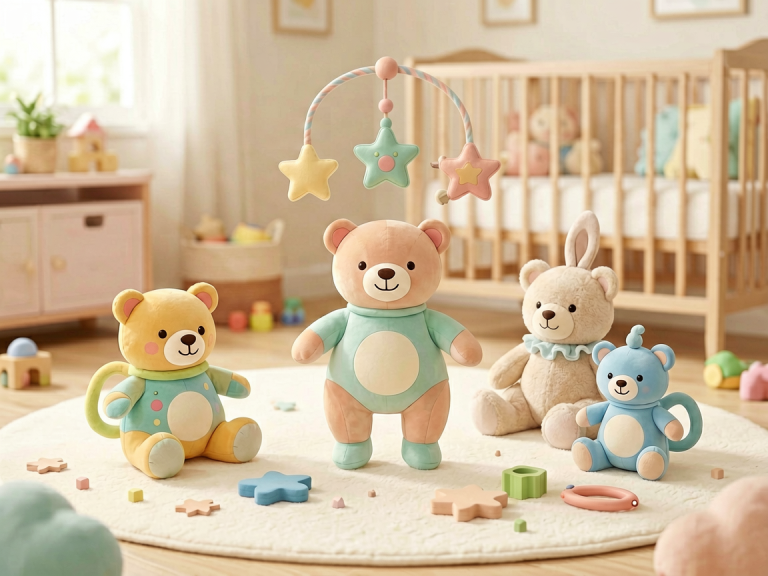
Another category is mobiles. While many parents choose mobiles for their decorative value, the best imaginative mobiles are those that move naturally with air currents or gentle touches. A mobile made of lightweight felt shapes, trees, or animals gives the baby something to follow with her eyes. As the shapes slowly rotate, the baby imagines (in her pre-verbal way) that the objects are dancing. This is the earliest form of narrative thinking: "The bear goes up, then down, then round." For safety, always ensure the mobile is securely attached out of the baby's reach once she can sit up. But during the newborn period, when she is mostly lying on her back, a mobile can be a captivating window into a moving world.
The Parent’s Role: The Ultimate Imaginative Toy
No commercial toy can replace the presence of a caring adult. The newborn's most important imaginative toy is you—your voice, your face, and your gentle touch. When you hold a toy and make exaggerated faces, you are showing the baby how to pretend. When you crinkle a piece of paper and say "Ooh, what's that sound?" you are modeling curiosity. When you dance with your baby in your arms, you are introducing rhythm and joy. In fact, the American Academy of Pediatrics recommends that for infants under six months, the best "toy" is a responsive caregiver.
That said, toys can be beautiful tools to enhance these interactions. Choose toys that invite you to play together: a soft book that you can read to the baby, a rattle that you can shake in a pattern, a scarf that you can gently float over the baby's face and pull away with a "peek-a-boo." The game of peek-a-boo is perhaps the ultimate imaginative toy for newborns. It teaches object permanence—the understanding that things exist even when hidden—which is a foundational concept for imaginative play. You do not need a special toy for this; just your hands or a lightweight cloth. But having a dedicated peek-a-boo toy, like a small, soft doll that can hide under a scarf, adds a structured element that many parents find helpful.
As a parting thought, remember that newborns grow incredibly fast. The toy that fascinates them at two weeks may bore them at ten weeks. Be prepared to rotate toys, follow your baby's cues, and not overstimulate. Too many toys at once can overwhelm a newborn's developing attention span. A small basket with three or four carefully chosen items is far better than a cluttered nursery floor. The best imaginative toys for newborns are those that respect the baby's fragile perceptual world while gently expanding it. They are invitations to wonder, not demands to perform. With the right toys—and with you as the guide—your newborn will begin a lifelong journey of imagination, one soft rattle, one black-and-white pattern, one loving smile at a time.