Magnetic Tiles vs Building Blocks: Which Toy Best Fuels the Development of a 5-Year-Old?
Introduction: The Great Toy Debate
Every parent and early childhood educator knows the scene: a child sits cross-legged on the floor, brow furrowed in concentration, tiny hands pushing, pulling, stacking, and clicking. The materials in front of them may look simple—plastic squares with hidden magnets, or wooden blocks with painted edges—but the learning happening is anything but simple. At age five, children stand at a cognitive and motor crossroads. They are no longer toddlers who simply knock things down; they are emerging engineers, storytellers, and problem-solvers. Choosing between magnetic tiles and traditional building blocks is not just about which toy keeps a child busy longer. It is about understanding how each medium shapes spatial reasoning, creativity, fine motor skills, social interaction, and even emotional regulation.
In this article, we will compare magnetic tiles and building blocks across seven critical dimensions: cognitive development, fine motor skills, creativity and open-ended play, social and collaborative benefits, safety and durability, longevity and complexity, and specific educational outcomes for five-year-olds. By the end, you will have a clear framework to decide which toy—or which combination—best supports your child’s unique developmental stage.
Cognitive Development: Spatial Reasoning and Problem-Solving
Magnetic Tiles: Instant Gratification Meets Structural Thinking
Magnetic tiles, such as Magna-Tiles or PicassoTiles, have a distinct advantage when it comes to teaching three-dimensional spatial relationships. The magnets instantly snap together, allowing a five-year-old to build towering structures with minimal frustration. This low barrier to failure is crucial at age five, when perseverance is still developing. Children can experiment with balance, symmetry, and load distribution without the risk of a toppling tower that shatters their confidence. For example, a child can construct a cube, then a pyramid, then a geodesic dome, all within minutes. Each success reinforces an intuitive understanding of geometry: that a square can become a face of a larger polyhedron, that triangles provide stability, and that the orientation of a magnetic edge determines the angle of a joint.
However, the instant adhesion also means that some trial-and-error learning is bypassed. A five-year-old using magnetic tiles does not need to learn the delicate art of maintaining equilibrium through careful placement; the magnets do the heavy lifting. Some educators argue that this shortcut can reduce the cognitive load required for true structural problem-solving. In contrast, traditional blocks demand that the child constantly micro-adjust to prevent collapse, which builds a deeper, more kinesthetic sense of physics.
Building Blocks: The Physics Lab of Childhood
Classic wooden or plastic building blocks—whether unit blocks, Duplo, or standard LEGO Duplo—force a child to grapple with real-world constraints: friction, gravity, and precise alignment. A five-year-old stacking blocks must consider the center of gravity with every addition. If a block is placed slightly off-center, the whole tower wobbles. The child learns to correct by trial and error, developing what developmental psychologists call “means-end analysis.” They must plan ahead: “If I put this large block on top of two small ones, will it stay?” This process strengthens executive function, especially cognitive flexibility and inhibitory control.
Yet blocks have a steeper learning curve. A five-year-old who has not yet developed steady fine motor control may become frustrated when a carefully stacked wall crumbles repeatedly. This frustration can be productive—if a caregiver or peer is nearby to offer encouragement—but it can also lead to abandonment of the activity. For some children, the immediate reward of magnetic tiles is more motivating and sustains engagement longer, thereby increasing total time-on-task for cognitive development.
Sub-conclusion: Magnetic tiles excel at introducing spatial concepts quickly and joyfully, while building blocks embed deeper, more demanding physics lessons through inevitable failure.
Fine Motor Skills: Precision, Grip, and Hand-Eye Coordination
Magnetic Tiles: Easier on Little Hands
Magnetic tiles are typically larger and lighter than standard wooden blocks. A five-year-old can grasp a square tile with a whole-hand palmar grip or a pincer grasp, depending on the size (common tiles are 3 inches or 7.5 cm per side). The magnets snap together with a satisfying click that does not require much force. This ease makes magnetic tiles ideal for children with lower muscle tone or those who tire quickly. The act of separating tiles, however, does require a twisting motion and some strength—this is an excellent exercise for forearm muscles and bilateral coordination (using two hands together to pull or push).
But do magnetic tiles challenge the small muscles of the hand enough? Some occupational therapists note that because tiles connect magnetically, the child does not need to develop the precise finger-and-thumb coordination required to align block edges perfectly. The magnets self-correct slight misalignments, which, while reducing frustration, also reduces the demand on fine motor control.
Building Blocks: A Fine Motor Workout
Building blocks demand precision. A five-year-old stacking wooden unit blocks (which have no interlocking mechanism) must align each block exactly so that it does not tip. This requires careful visual-motor integration and steady, controlled movements. When using interlocking blocks like Duplo or LEGO, the child must exert precisely the right amount of downward pressure to snap two studs into place. That action strengthens the intrinsic hand muscles and reinforces the motor planning needed for later tasks like handwriting, buttoning, and using scissors.
Moreover, blocks come in many sizes: from small cubes (1 cm) to large hollow blocks. Handling a variety of sizes requires different grips—pincer, tripod, palm. This variety builds hand strength and dexterity across the entire hand. For a five-year-old, the struggle to press a Duplo brick onto a baseplate is not a flaw; it is a targeted fine motor exercise.
Sub-conclusion: Both toys contribute to fine motor development, but building blocks demand more precise, effortful coordination, while magnetic tiles offer a gentler, more accessible entry point.
Creativity and Open-Ended Play: The Freedom to Imagine
Magnetic Tiles: Translucent Beauty and Light Play
One unique feature of magnetic tiles is their translucency. When a child builds a cube with colored tiles and places a flashlight underneath, the structure glows like a stained-glass window. This open-ended element—combining architecture with light and color—invites a different kind of creativity. Children often create “houses for fairies,” “space stations,” or “aquariums” where they can see the interior through the colored walls. The magnetic property also allows for unconventional shapes: two-dimensional flat patterns can be folded up into three-dimensional forms, teaching transformation of shape.
However, some critics argue that magnetic tiles, because they snap together so easily, lead to repetition. Many children build the same type of cube or tower repeatedly because the magnets always behave the same way. The material itself is not “messy” or ambiguous; it has predictable properties that may not stimulate as much divergent thinking as, say, a pile of sticks and fabric.
Building Blocks: Infinite Configurations with No Rules
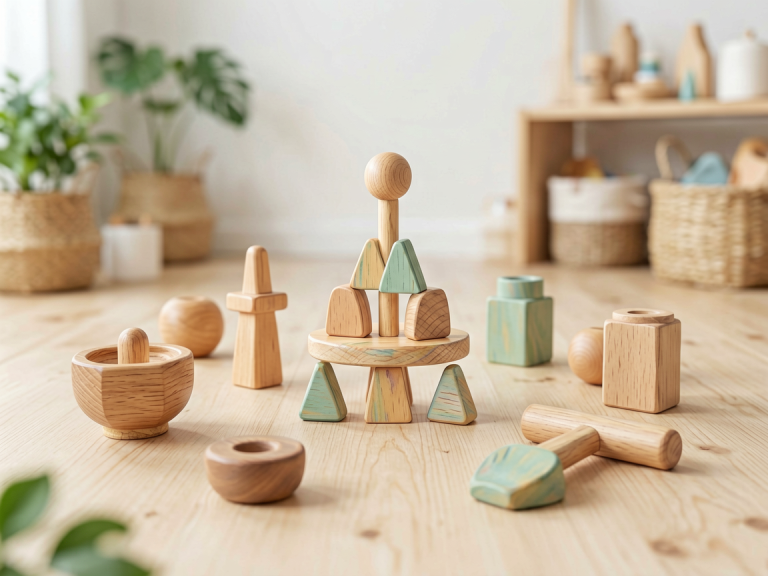
Building blocks, especially plain wooden ones, are the ultimate open-ended material. A five-year-old can use a rectangular block as a phone, a bridge support, a slice of bread, a car, or a bed for a doll. Because blocks do not have a built-in connection system, the child must decide how to relate objects to one another—stacking, balancing, side-by-side, or even lining them up to create patterns. This ambiguity encourages symbolic play, which is the bedrock of creativity at age five.
Interlocking blocks like LEGO add a structural constraint that can actually boost creativity through limitation. Having to connect a red 2×4 brick to a blue 2×2 brick in only certain ways forces the child to problem-solve within a system. This is a different kind of creativity—combinatorial creativity—that engineers and designers use. For five-year-olds, combining bricks to make a spaceship that “looks like” a spaceship requires both imagination and adherence to physical rules.
Sub-conclusion: Magnetic tiles offer a unique aesthetic and light-play dimension, but building blocks provide a broader canvas for symbolic and divergent thinking.
Social and Collaborative Benefits: Playing Together
Magnetic Tiles: Natural Collaboration
Because magnetic tiles are lightweight and easy to connect, two or three five-year-olds can build a large structure together without one child’s movement causing collapse. The magnetic connection actually holds the pieces steady, so if a child bumps the table, the structure sways rather than falls. This reduces conflict. Children naturally divide roles: “You build the base, I’ll make the tower.” The visual appeal (bright colors, transparency) attracts multiple children to the same project.
On the flip side, magnetic tiles can lead to “magnet battles” where children fight over who gets to hold the special shapes (squares vs. triangles vs. windows). Because the pieces are relatively expensive, most sets have limited numbers, which can cause scarcity-driven conflict.
Building Blocks: Teaching Negotiation and Patience
Block play requires more negotiation. When two children build with loose blocks, they must agree on what to build, where to place blocks, and how to share space. If a tower topples, they must decide collectively whether to rebuild or try something new. These moments of failure and negotiation are rich social-emotional learning opportunities. A five-year-old learns to say, “Your block is too big; it will fall,” and the other child learns to listen or argue. The teacher or parent can mediate, turning a crash into a lesson in compromise.
However, block play can also foster more solitary behavior. A child deeply focused on a complex LEGO model may resist peer interaction. The social benefit depends strongly on the set-up and adult facilitation.
Sub-conclusion: Both toys promote social skills, but magnetic tiles facilitate smoother group play, while building blocks create more opportunities for conflict resolution and negotiation.
Safety and Durability: Practical Considerations
Magnetic Tiles: The Magnet Safety Question
The primary safety concern with magnetic tiles is the magnets themselves. High-quality brands (Magna-Tiles, PicassoTiles) use encased magnets that are extremely difficult to dislodge. However, cheaper knock-offs may have weak plastic shells that crack, exposing small magnets. If a five-year-old swallows a magnet, it can cause life-threatening internal injuries. Therefore, parents must buy reputable brands and regularly inspect for cracks. Additionally, magnetic tiles are made of hard plastic that can cause bruises if thrown. Their weight is light enough that a direct hit to the face is painful but rarely causes serious injury.
Durability: Magnetic tiles are very durable—they do not splinter, chip, or absorb moisture. They can be wiped clean. However, the magnets can weaken over years of use, especially if dropped repeatedly.
Building Blocks: Choking Hazards and Splinters
Wooden blocks carry risks: splinters if unfinished, chipping if painted with low-quality paint (lead concerns are rare now but worth checking), and hard corners that can cause painful falls. Small blocks (under 1.25 inches) pose a choking hazard for younger siblings, so families with infants must be vigilant. For a five-year-old, large unit blocks are generally safe.
Durability: High-quality hardwood blocks (maple, beech) can last decades. Plastic interlocking blocks like LEGO are virtually indestructible. Blocks are also easier to clean than magnetic tiles (no crevices for dirt).
Sub-conclusion: Both are safe when purchased from reputable manufacturers, but magnetic tiles require more vigilant inspection for magnet exposure, while blocks demand awareness of choking hazards for younger siblings.
Longevity and Complexity: Will This Toy Grow with the Child?
Magnetic Tiles: Stalling by Age Seven?
Many parents report that magnetic tiles lose their appeal around age 6–7. The reason: the structures possible with tiles are inherently limited by the shape of the tiles themselves. While you can build impressive castles and rockets, the pieces are essentially flat polygons. There is no way to create moving parts (wheels, hinges, gears) without add-on sets. A five-year-old may be perfectly happy, but by seven, many children want realism and mechanical functionality. Magnetic tile sets often get repurposed as walls for other toys (like toy cars) rather than as a primary building medium.
That said, some children use magnetic tiles well into elementary school for math lessons (fractions, symmetry, volume) or for architectural modeling when combined with other materials.
Building Blocks: From Toddler to Teen
Building blocks scale beautifully. A five-year-old can enjoy basic unit blocks; a seven-year-old can use the same blocks for complex architectural projects (bridges, towers with arches); a twelve-year-old can build motorized LEGO creations. The interlocking system of LEGO, in particular, has infinite complexity with advanced sets and robotics (LEGO Spike). Wooden blocks remain a staple for art projects, geometry lessons, and even prototype building for older kids.
Therefore, building blocks—especially a combination of unit blocks and interlocking bricks—offer a much longer developmental runway.
Sub-conclusion: For a toy that lasts from age 5 through adolescence, building blocks are superior. Magnetic tiles are a fantastic short-term investment for spatial reasoning but may not sustain interest beyond early elementary.
Educational Outcomes: What Do Experts Recommend?
Research consistently shows that both types of play enhance STEM readiness. A University of Delaware study found that children who played with magnetic tiles scored higher on tests of mental rotation and spatial visualization—key predictors of math and science achievement. The intuitive, three-dimensional feedback of tiles seems especially beneficial for girls, who often have less spatial play experience.
However, a classic study from the 1980s (Case & Okamoto) demonstrated that block play improves planning and problem-solving strategies more dramatically than magnetic construction, precisely because of the trial-and-error component. For a five-year-old who is already confident and resilient, blocks may provide superior cognitive challenge. For a child who is easily discouraged, magnetic tiles build confidence and foundational spatial skills that later transfer to block play.
Practical recommendation for parents and teachers: Do not choose one. Offer both. Use magnetic tiles for initial exploration, cooperative group projects, and light-play activities. Use building blocks for focused solo challenges, fine motor practice, and projects that require patience and precision. A five-year-old who has access to both will develop a richer set of skills than one who uses only one type.
Conclusion: The Balanced Approach Wins
At age five, the question is not “magnetic tiles OR building blocks,” but rather “how can I use each toy strategically to support my child’s development?” Magnetic tiles offer a joyful, low-frustration entry into three-dimensional thinking, geometry, and collaborative building. They are perfect for short attention spans, rainy afternoons, and groups of children. Building blocks, with their demand for precision, physics understanding, and symbolic creativity, challenge a five-year-old’s problem-solving, fine motor control, and patience. They are ideal for one-on-one play, structured tasks, and long-term growth.
Both toys are safe, durable, and educationally valuable. The best choice depends on the individual child’s temperament, fine motor abilities, and interests—and on the adult’s willingness to rotate materials. A child who plays with magnetic tiles today may build with blocks tomorrow, learning different lessons from each. In the end, the goal is not to pick a winner, but to fill the playroom with tools that inspire curiosity, resilience, and joy. And that is a construction project every parent can get behind.