The Power of Play: A Comprehensive Guide to Learning Toys for 6-Year-Olds
Introduction
The age of six is a remarkable milestone in a child's development. At this stage, children have typically left the toddler years behind and entered a phase of rapid cognitive, social, emotional, and physical growth. They are learning to read, write, and solve basic math problems; they are forming friendships and understanding rules; they are developing fine motor skills and an ever-expanding imagination. The right learning toys for 6-year-olds can harness this natural energy and curiosity, transforming playtime into a powerful educational experience. Unlike passive entertainment, learning toys actively engage the child’s mind, encouraging them to explore cause and effect, practice problem-solving, and express creativity. In this article, we will explore the developmental needs of a six-year-old, categorize the most effective types of learning toys, offer recommendations, and provide practical tips for parents and educators to choose wisely.
Understanding the 6-Year-Old Brain: What Kind of Play Matters Most
A six-year-old’s brain is undergoing a period of intense neural pruning and connection-building. Executive functions—such as working memory, cognitive flexibility, and inhibitory control—are beginning to solidify. Children at this age are capable of following multi-step instructions and engaging in cooperative play, but they still need concrete, hands-on experiences to grasp abstract concepts. According to developmental psychologists, the most beneficial learning toys for this age group do three things: they promote active engagement (not passive consumption), they scaffold learning by providing just enough challenge without causing frustration, and they encourage social interaction or independent exploration.
For instance, a simple jigsaw puzzle with 50–100 pieces can help a six-year-old develop spatial reasoning, patience, and attention to detail. A board game that requires counting spaces or reading simple instructions combines math and literacy with turn-taking and emotional regulation. The best toys blur the line between "learning" and "playing," because when a child is genuinely having fun, their brain is most receptive to new information.
Key Categories of Learning Toys for 6-Year-Olds
To make sense of the vast market of educational toys, it is helpful to break them down into four major categories based on the skills they target: STEM (Science, Technology, Engineering, and Mathematics), Language and Literacy, Creative Arts, and Social-Emotional Learning. Each category addresses specific developmental domains, and a well-rounded toy collection should include items from all four.
STEM Toys: Building Logical Thinkers
STEM toys for six-year-olds are designed to introduce foundational concepts in a playful, tactile way. Unlike the intimidating "science kits" that may overwhelm young children, age-appropriate STEM toys emphasize experimentation, failure, and iteration—the very essence of scientific thinking.
Construction and Engineering Sets are timeless examples. Magnetic building tiles (such as Magna-Tiles) allow children to create 3D structures while learning about geometry, balance, and magnetism. More advanced kits, like simple gear sets or wooden marble runs, teach cause-and-effect and basic physics. According to research from the National Association for the Education of Young Children (NAEYC), children who engage in open-ended construction play demonstrate stronger spatial reasoning skills, which are predictors of future success in mathematics and engineering.
Coding Toys have become increasingly popular for this age group. Board-game-style coding kits like "Robot Turtles" or "Code-a-Pillar" teach sequencing, logic, and debugging without requiring a screen. These toys use colorful pieces and simple commands to guide a robot or character, helping children understand that computers follow precise instructions. For a six-year-old, the joy of making a robot move forward, turn, and light up is both empowering and educational.
Science Experiment Kits designed for young children—such as those that involve mixing safe chemicals to create color changes, growing crystals, or exploring magnetism—can spark a lifelong interest in science. The key is to choose kits that come with clear, illustrated instructions and adult supervision guides. Simple microscopes and magnifying glasses also allow children to observe the natural world, fostering curiosity and observation skills.
Language and Literacy Toys: Cultivating a Love for Words
At age six, most children are in kindergarten or first grade, where reading and writing instruction becomes more systematic. Learning toys that support literacy should not feel like drills; they should make language discovery exciting.
Phonics-Based Games are effective tools. Board games that require players to sound out letters, match words to pictures, or build simple sentences can reinforce classroom learning in a low-pressure environment. For example, "Zingo! Word Builder" or "ThinkFun Zingo!" help children recognize word families and practice spelling. Card games like "Sight Word Bingo" turn memorization of high-frequency words into a social activity.
Storytelling and Role-Play Sets also support language development. Puppet theaters, felt boards, or simple character figurines encourage children to invent narratives, which strengthens vocabulary, sentence structure, and comprehension. A six-year-old might create a story about a dragon and a knight, using new words they have learned. Additionally, magnetic letters and word-building boards allow for hands-on exploration of spelling patterns. When children physically manipulate letters to form "cat," "bat," and "hat," they internalize phonics rules far better than from a worksheet.
Interactive Reading Toys—such as talking pens that read aloud when tapped on special books—can be valuable for reluctant readers or English language learners. These toys provide immediate auditory feedback, building confidence and tracking skills.
Creative and Artistic Toys: Nurturing Imagination and Fine Motor Skills
Creativity is not merely an outlet for emotion; it is a cognitive skill that involves divergent thinking, pattern recognition, and problem-solving. For a six-year-old, having access to open-ended art materials encourages them to explore their own ideas without fear of "getting it wrong."
Clay, Play-Doh, and Modeling Compounds are excellent for fine motor development. Rolling, pinching, and shaping clay strengthens hand muscles that are essential for handwriting. More advanced options include air-dry clay or polymer clay that can be baked, allowing children to create permanent sculptures, beads, or small figures. Adding simple tools like plastic knives, rolling pins, and texture stamps enhances creativity.
Drawing and Painting Kits provide endless possibilities. A set of high-quality washable markers, watercolor paints, colored pencils, and a sketchbook can occupy a six-year-old for hours. Look for kits that include instruction cards or prompts—like "draw your dream house" or "create a monster using only three colors"—to stretch their imagination. Sticker books, mosaic tiles, and latch-hook kits also combine creativity with fine motor control and pattern recognition.
Construction in the Arts: Some toys bridge the gap between STEM and art. For example, "K’NEX" or "LEGO Classic" sets allow children to build anything from a car to a castle. While these are often considered STEM toys, the creative process of designing and redesigning a model is fundamentally artistic. Similarly, "Makedo" kits provide child-safe saws and connectors to create functional objects from cardboard boxes, encouraging recycling and design thinking.
Social and Emotional Learning (SEL) Toys: Building Character and Relationships
In the rush to teach academic skills, social and emotional development can sometimes be overlooked. Yet, for a six-year-old, learning to manage emotions, cooperate with others, and resolve conflicts is just as important as learning to read. The best SEL toys provide structured opportunities for empathy, communication, and self-regulation.
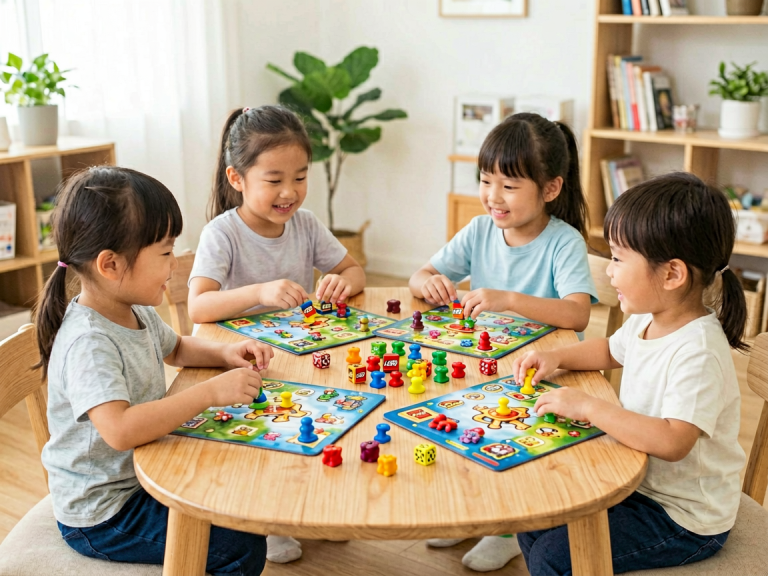
Cooperative Board Games are a powerful category. Unlike traditional competitive games where only one person wins, cooperative games require all players to work together toward a common goal. Titles like "The Sneaky, Snacky Squirrel Game" (a counting/strategy game) or "Hoot Owl Hoot!" (a color-matching race against time) teach teamwork, patience, and resilience. When children lose together, they learn to handle disappointment; when they win together, they celebrate shared success.
Emotion Recognition Tools are also valuable. Card games that ask children to identify feelings from facial expressions or scenarios can improve emotional vocabulary. Toys like "Feelings Flashcards" or "The Mood Box" encourage children to reflect on their own emotions and recognize them in others. For children who struggle with anger or anxiety, calm-down jars (glitter jars) or fidget toys can serve as sensory-regulation tools, helping them practice self-soothing.
Pretend Play Sets that mimic real-world roles—such as doctor kits, kitchen sets, or cash registers—allow children to practice social scripts. Through role-play, a six-year-old can learn how to take turns as a patient and a doctor, practice polite language, and negotiate. Playing with friends or siblings also requires them to share ideas, compromise, and manage disagreements. These simple interactions are the foundation of emotional intelligence.
Tips for Choosing the Right Learning Toys for Your 6-Year-Old
With so many options available, selecting the perfect learning toy can feel overwhelming. Here are a few evidence-based guidelines:
- Follow the child’s interests. A child who loves dinosaurs will be more engaged with a dinosaur excavation kit than with a generic science kit. Observe what naturally captures their attention—animals, space, building, art—and choose toys that build on that passion.
- Prioritize open-ended play. Toys that can be used in multiple ways (like blocks, clay, or magnetic tiles) offer more learning value than toys with a single, predetermined outcome. Open-ended toys encourage creativity and problem-solving over rote memorization.
- Check for appropriate challenge level. A toy that is too easy will bore a six-year-old; one that is too difficult will frustrate them. Look for toys that have adjustable difficulty or optional advanced rules. Many board games and construction sets include multiple levels of play.
- Avoid screens when possible. While there are excellent educational apps and digital games, the physical, tactile nature of traditional toys provides sensory input that screens cannot replicate. Fine motor development, hand-eye coordination, and social interaction are best fostered with tangible objects.
- Consider durability and safety. Six-year-olds are still developing impulse control, so toys should be sturdy and free of small parts that could pose a choking hazard. Read age recommendations carefully, and avoid toys with complicated electronic components that can break easily.
- Involve the child in the selection. Take your child to a toy store or browse online catalogs together. Ask them what they like and why. When children feel ownership over their toys, they are more likely to engage deeply with them.
Conclusion: Play as a Pathway to Lifelong Learning
Learning toys for six-year-olds are not merely accessories to childhood; they are tools that shape how a child understands the world. The best toys—whether a set of colorful magnetic tiles, a cooperative board game, or a simple set of watercolor paints—offer children the chance to experiment, fail, try again, and succeed on their own terms. They build confidence, resilience, and a love for discovery that will serve the child well beyond the early school years.
As parents, educators, and caregivers, we have the privilege and responsibility to curate an environment where play and learning are inseparable. When we choose toys with intentionality—focusing on the developmental needs of a six-year-old—we are not just buying objects; we are investing in habits of mind that will last a lifetime. So the next time you see a six-year-old deeply absorbed in stacking blocks, mixing colors, or negotiating the rules of a game, remember: they are not just playing. They are learning how to think, how to feel, and how to be human. And that is the most important lesson of all.
*(Word count: approximately 1,350 words)*