The Silent Curriculum: How Educational Toys Shape a Newborn’s First Discoveries
Introduction: Why the First Months Matter Most
In the hushed, dimly lit world of a newborn, every sensation is a revelation. The flutter of a mobile, the crinkle of soft fabric, the gentle chime of a rattle — these are not mere distractions. They are the building blocks of cognition, the first lessons in cause and effect, and the foundation of a lifelong relationship with learning. While many parents instinctively surround their infants with colorful objects, the concept of “educational toys for newborns” is often misunderstood. Some assume that education begins with flashcards or structured lessons. In reality, the most profound learning happens through play — and the right toys can transform that play into a powerful developmental tool.
This article explores the science behind newborn learning, offers a framework for selecting developmentally appropriate toys, and provides practical guidance for parents who wish to nurture their child’s curiosity from the very beginning. We will examine the key areas of development — sensory, motor, cognitive, and social-emotional — and show how thoughtfully chosen toys can support each one.
The Science of Early Brain Development
Before diving into specific toys, it is essential to understand what is happening inside a newborn’s brain. At birth, an infant’s brain contains roughly 100 billion neurons, but many of these connections are not yet formed. Synapses — the connections between neurons — are created at a breathtaking rate, especially during the first three years of life. This period is often called the “critical window” for sensory and motor development.
During the first few months, babies rely heavily on their senses: sight, sound, touch, taste, and smell. Their vision is blurry at birth, gradually sharpening over weeks. They are especially drawn to high-contrast patterns — black and white, bold reds and yellows — because these are easiest for their developing retinas to process. Their hearing is more mature; they recognize their mother’s voice from birth and are soothed by rhythmic sounds. Touch is perhaps the most vital sense of all, as skin-to-skin contact releases oxytocin and fosters emotional bonding.
Educational toys for newborns are designed to stimulate these senses in a safe, age-appropriate way. They are not “teaching” in the traditional sense; rather, they provide the raw material for neural wiring. Every time a baby grasps a textured ring, hears the shaker’s sound, or follows a moving object with their eyes, a new neural pathway is strengthened.
Key Principles for Choosing Newborn Educational Toys
Not every colorful object qualifies as educational. To maximize developmental benefit, parents should consider several principles:
1. Safety First
For newborns, toys must be free of small parts, sharp edges, and toxic materials. Look for certifications like ASTM or EN71. All items should be easy to clean, as babies frequently mouth objects. Size matters: anything small enough to fit through a toilet paper roll is a choking hazard.
2. Sensory Richness
The best newborn toys engage multiple senses simultaneously. A toy that is visually striking, makes a pleasant sound, and has varied textures offers more stimulation than a single-sensory object. For example, a soft crinkle book combines touch, sound, and sight.
3. Simplicity Over Complexity
Newborns have short attention spans and limited motor control. A toy that does too much — plays songs, lights up, moves — can overwhelm rather than engage. Simpler toys, such as a plain wooden rattle or a black-and-white pattern card, allow the baby to focus on one stimulus at a time.
4. Progressive Challenge
A good educational toy grows with the child. A play gym with dangling toys can be used first for visual tracking, then for batting, and later for grasping. Choose toys that offer different levels of interaction as the baby develops.
5. Open-Ended Possibilities
Toys that can be used in multiple ways encourage creativity and exploration. A soft block can be mouthed, stacked, squeezed, or dropped. In contrast, a battery-operated toy that does one thing (e.g., a singing plush) offers limited learning opportunities.
Age-Specific Categories of Educational Toys for Newborns
Development proceeds rapidly in the first year. What works at one month may bore a six-month-old. Here is a breakdown of toys suited to each stage, along with the developmental skills they target.
0–3 Months: Sensory Awakening
During the first three months, babies are primarily observers. Their vision improves from about 8–12 inches to farther distances. They begin to track objects and show interest in faces. The most effective toys at this stage are those that provide high-contrast visual stimulation and gentle auditory feedback.
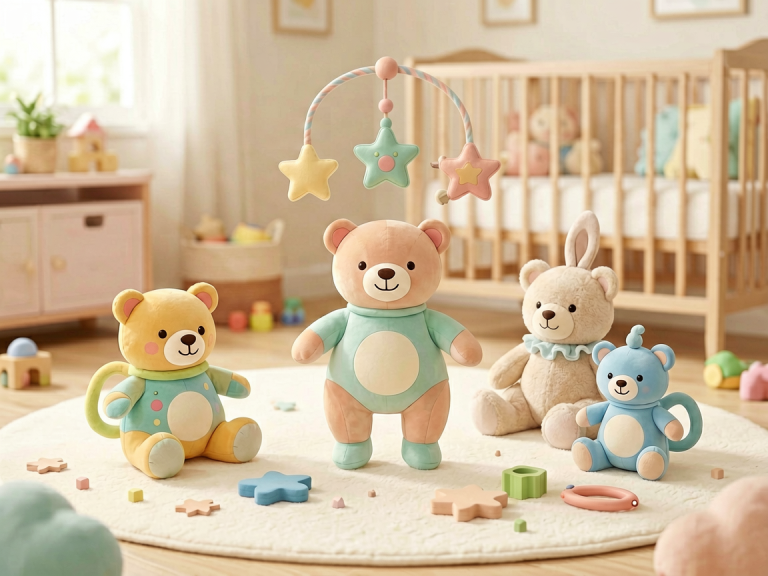
High-contrast black-and-white cards or mobiles. These are among the first toys a newborn truly “sees.” Placing a mobile with bold geometric patterns above the crib encourages visual focusing and tracking. Research shows that newborns prefer these patterns over pastels.
Soft rattles and chime toys. Lightweight rattles with a gentle sound — not too loud or jarring — help babies connect their own movements with auditory feedback. When a baby accidentally hits the rattle and hears a sound, a primitive cause-and-effect loop begins.
Textured sensory balls and fabric squares. Soft, bumpy, or crinkly textures introduced during tummy time encourage tactile exploration. These can be placed near the baby’s hands or feet so they discover them by chance.
Unbreakable mirrors. Babies are fascinated by faces, especially their own. A safe, shatterproof mirror placed low on the wall or on a play mat encourages self-recognition (which develops around 18 months) and provides visual stimulation.
3–6 Months: Grasping and Batting
Around three months, babies begin to reach for objects. Their hand-eye coordination improves, and they learn to intentionally grasp. Toys that invite grabbing, shaking, and mouthing are ideal.
Activity gyms or play mats with hanging toys. These encourage batting and reaching. Choose a gym with toys that are at different heights and textures. The baby will practice tracking with eyes and eventually swatting with hands.
Teething rings with varied textures. Teething is often uncomfortable, but textured rings provide oral stimulation and help with sensory integration. Look for BPA-free silicone or natural wood.
Soft blocks with patterns. Lightweight fabric blocks are easy to grasp. They can be knocked over, mouthed, and later stacked. The different patterns on each face stimulate vision.
Musical instruments like maracas or egg shakers. At this stage, babies can hold a small shaker and shake it intentionally. This reinforces the concept of agency — “I make this happen.”
6–12 Months: Cause, Effect, and Movement
From six months onward, babies become mobile — rolling, scooting, crawling, and eventually standing. They understand object permanence (that things exist even when hidden) and love to drop, throw, and retrieve items. Toys that encourage problem-solving and gross motor skills are key.
Stacking cups or rings. These classic toys teach size relationships, hand-eye coordination, and sequencing. A baby may first knock over a stack, then later attempt to place rings on a post. The cognitive leap is enormous.
Activity boxes with doors, latches, and buttons. Simple cause-and-effect toys, such as a box with a button that makes a sound or a door that opens to reveal a mirror, captivate infants. They learn that their actions produce predictable outcomes.
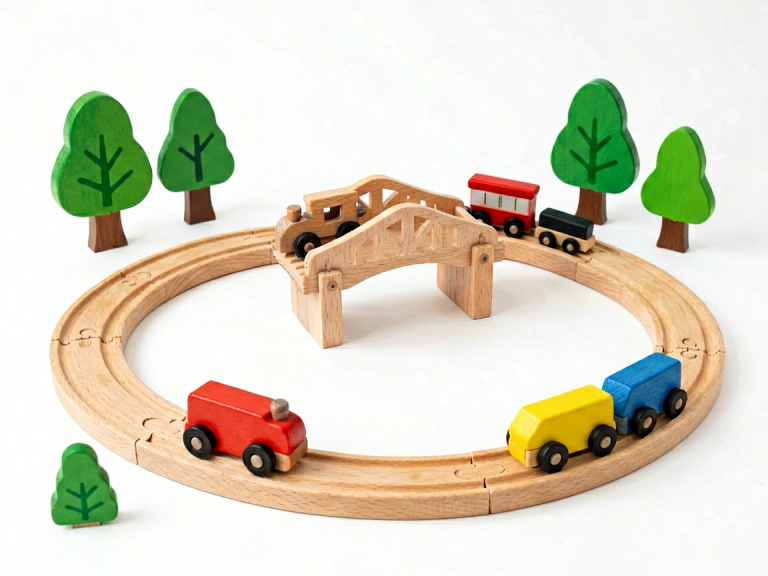
Push-and-pull toys. Once a baby can sit or stand, a push toy like a small wheeled cart with blocks encourages cruising and walking. The sound of the wheels turning adds auditory feedback.
Simple puzzles with large knobs. Around 9–12 months, some babies can place a circle into a round hole. Large, easy-to-grasp knobs make this possible. This builds spatial reasoning and fine motor control.
The Role of Parent Interaction
No toy, no matter how well designed, can replace the human connection. Educational toys are tools, but the real magic happens when a parent engages with the baby during play. Talking to the baby about what they are seeing, describing textures (“This is soft”), and celebrating discoveries (“You shook the rattle!”) dramatically enhances learning. Language development depends on this back-and-forth interaction.
Furthermore, parents should observe their baby’s cues. If the baby turns away or becomes fussy, they are overstimulated. Follow the child’s lead. Some days they may want to explore a new toy; other days they prefer familiar comfort objects.
Safety and Maintenance: Non-Negotiables
Given that newborns explore primarily with their mouths, hygiene and safety are paramount. Wash fabric toys regularly in hot water. Wipe down plastic and wooden toys with a mild disinfectant. Inspect toys for wear — loose stitching, cracked plastic, or splinters — and discard damaged items.
Avoid toys with long strings or cords that could pose a strangulation risk. Battery compartments should be secured with screws. Never leave a baby unattended with a toy that has small parts, even if labeled age-appropriate.
Finally, be mindful of overstimulation. A nursery filled with beeping, flashing, musical toys can overwhelm an infant’s developing sensory system. The best environment is one that offers variety but also calm periods for rest and quiet bonding.
Conclusion: Laying the Foundation
Educational toys for newborns are not about pushing academic skills onto infants. They are about respecting the tiny scientist within every baby — the one who studies every shadow, tastes every surface, and listens to every sound. By choosing toys that are safe, sensory-rich, and developmentally aligned, parents provide the raw materials for neural growth. But the greatest gift remains the loving presence of a caregiver who shares in the wonder.
The first year is a silent curriculum, written in giggles, drool, and curious eyes. With thoughtful guidance, that curriculum becomes the bedrock of a lifetime of learning. So pick up a rattle, lie down on the play mat, and watch your newborn teach you what it truly means to discover the world.