The Silent Symphony: How Developmental Toys Shape a Newborn’s First Language of Learning
Introduction: The First Canvas of the Mind
A newborn enters the world not as a blank slate, but as an eager explorer whose every sense is a portal to understanding. In the quiet, dimly lit hours of early infancy, the most profound learning occurs—not through lectures or flashcards, but through the gentle touch of a soft rattle, the contrasting patterns of a black-and-white mobile, and the reassuring sound of a crinkling fabric toy. These are not mere distractions; they are the building blocks of neural architecture. Developmental toys for newborns are the unsung heroes of early childhood, meticulously designed to align with the rapid, almost miraculous unfolding of a baby’s brain. This article delves into the science, the selection, and the profound impact of these first playthings, arguing that they are not luxuries but essential tools for nurturing the cognitive, sensory, and emotional foundations of life.
The Neuroscience of Early Play: Why Newborns Need More Than Just Love
The Critical Window of Synaptic Growth
During the first three months of life, a newborn’s brain forms approximately 1 million new neural connections every second. This explosive period of synaptogenesis is guided by experience—specifically, by sensory stimulation. Every sight, sound, touch, and movement carves a pathway that will either be strengthened or pruned away. Developmental toys are designed to provide precisely calibrated stimulation. For instance, a high-contrast black-and-white card triggers the visual cortex, encouraging the formation of pathways responsible for pattern recognition and focus. Without such targeted input, the brain’s plasticity remains underutilized. A newborn does not need a roomful of toys, but they do need intentional, developmentally appropriate objects that speak to their current stage of sensory awakening.
The Role of Multisensory Integration
Newborns experience the world as a blur of disconnected sensations—the warmth of a blanket, the sound of a mother’s voice, the sight of a moving shadow. They cannot yet integrate these into a coherent whole. Developmental toys serve as bridges. Consider a simple fabric ball with a bell inside: the baby sees its bright colors, feels its soft texture, hears its gentle chime, and may even bring it to their mouth. This simultaneous activation of multiple senses encourages cross-modal integration, a critical cognitive skill that underpins later abilities such as reading (linking visual symbols to sounds) and language (connecting spoken words to objects). The toy is not just a plaything; it is a tiny classroom for neural coordination.
Categories of Developmental Toys for Newborns: A Guided Tour
Visual Stimulation Toys: The Art of Seeing
In the first weeks, a newborn’s vision is blurry, limited to approximately 8 to 12 inches, and they are most attracted to high-contrast patterns—especially black, white, and red. Visually stimulating toys in this category include:
- Black-and-white contrast cards or mobiles: These are not arbitrary decorations. Research shows that high-contrast geometric patterns (stripes, checkerboards, bullseyes) capture a newborn’s gaze longer than muted colors, thereby strengthening the ocular muscles and the brain’s visual processing centers. A mobile hung over the crib at the correct distance (about 12 inches) becomes a mesmerizing universe of shapes that encourages tracking.
- Soft books with bold patterns: Cloth books featuring simple, high-contrast images (faces, circles, wavy lines) allow a baby to “read” with their eyes, even before they can grasp. Placing a baby on their back and slowly moving such a book across their field of vision teaches them to follow objects—a precursor to reading and hand-eye coordination.
Auditory and Tactile Toys: The Sound and Feel of Discovery
Newborns are born with a fully functioning auditory system, though they prefer high-pitched, soothing sounds (the reason “motherese” works so well). Tactile sensitivity is also acute, especially around the mouth and hands. Ideal toys in this category include:
- Soft rattles and crinkle toys: A rattle that is easy to hold (with a chunky handle or soft straps) emits a gentle, non-startling sound when shaken. Even if the baby cannot yet intentionally shake it, they will accidentally trigger the noise, creating a cause-and-effect experience—a foundational concept for logical thinking. Crinkle toys, made from rustling fabric, provide a surprising auditory texture that makes the baby pause, listen, and turn their head toward the sound, thereby developing sound localization.
- Textured teething rings and sensory balls: While teething typically begins later, offering safe, silicone or fabric toys with varied textures (nubs, ridges, bumps) allows a newborn to explore with their mouth and hands. This oral and manual exploration maps the sensory cortex—the part of the brain that connects touch with recognition.
Motor Development Toys: The First Stretches and Swipes
Newborns have limited voluntary movement, but they are born with reflexes (grasping, rooting, stepping) that lay the groundwork for motor skills. Developmental toys that encourage movement include:
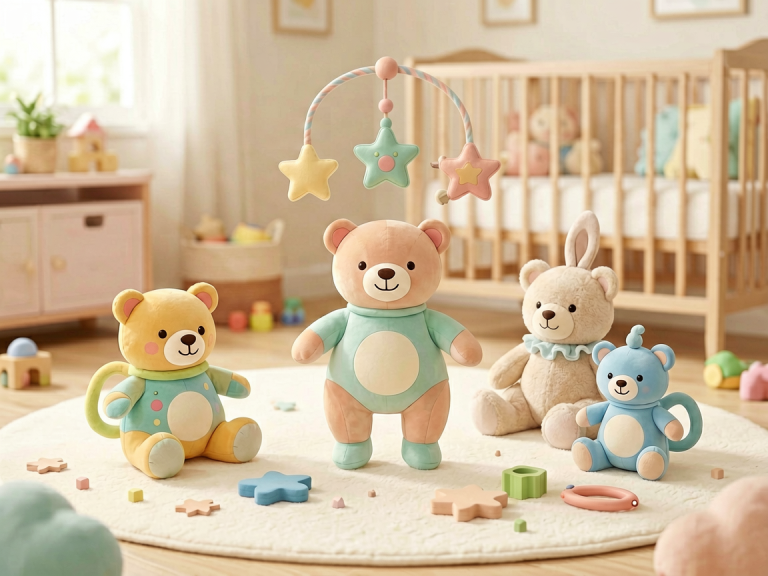
- Activity gyms and play mats: A soft mat with hanging toys (often with mirrors, bells, and high-contrast patterns) invites a baby to bat at the toys, kick their legs, and turn their head. Tummy time mats with built-in pillows and dangling objects are particularly crucial. Tummy time strengthens neck, back, and shoulder muscles, preventing flat spots and preparing for rolling and crawling. The toys on the mat provide a motivation to lift the head and reach out—a subtle but powerful motor challenge.
- Grasping toys and wrist rattles: Some toys are designed to be strapped onto a baby’s wrist or ankle. When the baby waves their arm or kicks, the toy moves and makes a sound, reinforcing the connection between action and reaction. This self-generated feedback is more powerful than any passive observation because it teaches agency—the baby learns, “I did that.”
How to Choose the Right Developmental Toys: Safety, Simplicity, and Sensitivity
Safety First: The Non-Negotiable Rule
For newborns, safety is paramount. Every toy must be free of small parts that could be a choking hazard (use a toilet paper tube as a gauge—if the part fits inside, it is unsafe). Materials should be non-toxic, BPA-free, and phthalate-free. Avoid toys with long strings or ribbons longer than 12 inches, as these pose strangulation risks. All toys should be easy to clean (newborns mouth everything), either by machine washing or wiping with mild soap. Additionally, avoid loud, jarring noises—newborns’ ears are sensitive, and sudden loud sounds can startle and distress them.
Less Is More: The Principle of Minimalist Stimulation
A common mistake among eager parents is overwhelming a newborn with a cascade of bright, noisy, flashing toys. In reality, newborns have a very limited attention span (often only a few minutes at a time) and can become overstimulated easily. Signs of overstimulation include fussiness, turning away, arching the back, or falling asleep abruptly. The best developmental toys are simple, offering one or two features at a time. A single black-and-white mobile with soft music is more effective than a multi-colored, interactive electronic toy. The goal is not to entertain but to gently challenge the baby to focus, track, and respond.
Age-Appropriate Progression
Developmental toys should evolve with the baby. For a newborn (0–2 months), prioritize high-contrast visuals and gentle sounds. At around 2–3 months, introduce toys that encourage reaching and batting. By 3–4 months, toys that can be grasped and brought to the mouth become more interesting. Parents should observe their baby’s cues: if a toy holds their attention for even 10 seconds, it is serving its purpose. If the baby ignores it or turns away, it may be too complex or not yet relevant to their stage.
The Emotional and Social Dimensions of Toy Play
Bonding Through Shared Attention
Developmental toys are not meant to be used in isolation. The most significant benefit arises when an adult engages with the baby using the toy. Talking to the baby about the toy (“Look at the red circle! Can you hear the rattle?”) provides language exposure, social reciprocity, and emotional warmth. The baby learns that play is a shared, joyful experience, which fosters secure attachment. A toy that elicits a smile or a coo becomes a bridge for connection.
Preventing Sensory Deprivation
In some environments—particularly in hospitals or homes with minimal stimulation—newborns may not receive enough sensory input, leading to delays in visual tracking or motor milestones. While “tummy time” and parental interaction are the most important, developmental toys fill the gaps. For instance, a baby who cannot yet lift their head well benefits from a bright toy placed in their line of sight, encouraging them to try. Toys should never replace human interaction, but they can supplement it, especially when a parent needs to put the baby down briefly.
Conclusion: The Quiet Investment in a Lifetime of Learning
The world of a newborn is a magnificent cacophony waiting to be sorted into a symphony. Developmental toys are the conductors—offering rhythm, contrast, and melody in the form of gentle rattles, soft textures, and stark patterns. They are not about “early academics” or pushing milestones; they are about honoring the baby’s intrinsic drive to explore, giving them safe and responsive materials with which to do so. A well-chosen toy does not “teach” a baby; it invites the baby to teach themselves. It whispers, “You can focus. You can reach. You can make a sound.” And in those whispers, the architecture of a curious, capable mind is laid, brick by neural brick.
Parents who invest in thoughtful, simple, developmentally appropriate toys are not just buying playthings. They are curating the first gallery of the baby’s world. They are offering the baby a language before words—a language of sensation, movement, and discovery. And that language, once spoken, will never be forgotten. So choose wisely, observe closely, and let the silent symphony begin.