The Transformative Power of Learning Toys for 9-Year-Olds: Building Skills for a Lifetime
Introduction: The Critical Leap at Age Nine
At nine years old, children stand at a fascinating crossroads of development. They have outgrown the simple, sensory-driven play of early childhood, yet they are not quite ready for the abstract, high-stakes academics of middle school. This age is a sweet spot where curiosity is at its peak, logical reasoning begins to flourish, and social awareness deepens. The right learning toys for 9-year-olds can harness this transformative energy, turning play into a vehicle for cognitive growth, emotional resilience, and creative exploration. Unlike toys that merely entertain, learning toys are designed to challenge, inspire, and teach—often without the child even realizing they are learning. In this article, we will explore why these toys are essential, what categories best suit a nine-year-old’s developing brain, and how parents can make informed choices that foster a lifelong love of discovery.
The Cognitive Landscape of a 9-Year-Old
Before diving into specific toys, it is crucial to understand what is happening inside a nine-year-old’s mind. According to developmental psychologist Jean Piaget, children at this age are in the “concrete operational stage.” They can think logically about concrete events, understand cause and effect, and perform mental operations like sorting, sequencing, and classification. However, they still struggle with purely abstract or hypothetical concepts. This means that learning toys should provide tangible, hands-on experiences that allow them to manipulate objects, test hypotheses, and see immediate results. Additionally, nine-year-olds are developing a stronger sense of self-efficacy—they want to feel competent and capable. Toys that offer incremental challenges, clear feedback, and opportunities for mastery are particularly effective. Furthermore, their attention spans are lengthening, enabling them to engage in more complex, multi-step activities that may take an hour or more to complete. This is the perfect age to introduce toys that require planning, patience, and iterative problem-solving.
STEM Toys: Engineering the Future
One of the most powerful categories of learning toys for nine-year-olds is STEM (Science, Technology, Engineering, and Mathematics). At this age, children are ready to move beyond simple building blocks and into more sophisticated construction kits. Robotics kits, for instance, allow them to assemble motors, sensors, and gears to create moving machines. Many modern kits come with programmable components that introduce basic coding concepts through visual drag-and-drop interfaces. A nine-year-old can build a robotic arm that picks up objects or a line-following car, learning about mechanical advantage and sequential logic in the process. Another excellent option is a circuit-building set, where children snap together wires, batteries, LEDs, and switches to create working electronic devices. These toys teach electricity fundamentals, problem-solving, and the satisfaction of seeing a bulb light up after troubleshooting a faulty connection. For children interested in chemistry, there are safe, age-appropriate chemistry sets that use everyday materials to demonstrate reactions, crystallization, and pH testing. The key is that these toys are not passive; they require active engagement, trial and error, and a willingness to learn from failure—skills that are far more valuable than memorizing facts.
Creative Construction: Beyond Legos
While classic building blocks remain popular, nine-year-olds crave more versatility and realism. Advanced construction sets, such as magnetic tiles, marble runs, or architectural model kits, encourage spatial reasoning and design thinking. For example, a magnetic tile set can be used to build intricate 3D structures, bridges, and even simple machines like pulleys. Marble runs teach gravity, trajectory, and the importance of precise angles. Some kits even incorporate gears and levers, allowing children to experiment with mechanical advantage. Another growing trend is open-ended craft kits that combine engineering with art, such as sewing machines for kids that let them design and stitch their own fabric creations, or 3D printing pens that allow them to draw in three dimensions. These toys blur the line between art and science, fostering a growth mindset where mistakes become design iterations. They also help develop fine motor skills and hand-eye coordination, which are still refining at this age.
Board Games: The Social Learning Revolution
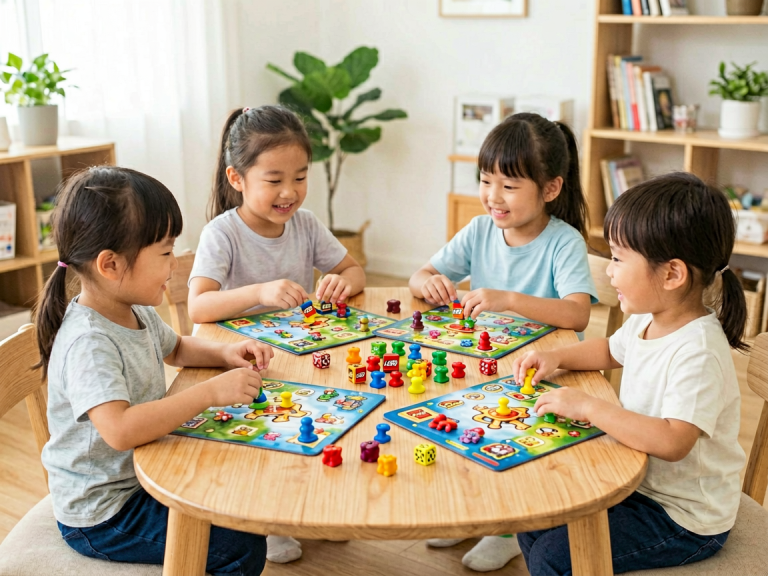
Learning toys for nine-year-olds are not limited to solitary activities. In fact, social interaction is a critical component of development at this age. Cooperative and strategic board games offer a rich environment for learning. Games that require negotiation, resource management, and forward planning—such as “Catan: Junior” or “Ticket to Ride: First Journey”—teach mathematics (counting, probability), logic, and social skills like turn-taking and gracious losing. More dedicated educational games focus on spelling, grammar, or geography, turning academic subjects into competitive fun. For instance, a game that involves mapping countries or states can cement geographical knowledge far better than a worksheet. There are also coding board games that use cards and tokens to simulate programming logic, introducing concepts like loops, conditionals, and debugging without a screen. The shared experience of playing a game also builds emotional intelligence: children learn to read others’ intentions, manage frustration, and collaborate toward a common goal. In an era when digital play often isolates, board games bring families and friends together around a table, creating memories while building brains.
Language and Literacy Toys: Words as Play
Reading and writing skills surge at age nine, but many children still view them as chores. Learning toys can make language acquisition engaging. One powerful tool is a subscription-based “story starter” kit that provides themed prompts, character cards, and setting dice to inspire creative writing. Children roll the dice to determine a story’s protagonist, conflict, and setting, then write their own narratives. This not only improves vocabulary and grammar but also narrative structure and imagination. For vocabulary building, word-building tiles or magnetic poetry sets allow children to physically manipulate words, creating poems or sentences on a magnetic board. There are also electronic reading pens that scan text and read it aloud, helping struggling readers build confidence. For bilingual families or those learning a second language, interactive flashcards with audio and games can make vocabulary practice feel like a game show. The key is to present language as a tool for storytelling and self-expression, not just a subject to be tested.
Outdoor and Physical Learning Toys
Nine-year-olds still have abundant energy, and learning can happen outside the classroom or living room. Science exploration kits designed for the outdoors—like bug-catching kits with magnifying glasses, plant pressers, or weather stations—turn a backyard into a laboratory. A simple compass and map activity can teach orienteering and basic geometry. For a more structured approach, some companies sell “treasure hunt” kits that require solving math problems or riddles to find hidden clues, combining physical movement with mental challenge. Building a birdhouse or a simple catapult from a kit teaches practical engineering and carpentry skills. Physical activity also boosts brain function: studies show that exercise improves attention and memory, so toys that encourage running, jumping, or balancing—like agility ladder sets or slacklines—are not just fun but neuroprotective. Even a classic jump rope can be turned into a learning tool by counting jumps, timing intervals, or reciting multiplication tables in rhythm.
Choosing the Right Toy: A Parent’s Guide
With so many options, selecting the best learning toys for a nine-year-old can be overwhelming. Start by observing your child’s natural interests. A child who loves building will thrive with a construction kit; a child who loves asking “why” might enjoy a science experiment set. Avoid toys that are too easy (they bore quickly) or too hard (they frustrate). Look for toys that offer multiple levels of difficulty or open-ended play, so they can grow with the child. It is also wise to choose toys that minimize screen time—while some digital tools are excellent, hands-on, tactile play is irreplaceable for neural development. Finally, consider the toy’s potential for social interaction: can it be played alone, with siblings, or with friends? A toy that encourages collaboration is often more valuable than one that isolates. Remember, the goal is not to create a “genius” but to foster a love of learning, resilience in the face of challenges, and the joy of discovery.
Conclusion: Play Is the Highest Form of Research
Albert Einstein once said, “Play is the highest form of research.” For a nine-year-old, learning toys are not just diversions; they are laboratories where hypotheses are tested, failures are accepted, and victories are earned. Whether it’s a robotics kit that teaches programming logic, a board game that sharpens strategy, or a magnifying glass that reveals the hidden world of insects, these tools lay the groundwork for critical thinking, creativity, and confidence. As parents and educators, our responsibility is to provide the raw materials for this research—not to dictate the outcomes. By choosing thoughtful learning toys, we give nine-year-olds the gift of agency: the chance to explore the world on their own terms, one playful experiment at a time. So the next time you see a child deeply absorbed in a challenging puzzle or a building project, remember: they are not just playing. They are building the architecture of their future minds.