Unlocking Potential: The Best Educational Toys for 7-Year-Olds to Foster Growth and Curiosity
Introduction
At age seven, children enter a magical stage of cognitive and social development. They have moved beyond the basics of reading and math, yet their minds are still wonderfully plastic, eager to explore complex ideas through play. The right educational toys can transform casual fun into powerful learning experiences—sharpening problem-solving skills, nurturing creativity, and building resilience. But with a sea of options on the market, how do parents and educators choose truly beneficial toys? This article dives deep into the best educational toys for 7-year-olds, organized by key developmental domains. Each section explains why a particular category matters and highlights concrete examples that balance engagement with educational value. By the end, you will have a curated roadmap to help your seven-year-old thrive through play.
1. Building Blocks of STEM: Coding and Robotics Kits
Seven-year-olds are naturally curious about how things work. They ask “why” and “how” constantly, and STEM toys channel that curiosity into structured exploration. Coding and robotics kits are particularly powerful because they teach sequencing, logical reasoning, and the satisfaction of debugging—all while feeling like a game.
Why they work: At this age, children can grasp basic programming concepts such as loops, conditionals, and variables when presented in a visual, block-based format. Robotics kits add a tangible dimension: a child writes code, and a robot moves, lights up, or makes sounds. This immediate feedback loop reinforces cause-and-effect thinking and builds computational literacy without the frustration of syntax errors.
Top picks:
- LEGO Boost Creative Toolbox – This kit combines classic LEGO bricks with a programmable hub and motors. Kids build five different models (a robot, a guitar, a cat, etc.) and use a simple drag-and-drop app to bring them to life. The open-ended nature encourages redesigns and custom behaviors. I have seen seven-year-olds spend hours tweaking their robot’s path to navigate a cardboard maze—unconsciously practicing geometry and algebra.
- Osmo Coding Starter Kit – Osmo uses the iPad’s camera to create an augmented reality experience. Physical coding blocks are placed in front of the screen, and characters like Awbie the monster respond instantly. This hybrid of tactile and digital play is ideal for children who need a break from pure screen time but still crave interactive feedback.
- Botley 2.0 the Coding Robot – For families wanting a screen-free option, Botley 2.0 is a gem. Kids program it through a remote controller, entering up to 150 steps. It can detect objects, follow black lines, and even transform into a train or a ghost. The absence of a screen means fewer distractions and more collaborative play.
Educational impact: Beyond coding, these toys nurture persistence. When a robot fails to follow instructions, a child must retrace their steps, identify the error, and try again—a process that builds executive function and a growth mindset, both crucial for later academic success.
2. Creative Exploration: Art and Craft Sets
While STEM skills dominate modern educational discourse, creativity remains the engine of innovation. For seven-year-olds, open-ended art supplies and craft kits offer more than just fun: they develop fine motor control, spatial reasoning, and emotional expression. The key is choosing sets that provide structure without over-constraining.
Why they work: At seven, children can handle scissors, glue, and small beads with increasing dexterity. They also begin to plan their creations in advance, moving from random scribbles to intentional designs. Art toys that require following multi-step instructions (like a weaving loom or a bead jewelry kit) strengthen attention span and procedural memory. Meanwhile, completely free-form materials (clay, paints, recycled objects) encourage divergent thinking—the ability to generate multiple solutions to a single problem.
Top picks:
- KiwiCo Craft Discovery Boxes – These subscription boxes deliver themed craft activities that blend art with science. One month might involve making a solar system mobile (painting planets and understanding orbits), and the next could be a stop-motion animation kit. Each box includes high-quality materials and illustrated instructions that children can follow independently.
- Spirograph Deluxe Set – A classic that never grows old. The interlocking gears allow children to create intricate geometric patterns that look like professional art. The act of planning which gear to use and how to rotate it teaches algebraic thinking (ratios, symmetry) while producing gorgeous results.
- Melissa & Doug Deluxe Wooden Bead Set – Simple but endlessly versatile. Stringing beads in patterns (e.g., red-blue-red-blue) introduces early patterning and sequencing. More advanced children can design necklaces for specific people, incorporating color theory and empathy.
Educational impact: Creative play reduces anxiety and fosters a sense of agency. When a child says, “I made this,” they are not just proud of an object—they are proud of their ability to bring an idea to life. This boosts self-efficacy, which correlates strongly with academic motivation and social competence.
3. Logic and Strategy: Board Games and Puzzles
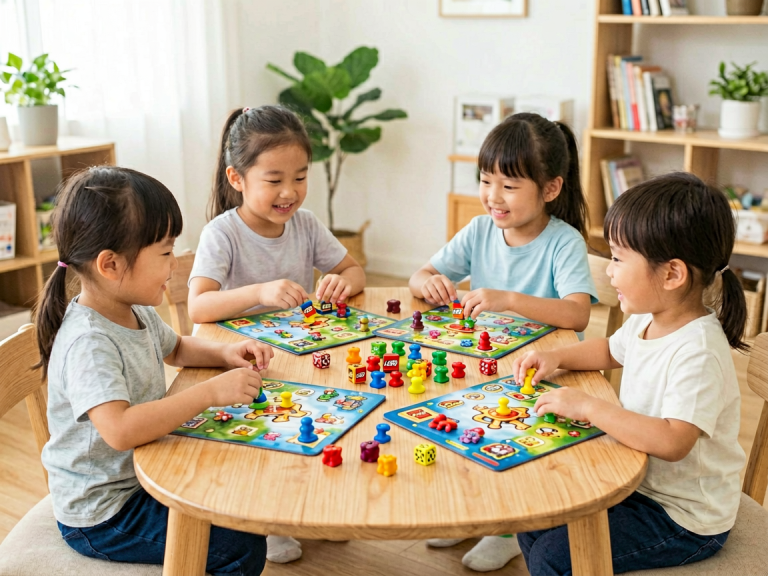
Board games are perhaps the most underestimated educational tools for seven-year-olds. They teach patience, turn-taking, and sportsmanship while simultaneously exercising working memory, planning, and flexible thinking. Puzzles, especially those with 100–200 pieces, train visual-spatial skills and concentration.
Why they work: Seven-year-olds have the attention span to sit through a 30-minute game, and they are old enough to understand rules that involve a small degree of strategy. Unlike many digital games, analog board games require face-to-face interaction, reading social cues, and managing emotions when losing. These are life skills that no app can replicate.
Top picks:
- Ticket to Ride: First Journey – A simplified version of the classic train route-building game. Players collect colored cards to claim railway routes across a map. It teaches geography, counting, risk assessment (do I go for a long route or multiple short ones?), and flexible thinking when opponents block your path.
- Rush Hour Logic Game – A single-player puzzle where the child slides cars and trucks to free a red car from a traffic jam. Each challenge card increases in difficulty. It is pure spatial reasoning—rotating vehicles mentally and planning multiple moves ahead. I have observed seven-year-olds who struggle with math suddenly excel at Rush Hour because it uses visual logic instead of numbers.
- Ravensburger Puzzles (100–150 pieces) – Ravensburger’s precision-cut pieces and vibrant images make puzzling addictive. The act of sorting edges, identifying patterns, and fitting pieces strengthens visual discrimination and perseverance. For a collaborative twist, families can work on a puzzle together, modeling teamwork and communication.
Educational impact: Research shows that regular board game play improves executive functions such as inhibitory control (not grabbing the first piece you see) and cognitive flexibility (changing strategies mid-game). These skills are better predictors of academic achievement than IQ in early elementary school.
4. Language and Literacy: Interactive Reading Tools
Seven is a pivotal year for reading. Children transition from “learning to read” to “reading to learn,” but they still need scaffolding to build vocabulary, comprehension, and a love of stories. Interactive reading toys can bridge the gap between picture books and chapter books, making literacy feel like an adventure rather than a chore.
Why they work: Games that require reading instructions, decoding clues, or creating narratives naturally boost literacy. The best options combine physical play with text—so the child does not feel like they are “studying.” Moreover, storytelling toys encourage children to become authors themselves, which deepens their understanding of plot, character, and sequence.
Top picks:
- Story Time Chess – This innovative set teaches chess using storybooks that personify each piece. For example, the King is a sleepy king who moves one step at a time. The stories are so engaging that children learn the rules without realizing it. By age seven, many children can play a full game of chess using the narrative cues, building vocabulary (e.g., “castling,” “checkmate”) and strategic thinking.
- LeapFrog LeapReader (with activity books) – The LeapReader pen reads words aloud when you touch them, providing pronunciation, definitions, and sound effects. It is excellent for independent reading practice, especially for struggling readers who need audio support without feeling embarrassed.
- Rory’s Story Cubes – A set of nine dice with pictures on each face (e.g., a key, a bird, a question mark). Players roll the dice and must tell a story that incorporates all the images. This game sparks oral language development, creativity, and narrative sequencing. It can be played solo or in a group, and the stories are always hilarious and unpredictable.
Educational impact: According to the National Literacy Trust, children who enjoy reading are three times more likely to have above-average reading skills. Toys that make reading playful—rather than a solitary, silent activity—cultivate that enjoyment. They also support English language learners by providing visual and auditory cues together.
5. Hands-On Science: Experiment Kits
Seven-year-olds are budding scientists. They love mixing, pouring, and observing reactions—even if the outcome is a messy, colorful explosion. Science experiment kits allow them to conduct safe, guided investigations that teach the scientific method: ask a question, form a hypothesis, test it, and observe results.
Why they work: These kits satisfy a child’s natural urge to explore cause and effect while building patience and attention to detail. Many include real lab tools (test tubes, pipettes, magnifying glasses) that make children feel like real researchers. The best kits also include “why it works” explanations written at a seven-year-old’s reading level.
Top picks:
- Snap Circuits Jr. SC-100 – A classic electronics kit where components (lights, buzzers, fans) snap onto a plastic grid. Children build working circuits by following diagrams. They can create a doorbell, a flying fan, or a light controlled by a switch. This introduces electricity, conductivity, and circuit design in a completely safe, frustration-free way.
- NATIONAL GEOGRAPHIC Mega Crystal Growing Lab – Children mix chemicals and watch crystals grow over several days. The kit includes a display stand and a real geode to crack open. The waiting period teaches delayed gratification, and the final crystals are beautiful enough to inspire wonder about geology and chemistry.
- Thames & Kosmos Chem C1000 – For more advanced seven-year-olds who have already dabbled in science, this chemistry set offers 125 experiments, from making invisible ink to creating slime. The manual explains the chemical reactions in simple language, and the included safety glasses make it feel official.
Educational impact: Hands-on science promotes inquiry-based learning. Instead of memorizing facts, children learn to ask, “What will happen if…?” This mindset is foundational for higher-order thinking in all subjects. Moreover, successful experiments boost confidence—failure becomes simply “another interesting result.”
6. Physical and Social Play: Cooperative Games and Active Toys
Cognitive development is incomplete without physical and social growth. Seven-year-olds need to run, climb, and negotiate with peers. Educational toys in this category focus on gross motor skills, teamwork, and emotional regulation—all while being undeniably fun.
Why they work: Many seven-year-olds are starting organized sports, but cooperative games offer a different lesson: winning is not the only goal. These toys emphasize working together toward a common objective, learning to communicate, and handling setbacks as a team. Active play also releases endorphins, improving mood and focus for sedentary learning later.
Top picks:
- Haba Animal Upon Animal – A dexterity game where players stack wooden animals on an ever-precarious crocodile. Each wrong move can topple the tower, but everyone works together to keep it balanced. The game requires fine motor control and patience, and it often leads to shared laughter rather than tears.
- Bilibo – A single, shell-shaped plastic toy that can be used as a spinning seat, a building block, a sled, or a cradle. Its open-endedness encourages creative physical play—kids invent their own games, such as “who can spin the longest?” It develops balance and core strength without feeling like exercise.
- Soccer Ball with a Built-in Pump (e.g., Franklin Sports) – Simple but brilliant: a soccer ball that includes a miniature pump inside. This incentivizes children to inflate the ball themselves (responsibility) and then organize a pickup game with friends. Running and kicking builds cardiovascular health, and the social negotiation of rules teaches compromise and equity.
Educational impact: Physical play is linked to improved cognitive function, particularly in working memory and attention. Cooperative games specifically reduce aggressive behaviors and increase prosocial skills like sharing, listening, and encouraging others—all of which are vital for classroom harmony.
Conclusion
Choosing the best educational toys for seven-year-olds is not about buying the most expensive or the most “academic” options. It is about balance. A well-rounded toy shelf should include STEM kits that challenge logical thinking, art sets that spark creativity, board games that teach strategy and social grace, reading tools that build literacy, science kits that cultivate curiosity, and active play items that strengthen the body and mind. Each toy in this list has been selected because it respects a seven-year-old’s developmental stage: they are complex enough to engage but not so daunting as to cause frustration. Remember, the true educational value of any toy lies in how it is used. When a child is absorbed in play—whether debugging a robot or stacking animals—they are learning how to learn. And that is the most important skill of all.