Wooden vs. Plastic Toys for 9-Month-Olds: A Comprehensive Guide for Parents
Introduction
The ninth month of life marks a remarkable developmental leap. Infants at this age are typically sitting unsupported, beginning to crawl, pulling themselves up to stand, and exploring their environment with newfound vigor. Their fine motor skills are developing rapidly: they grasp objects with a pincer grip, transfer toys from hand to hand, and delight in shaking, banging, mouthing, and dropping everything within reach. For parents and caregivers, selecting appropriate toys during this critical window is not merely a matter of entertainment—it is a profound investment in the child’s sensory, cognitive, and physical growth. Among the most debated choices is the material of the toys themselves: wooden versus plastic. While both have merits, the decision carries implications for safety, developmental stimulation, environmental sustainability, and long-term learning. This article delves deeply into the science, practical considerations, and expert recommendations to help parents make an informed choice for their nine-month-old.
Safety First: Materials, Toxins, and Physical Hazards
Chemical Safety and Regulatory Standards
At nine months, everything goes into the mouth. The mouth is a primary sensory organ for infants, and toys are constantly chewed, slobbered on, and swallowed (if small enough). Therefore, the chemical composition of toys is paramount. High-quality wooden toys are typically made from solid hardwoods like beech, maple, or birch, finished with non-toxic, water-based paints or natural oils. They often carry certifications such as EN71 (European standard) or ASTM F963 (American standard), ensuring they are free from lead, phthalates, BPA, and other endocrine disruptors. Plastic toys, on the other hand, vary widely. Many mass-market plastics contain bisphenol A (BPA) or phthalates that can leach when chewed. Even "BPA-free" plastics may contain substitutes like bisphenol S (BPS), which have similar health concerns. For a nine-month-old who mouths toys constantly, the risk of ingesting harmful chemicals from cheap plastic is non-negligible. However, high-quality plastic toys made from food-grade silicone or polypropylene (PP) are generally safe. The key is to look for reputable brands that voluntarily test and label their products.
Choking Hazards and Durability
Another critical safety dimension is the risk of choking. At nine months, infants have a strong bite but limited coordination. Wooden toys, being rigid and often solid, rarely break into small pieces unless deliberately splintered—a rare occurrence with well-made toys. Plastic toys, however, can crack or shatter under pressure, potentially creating sharp edges or small fragments. Additionally, many plastic toys contain batteries, screws, or other small components that can become loose. A nine-month-old’s exploratory behavior includes pulling, twisting, and dropping toys, all of which can dislodge parts. Wooden toys typically have fewer detachable pieces, and if they do (e.g., a wooden ring stack), the parts are large enough to be safe. Nevertheless, parents must always inspect any toy for loose parts, regardless of material.
Hygiene and Cleaning
Infants are notorious for spreading germs through saliva and mouthing. Plastic toys are non-porous and can be easily wiped down with disinfectant wipes or washed in warm, soapy water. Some can even go in the dishwasher. Wooden toys, being porous, cannot be soaked without risking damage to the finish or promoting mold growth. They require gentle cleaning with a damp cloth and mild soap, followed by air drying. During cold and flu season, plastic toys have a clear advantage in terms of sanitation. However, many natural wood finishes are antibacterial (e.g., beeswax), and regular wiping is sufficient. Parents must weigh the convenience of sterilization against the benefits of wood’s natural properties.
Developmental Benefits: Engaging the Senses and Motor Skills
Tactile and Proprioceptive Input
The developing brain of a nine-month-old thrives on varied sensory input. Wooden toys offer a unique tactile experience: the warmth of natural grain, the slight texture of unfinished surfaces, the satisfying weight and solidity. When an infant picks up a wooden block, they receive proprioceptive feedback—the sense of weight and resistance—that helps build body awareness and fine motor control. Plastic toys, by contrast, are often lightweight, smooth, and uniform. While this can be easier for a baby to handle initially, it provides less nuanced sensory information. The weight difference also influences how a baby learns to coordinate arm and hand muscles. Heavier wooden toys require more effort to lift and move, which strengthens the muscles needed for later skills like drawing or using utensils.
Sound and Visual Stimulation
Sound is another important factor. When a wooden toy is dropped, it produces a natural, resonant thud that is pleasing and predictable. Plastic toys often generate a higher-pitched, hollow rattle or a sharp clatter. For a nine-month-old who is beginning to understand cause and effect (I drop the toy, it makes a sound), the acoustic variety matters. Moreover, wooden toys usually have simpler designs with clear colors and natural wood contrast, which are easier for developing vision to process. Plastic toys can be overly bright, flashing, and noisy, which may overstimulate a nine-month-old’s still-maturing nervous system. While some stimulation is beneficial, too much can lead to fussiness and difficulty focusing. Montessori and Waldorf philosophies advocate for "simple, beautiful" toys that invite rather than command attention—and wood fits that ideal.
Open-Ended Play vs. Battery-Operated Functions
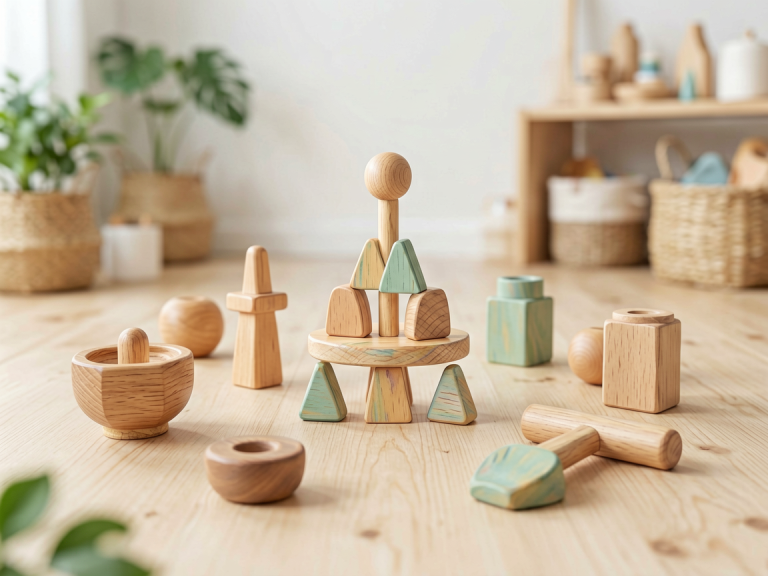
Most plastic toys aimed at nine-month-olds are "activity-based": they light up, play music, spin, or pop. These toys often require batteries and have limited ways to interact. A plastic toy that sings "The Wheels on the Bus" when a button is pressed teaches a single cause-effect relationship. Once the novelty wears off, the toy loses its appeal. Wooden toys, by contrast, are typically open-ended. A set of wooden blocks can be stacked, knocked down, sorted, banged, rolled, or later used for pretend play. A simple wooden car without wheels that spin noisily still invites pushing, picking up, and mouthing. This open-endedness fosters creativity, problem-solving, and sustained engagement. At nine months, the brain is forming neural connections through active exploration rather than passive observation. Open-ended wooden toys encourage the child to be the agent of their own play, which is developmentally optimal.
Environmental and Ethical Considerations
Sustainability and Carbon Footprint
From a global perspective, the choice between wood and plastic has significant environmental implications. Wood, especially when sourced from sustainably managed forests (look for FSC certification), is a renewable resource. After the toy’s lifespan, it can be composted, upcycled, or passed down for decades—wooden toys often become heirlooms. Plastic, derived from fossil fuels, is non-biodegradable. Even when recycled, it degrades in quality and ultimately ends up in landfills or oceans. The production of plastic also emits greenhouse gases. For eco-conscious parents, wooden toys represent a lower-impact choice. However, not all wooden toys are created equal: some are made from tropical hardwoods or coated with synthetic varnishes that undermine their environmental advantage. Likewise, some plastic toys are made from recycled materials or plant-based bioplastics, though these are still rare and often more expensive.
Longevity and Cost-Effectiveness
Although high-quality wooden toys often carry a higher upfront price tag, they typically last through multiple children and generations. A well-made wooden rattle or stacking ring can be used from nine months up through preschool. Plastic toys, especially battery-operated ones, tend to break, lose parts, or become obsolete when batteries corrode. Many parents find themselves replacing plastic toys frequently, which paradoxically ends up costing more over time. Additionally, wooden toys often maintain their aesthetic appeal and can be passed to younger siblings or donated. For a nine-month-old who is still developing fine motor skills, the durability of wood means fewer frustrations from broken toys.
Practical Tips for Choosing Toys for Your Nine-Month-Old
What to Look For in Wooden Toys
- Size and shape: Ensure all parts are too large to fit through a toilet paper roll (the standard choking test). Avoid any toy with small detachable components.
- Finish: Choose toys finished with beeswax, vegetable oils, or water-based paints. Avoid varnishes that may contain solvents.
- Weight: The toy should be light enough for a baby to lift but heavy enough to provide sensory feedback. A good test: if you drop it from a height of 30 cm, it shouldn’t bounce wildly or roll away too fast.
- Simplicity: At nine months, toys with one or two features (e.g., a grasping rattle, a shape sorter with one hole, a simple push-along car) are ideal. Avoid toys with multiple buttons, lights, or complex mechanisms.
What to Look For in Plastic Toys
- Material identification: Look for labels stating "BPA-free," "phthalate-free," and "food-grade silicone" or "polypropylene." Avoid PVC (polyvinyl chloride), which often contains harmful additives.
- No batteries: For nine-month-olds, battery-operated toys are generally unnecessary and can overstimulate. If you do choose a plastic toy with sound, ensure it has a volume control or an off switch.
- Easy to clean: Smooth, seamless surfaces are best. Avoid crevices where mold can grow.
- Purpose: Favor plastic toys that encourage interaction rather than passive observation—e.g., a simple nesting cups set rather than an electronic light-up keyboard.
The Hybrid Approach
Parents need not choose exclusively one material. A balanced toy collection might include a few high-quality wooden toys (blocks, a rattle, a stacking ring) alongside a few safe plastic items (a silicone teether, a squeeze ball, a plastic mirror). The key is to prioritize quality over quantity. Experts recommend having no more than five or six toys available at a time for a nine-month-old to avoid overchoice and encourage focused play.
Conclusion
The debate between wooden and plastic toys for nine-month-olds is not about a single "correct" answer—it is about understanding trade-offs. Wooden toys offer superior tactile and proprioceptive feedback, chemical safety, environmental sustainability, and open-ended play potential. Plastic toys provide ease of cleaning, lower initial cost, and greater variety of designs, including teething aids. For the nine-month-old, who is simultaneously developing motor skills, sensory integration, and early cognitive patterns, the ideal choice leans toward well-crafted wooden toys for their developmental richness. However, parents should not feel guilty about using high-quality, safe plastic items where convenience or specific features are needed. The most important criterion is always safety: ensure any toy, regardless of material, is free from toxins, intact, and appropriate for the child’s current stage. By making mindful selections, parents can create a play environment that nurtures curiosity, builds strength, and sparks joy—and that is the ultimate purpose of any toy, wooden or plastic.